
Supreme Court 7-Judge Bench Declares States’ Power To Levy Additional Sales Tax Reference Academic After GST
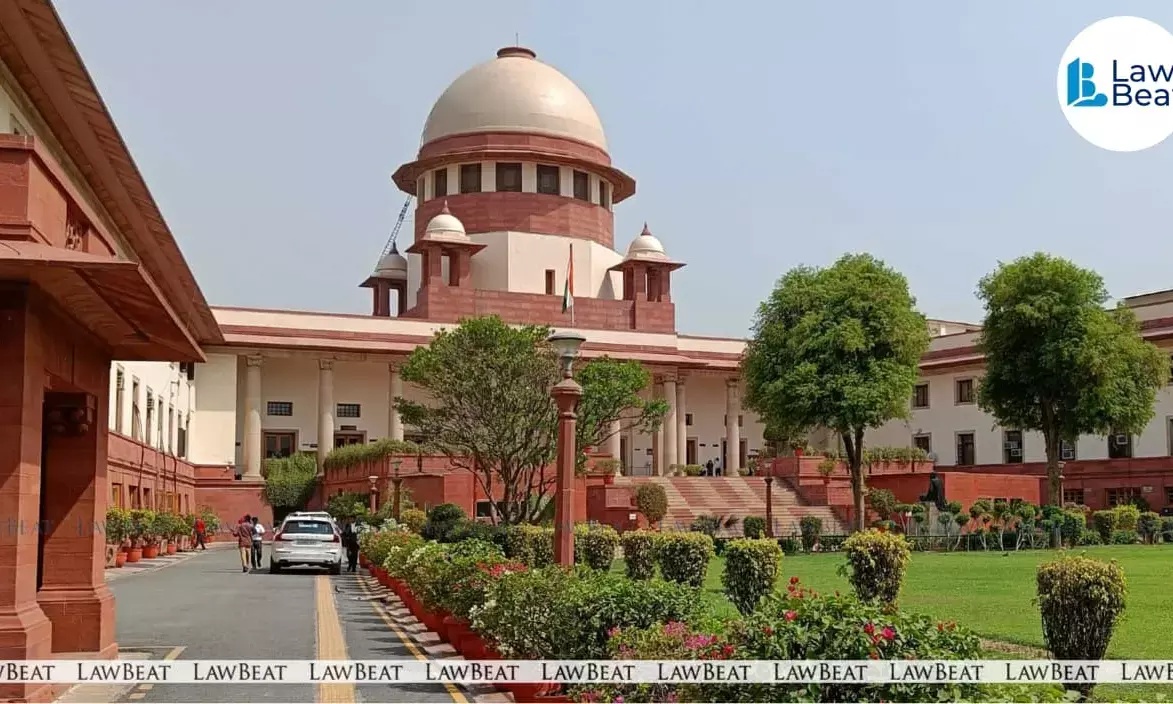
Supreme Court has clarified an additional tax or surcharge calculated as a percentage of the sales tax payable by a dealer amounts to an enhancement of the sales tax rate and falls within the States' legislative competence.
The Supreme Court's seven-judge Constitution Bench on Wednesday held that the nearly three-decade-old reference before it concerning the power of States to impose additional sales tax or surcharge calculated on the existing sales tax has become academic following the introduction of the Goods and Services Tax (GST) regime in 2017.
The seven-judge Bench comprised CJI Surya Kant and Justices K.V. Viswanathan, S.V.N. Bhatti, Joymalya Bagchi, N.V. Anjaria, Arun Palli and V. Mohana.
The Bench, headed by Chief Justice of India Surya Kant, held that the constitutional provisions and State enactments governing the disputed levies had subsequently been replaced, leaving the reference with no prospective significance.
However, the Court clarified that an additional tax or surcharge calculated as a percentage of the sales tax payable by a dealer amounts to an enhancement of the sales tax rate and falls within the States' legislative competence under the erstwhile Entry 54 of List II of the Seventh Schedule to the Constitution.
The Court further clarified that the five-judge Constitution Bench ruling in S. Kodar v. State of Kerala continues to hold the field. "The question referred to is of no practical significance and now academic. Consequently, the question referred to does not survive for adjudication by a seven-judge Bench, and the reference has to be answered accordingly," the CJI observed while pronouncing the judgment.
The reference arose from Arjun Flour Mills v. State of Odisha, which challenged Section 5A of the Odisha Sales Tax Act, 1947. The provision imposed additional tax at the rate of 10% on dealers having an annual turnover between Rs 10 lakh and Rs 1 crore, and 15% on dealers whose annual turnover exceeded Rs 1 crore.
The central question was whether States could impose an additional levy calculated on the sales tax payable by dealers under their legislative powers to tax the sale or purchase of goods under Entry 54 of List II, or whether such a levy amounted to a tax on income, a subject falling within Parliament's legislative domain under Entry 82 of List I.
The matter was referred to a larger Bench in 1999 following an apparent conflict between earlier Supreme Court decisions.
A seven-judge Bench decision in India Cement Ltd. v. State of Tamil Nadu struck down a cess linked to mining royalty, leading to questions about the scope of States' taxation powers.
Today the bench clarified that India Cement dealt with a different legislative field and did not establish that a levy calculated as a percentage of another tax would automatically fall outside the legislative competence of the State. Court also noted that the premise in India Cement that royalty constitutes a tax had subsequently been overruled by the nine-judge Bench decision in Mineral Area Development Authority v. Steel Authority of India.
In a separate concurring opinion, Justice K.V. Viswanathan held that S. Kodar was correctly decided and continues to remain good law. He found no conflict between the decisions in Kodar and Hoechst Pharmaceuticals.
The Bench, however, left open certain issues concerning the validity of a surcharge imposed under the Punjab General Sales Tax Act, 1948, on industrial units otherwise exempted from sales tax. It also left open the question concerning the transfer of cess proceeds under the Punjab Social Security Act, 2000, directly to the State Social Security Fund without first crediting them to the Consolidated Fund of the State under Article 266.
The Registry has been directed to place the lead matter and connected cases before an appropriate regular Bench for disposal in accordance with the observations made by the Constitution Bench.
Case Title: Arjun Flour Mills v. State of Odisha