
Supreme Court Allows One-Time Karthigai Deepam At Thirupparankundram Deepathoon On November 24
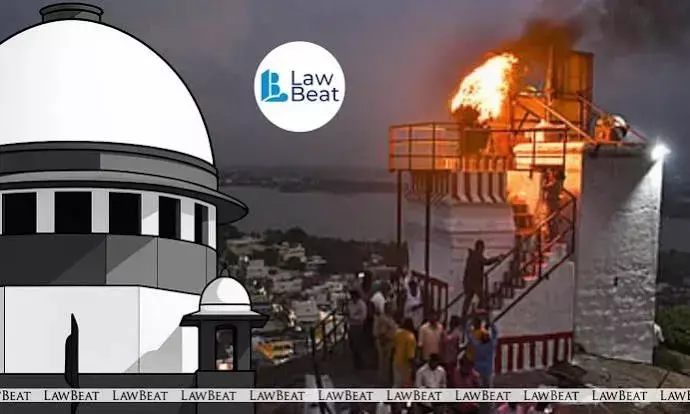
Supreme Court allows Deepam at Thirupparankundram Deepathoon only for November 24, recognising no customary right
The Supreme Court on Friday permitted the Karthigai Deepam to be lit at the stone pillar known as the Deepathoon, near the Dargah atop the Thirupparankundram hill in Madurai, on November 24. The permission was granted strictly as a temporary, one-time arrangement and not in recognition or enforcement of any asserted customary, religious or proprietary right. In the same order, the Court stayed the findings recorded in paragraphs 1 to 140 of the Madras High Court's judgment of January 6, 2026, insofar as they concern the present appeals, until further orders.
The Bench of Justices Aravind Kumar and Vipul M. Pancholi reasoned that the closeness of the festival made a limited interim arrangement necessary. At the same time, it made clear that it was expressing no opinion on the competing claims or on whether the High Court's findings were correct. The appeals will be listed in the second week of January 2027, and pleadings are to be completed by then.
Explaining why it had stepped in at the interim stage, the Court treated the proximity of the November 24 festival as a crucial consideration. It observed, "The opportunity to perform the ceremony on that particular day, if denied, cannot be restored by any subsequent adjudication."
The Court acknowledged that the consideration cuts both ways, since a ceremony once performed cannot be undone either. It said the interim arrangement rested on an independent assessment of the immediate and exceptional circumstances arising from the timing of the festival. The arrangement neither affirms nor revives the operative directions in the High Court's judgments, which remain subject to final adjudication.
The order is hedged with clarifications meant to prevent the permission from being used as precedent. The Court said its permission does not amount to a finding that the Deepathoon has historically been a place of customary religious observance. It has also not decided whether lighting the lamp there is an essential religious practice, or whether any individual, religious denomination or institution has an enforceable right to do so.
Neither the permission nor the performance of the ceremony may be relied upon as evidence of an established custom or religious usage, of a customary right or entitlement to access, or of any change in the existing legal position. The Court added that the arrangement cannot serve as an independent basis for seeking similar permission in later years. All questions of title, possession, usage, religious entitlement, temple administration and access remain open.
The Court summed up, "The limited accommodation, limited arrangement made today is not a determination of the dispute. It is an arrangement made precisely because the dispute remains to be determined."
The Bench noted that the appeals raise several significant questions. These include the extent of religious freedom, the enforceability of an asserted religious practice, the authority of the temple administration over religious observances, and the limits of judicial intervention in such matters. It also observed that broader questions under Articles 25 and 26 of the Constitution are pending before a nine-judge Constitution Bench in the Sabarimala reference.
The nature of the alleged custom, the legal character of the disputed site, the earlier judicial orders and the statutory authority of the institutions concerned will all be examined at the appropriate stage, the Court said.
The lamp is to be lit by a restricted team authorised by the Devasthanam. The District Collector, Madurai, will act as the nodal officer. The Collector will coordinate the arrangements in consultation with the Temple Executive Officer, the Archaeological Survey of India (ASI) and the Commissioner of Police, Madurai, and will settle the composition and size of the authorised team with them.
No member of the public may accompany the team to the Deepathoon, and no procession, public congregation, demonstration or slogan-raising will be allowed. Access is limited to authorised persons and to the officials needed for supervision, scrutiny and security, and the team must leave immediately after the ceremony. The District Administration will fix the timing, the route of access and the duration of the ceremony, having regard to public safety, fire prevention, archaeological protection and the maintenance of peace. The Centre may facilitate the deployment of a suitable CRPF contingent, if required, to supplement local police arrangements, subject to lawful deployment and operational feasibility.
The ASI will prescribe conditions to protect and preserve the monument and its surroundings. The Court barred any excavation, construction, structural alteration or permanent installation, and any damage to a monument, religious structure or property. The ceremony must also strictly comply with the applicable statutory requirements.
The Court directed that existing religious observances at the customary locations will continue undisturbed. Lawful religious activities at the Dargah, the mosque and other institutions, and access to and enjoyment of them, must not be interfered with in any manner. The arrangement confers no additional right of entry, occupation or control over any part of the hill.
Collector to report impediments an file compliance report
The District Collector, the Commissioner of Police, the ASI and the Central and State authorities concerned have been directed to coordinate closely. If a statutory, physical or security impediment arises that cannot reasonably be met through the prescribed safeguards, the Collector must bring it to the Court's notice at once. The Collector is also to file a brief compliance report within three days after the festival.
The Court said it expected all parties to cooperate with the authorities and to act with restraint and responsibility. The interim applications were disposed of in these terms, subject to further orders. The State's standing counsel will act as nodal counsel and prepare a convenience compilation of the pleadings, and all appearing advocates are to furnish soft copies.
About the SLP
The Special Leave Petition (SLP), filed on June 11 through Advocate-on-Record B. Karunakaran, assails a January 6 judgment of a Division Bench of the Madras High Court (Madurai Bench), which upheld an earlier order of a single judge allowing devotees to light a lamp at the 'Deepa Thoon' (stone lamp pillar).
The dispute pertains to a stone pillar located around 50 metres away from a Dargah on the hill. The writ petitions before the High Court had been filed by individuals seeking recognition of their right to light the 'Karthigai Deepam' at the spot.
The Hindu Religious and Charitable Endowments (HR&CE) Department, which administers the Lord Subramaniya Temple situated at the foothills, opposed the plea. The State contended that there was no established custom of lighting the lamp at the Deepa Thoon and asserted that the ritual had traditionally been performed at a different location.
Case Title: Commissioner HR & CE v. Rama Ravikumar and connected matters
Bench: Justices Aravind Kumar and Vipul M. Pancholi
Order Date: November 20, 2026