
Supreme Court Appoints Former Justice Ranjana Desai As Mediator In Reliance KG Basin Dispute
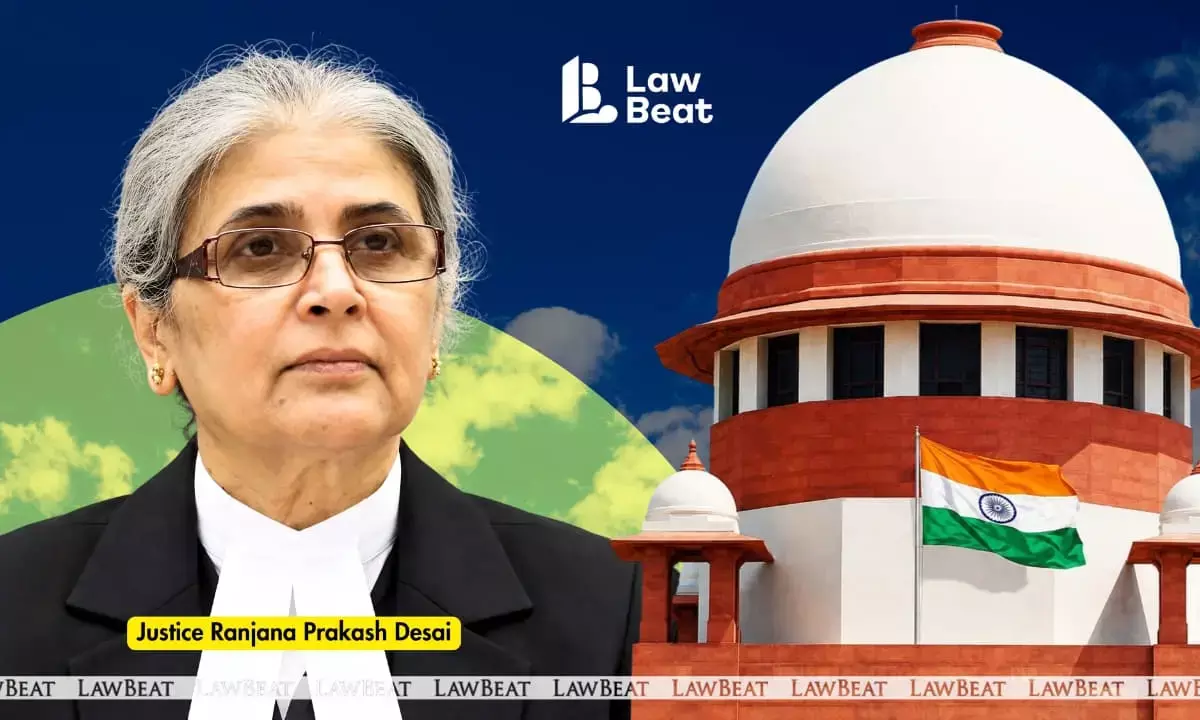
Supreme Court appoints Justice Desai as the sole mediator in the long-running Krishna-Godavari (KG) Basin gas migration dispute.
The Supreme Court on Friday appointed former Supreme Court judge Justice Ranjana Prakash Desai as the sole mediator in the long-running Krishna-Godavari (KG) Basin gas migration dispute involving Reliance Industries Limited (RIL), its consortium partners and the Union Government.
A Bench comprising Chief Justice of India Surya Kant and Justices Joymalya Bagchi and Vipul M Pancholi passed the order after being informed that the parties had been unable to arrive at a viable settlement.
“The parties themselves have not been able to find a viable solution. We suggest, on their behalf, that former judge of this court Ranjana Prakash Desai be requested to act as mediator,” the Bench observed.
Court has also requested Justice Desai to seek assistance from two domain experts, who may be suggested by the parties, to facilitate the mediation process.
Attorney General R Venkataramani, appearing for the Centre, assured the Court that the government would extend full cooperation to the mediator. Senior Advocate Kapil Sibal appeared for Reliance Industries.
The Bench has permitted the parties to make written and oral presentations before the mediator. The matter is expected to be taken up again after four weeks, when the parties will inform the Court about the progress of the mediation.
Background: The KG Basin Gas Dispute
The dispute concerns allegations that natural gas migrated from adjoining blocks operated by the state-owned Oil and Natural Gas Corporation (ONGC) into the KG-D6 block operated by the Reliance-led consortium off the Andhra Pradesh coast.
In April 2000, the Union Government entered into a Production Sharing Contract (PSC) with Reliance Industries and Niko Resources for the exploration and production of natural gas from the KG-DWN-98/3 block. Reliance initially held a 90% participating interest before transferring a portion of its stake to BP Exploration (Alpha) Limited in 2011.
The controversy came to the fore in 2013 when ONGC informed the Directorate General of Hydrocarbons that gas reservoirs in its adjoining blocks appeared to be connected with those in the Reliance-operated block.
ONGC alleged that the connectivity between the reservoirs had enabled gas to migrate from its fields into the Reliance block, allowing the consortium to extract and sell gas that it was not entitled to exploit. The Centre subsequently sought to recover the alleged financial gains from Reliance and its partners, contending that the extraction had resulted in unjust enrichment at the expense of the government and ONGC.
The government relied, among other things, on a technical study conducted by petroleum consultancy DeGolyer and MacNaughton. Its report, submitted in November 2015, indicated connectivity and continuity between the reservoirs in the ONGC and Reliance blocks. Following a review of the findings, the government raised a demand of approximately $1.55 billion, along with interest, against Reliance and its partners. Reliance disputed the allegations and invoked the arbitration mechanism under the production-sharing contract.
Arbitration Proceedings Since 2018
In July 2018, a three-member arbitral tribunal ruled by a majority of 2:1 in favour of Reliance and its partners, rejecting the Centre's claim for recovery of the alleged gains from the migrated gas.
The majority held that the production-sharing contract did not prohibit the contractor from producing gas, irrespective of its source, provided the producing wells were located within the contract area. One arbitrator, however, dissented from the majority view.
The Centre challenged the award before the Delhi High Court, arguing that the consortium had extracted gas belonging to ONGC and that the award was contrary to Indian public policy. In May 2023, a single judge of the Delhi High Court upheld the arbitral award, rejecting the Centre's challenge. The Union Government subsequently appealed against that decision.
On February 14, 2025, a division bench of the Delhi High Court set aside both the single judge's decision and the arbitral award, ruling against Reliance and its partners. The division bench held that the award suffered from patent illegality and was contrary to public policy. It also rejected the characterisation of the arbitration as an international commercial arbitration, holding that it was domestic in nature because Reliance, the lead claimant, was an Indian entity.
Supreme Court Proceedings
Reliance Industries, BP Exploration (Alpha) Limited and Niko (NECO) Limited subsequently approached the Supreme Court, challenging the Delhi High Court's February 2025 judgment. The Supreme Court commenced final hearings on the appeals in May 2026.
During the proceedings, the Centre maintained that the consortium had unlawfully benefited from gas belonging to ONGC. The government argued that the alleged extraction had caused substantial financial losses and that the award in Reliance's favour could not be sustained. Reliance, on the other hand, contested the findings against it and sought an opportunity to resolve the dispute through mediation or conciliation with the Centre.
On May 20, 2026, the Supreme Court declined to halt the ongoing hearing merely because Reliance and its partners intended to approach the government for mediation. The Bench indicated that proceedings could be concluded if both sides informed the Court that a settlement had been reached.
Case Title: Reliance Industries Limited Vs Union of India
Bench: CJI Kant, Justices Bagchi and Pancholi
Hearing Date: October 30, 2026