
Supreme Court Grants Bail To Shabir Ahmed Shah In Terror Funding Case
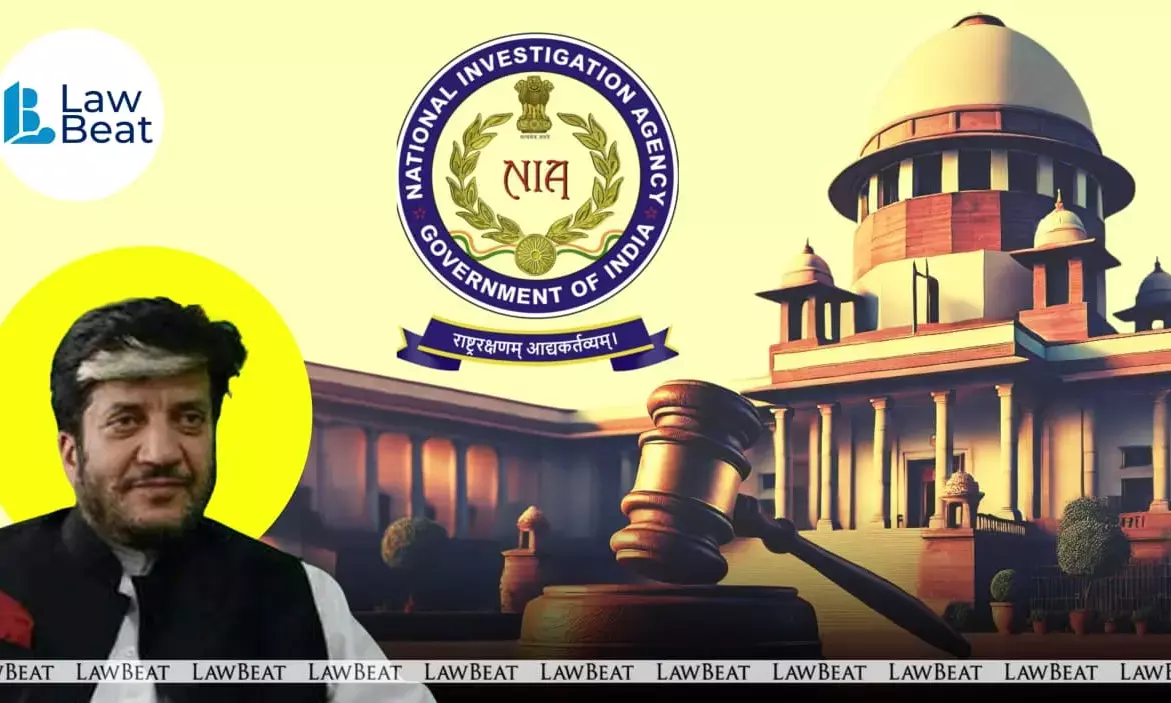
Supreme Court bench of Justices Vikram Nath and Sandeep Mehta granting bail to Kashmiri separatist leader Shabir Ahmed Shah in a terror funding case
The Supreme Court of India on Thursday granted bail to Shabir Ahmed Shah in a terror funding case after examining allegations of delay in the trial proceedings.
The bench of Justices Vikram Nath and Sandeep Mehta passed the order while hearing Shah’s plea seeking bail.
Senior Advocate Colin Gonsalves, appearing for Shah, told the Court that he had been midway through his arguments during the previous hearing and had since reviewed an additional affidavit filed by the prosecution.
Gonsalves contended that the counter affidavit filed by the respondents did not adequately address the issue of Shah’s prolonged detention. “In the counter affidavit, there is not a word about his detention. They have kept quiet. We didn’t even have the orders except one, which itself is very indicative,” he argued.
The senior counsel further submitted that the delay in the trial could not be attributed to Shah and that the prosecution had failed to move the proceedings forward despite the passage of considerable time.
Appearing for the respondent side, Senior Advocate Siddharth Luthra addressed the Court on behalf of the investigating agency.
During the hearing, the Bench questioned the prosecution regarding the delay in the trial process.
Justice Mehta specifically sought clarification from Luthra on the timeline for procedural compliance in the case.
“What do you say on delay? This offer of inspection… when was it supposed to be done?” Justice Mehta asked.
The Court also referred to procedural requirements under the Code of Criminal Procedure, noting that compliance with Section 207; relating to supply of documents to the accused,must ordinarily precede consideration of discharge under Section 227.
The Bench examined whether the statutory process had been properly followed and whether the delay in the proceedings had resulted in continued incarceration without meaningful progress in the trial.
After hearing submissions from both sides, the Court ultimately granted bail to Shah.
Earlier, Gonsalves had submitted that Shah was not named in the main chargesheet or the first supplementary chargesheet and was added only in the second supplementary chargesheet. When the Court asked about the primary allegations, Gonsalves stated that Shah had been booked for allegedly making provocative speeches and for terror funding. He had argued that the last speech attributed to Shah dated back to 1993 and that the terror funding allegation was based on claims that one person was carrying ₹75 lakh allegedly meant for Shah. Gonsalves had pointed out that the said individual had been acquitted in the Enforcement Directorate case and that Shah himself had already been granted bail in the ED matter.
Responding to a query on custody, Gonsalves had told the court that Shah had spent a cumulative period of nearly 40 years in custody across various cases and detentions, including over six-and-a-half years in the present FIR. He had argued that Shah had repeatedly been booked on the basis of the same allegations relating to speeches, leading to prolonged incarceration.
The Bench had noted that earlier FIRs also related to provocative speeches, to which Gonsalves agreed, stating that the allegations across cases were broadly similar.
Opposing the bail plea, Luthra had submitted that Shah was arrested in the present case in 2019 while he was already in custody in the ED case. Luthra had argued that the case involved allegations of funding street protests that disrupted the administration and claimed that protected witnesses had stated that Shah recommended candidates for medical seats in Pakistan, which were reserved for Kashmiri students. Luthra had also informed the Court that 34 witnesses had been examined so far out of 248 listed witnesses, with the prosecution proposing to prune the list to around 150. He had stated that charges were framed on March 16, 2022, and asserted that there had been no delay attributable to the prosecution, with four to five witnesses being examined each month.
Notably, in November 2025, the NIA had told the Court that there are newly introduced facts in Shah’s rejoinder affidavit. Accordingly, the Bench had granted three weeks time to NIA to file response on the rejoinder counter affidavit.
Case Title: Shabir Ahmed Shah v. NIA
Bench: Justice Vikram Nath and Justice Sandeep Mehta
Hearing Date: March 12, 2026