
Supreme Court Issues Notice On PIL Against Tripura Tribal Law Allowing Rape To Be Settled For Rs 1 Lakh
The Supreme Court issued notice on a PIL challenging Section 143 of the Jamatia Customary Laws Act, 2017, which, according to the petitioner, permits rape to be privately settled and compounded on payment of a fine of up to Rs 1,00,000
The Supreme Court on Monday issued notice on a public interest litigation challenging a provision of a Tripura tribal customary law which, according to the petitioner, permits rape to be privately settled and compounded on payment of a fine of up to Rs 1,00,000.
The petition, filed by Advocate Madhumita Bhattacharya through Advocate-on-Record Shoumendu Mukherji, assails Section 143 of the Jamatia Customary Laws Act, 2017, enacted by the Tripura Tribal Areas Autonomous District Council and assented to by the Governor.
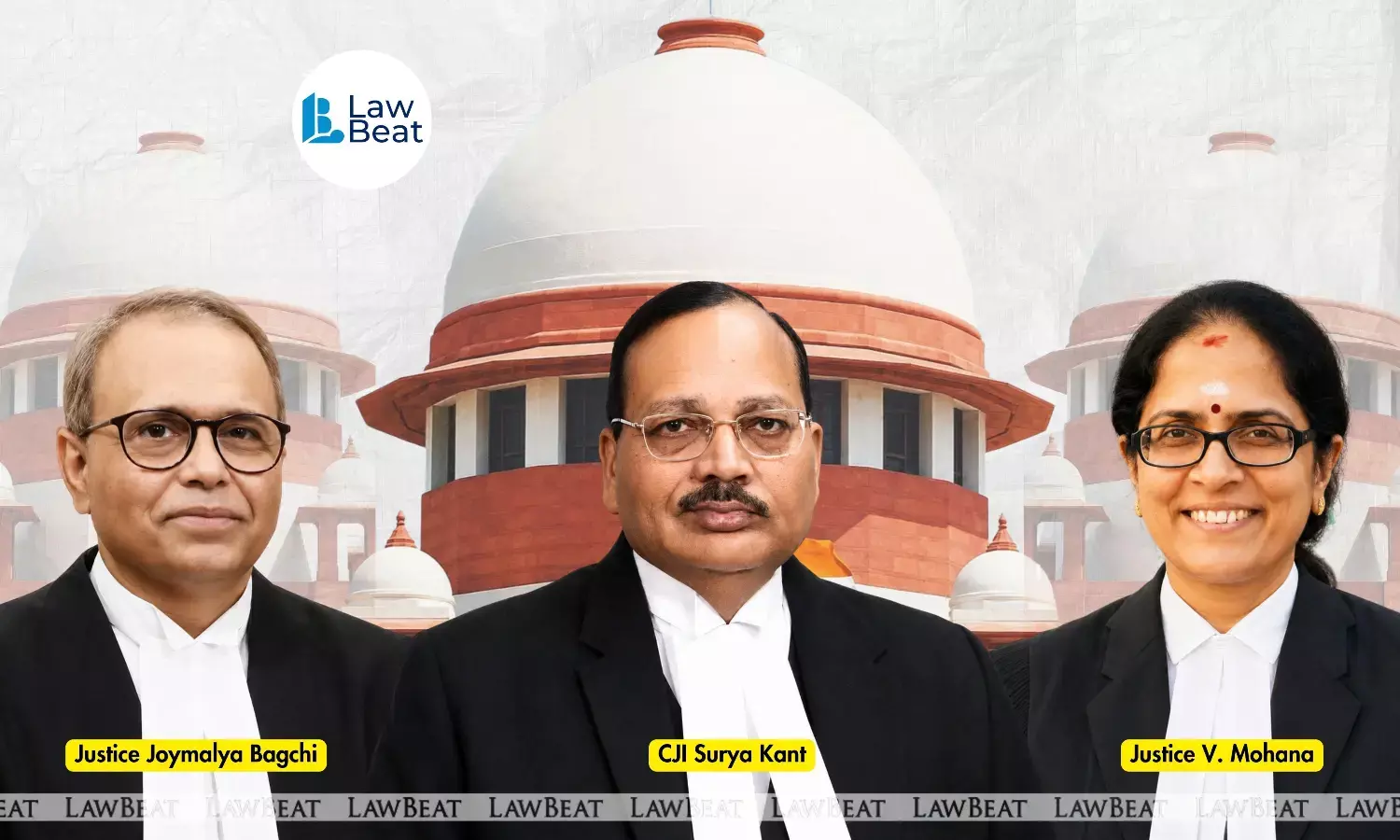
The Bench of CJI Surya Kant, Justice Joymalya Bagchi and Justice V. Mohana tagged the matter with a pending writ petition, WP (C) No. 88 of 2026, and listed it for hearing on November 27, 2026.
During the hearing, the Bench considered the constitutional question at the heart of the challenge: whether a law made by a District Council under the Sixth Schedule to the Constitution or a Central enactment would take precedence where the two conflict.
The principal ground of challenge is legislative competence. The petitioner accepts that the Sixth Schedule was intended to safeguard tribal identity, but contends that the authority it confers on District Councils is confined. The petition states, "The Sixth Schedule of the Constitution of India was designed to protect tribal cultural identity, social customs, and land rights. The power conferred upon District Councils or customary bodies to administer justice is strictly limited to civil disputes, personal laws (such as marriage, inheritance, and divorce), and petty local offences."
On that footing, it argues that the Council stepped outside its constitutional remit in dealing with an offence such as rape. "The Sixth Schedule does not confer legislative competence to formulate parallel penal codes that override substantive national criminal laws governing heinous crimes. Therefore, Section 143 suffers from an absolute lack of legislative competence," the petition reads.
Rape is an offence against the society
The petitioner relies on the settled principle that grave offences are wrongs against the community and not merely private disputes between the accused and the victim. According to the petition, "serious crimes are committed against society at large (in rem), and the State acts as the primary prosecuting agency representing the collective conscience of the community."
It points out that under the statutory scheme of Section 320 of the Code of Criminal Procedure, 1973, and its successor, Section 359 of the Bharatiya Nagarik Suraksha Sanhita, 2023, "heinous offences like rape are expressly categorised as strictly non-compoundable." A local enactment that permits such an offence to be compounded, the petitioner contends, cannot stand alongside that framework.
The petition is sharply critical of the effect of the provision. It states that Section 143, read with Section 164 of the Act, which deals with penalties and fines, "essentially places a price tag on a woman's dignity." By permitting an accused to escape the consequences of sexual violence through payment, the provision, the petitioner argues, "dangerously dilutes the line between a minor traffic offence and a heinous criminal act involving intent to cause hurt."
Compromise can't settle rape case
The petitioner argues that the impugned provision runs contrary to binding precedent of the Supreme Court, describing it as being "in direct contempt of the settled laws of this Hon'ble Court."
The petition relies on Gian Singh v. State of Punjab, (2012), in which, it says, the Court "unequivocally held that heinous crimes of mental depravity, such as murder, rape, and dacoity, cannot be appropriately quashed or settled even if a compromise is reached, as they have a serious impact on society."
It also cites State of Madhya Pradesh v. Madanlal, (2015), where, according to the petition, the Court held "that rape is an offence against the body of a woman-which is her temple-and under no circumstances can a compromise be construed as a factor to award lesser punishment or settle the dispute."
Beyond competence, the petition challenges Section 143 as an affront to Part III. It argues that the provision creates "an arbitrary and unconstitutional classification, subjecting tribal women to systemic discrimination based purely on geography and tribal affiliation." Because tribal women governed by the Act are denied the protection of the central criminal law that is available to women elsewhere in the country, the petitioner contends that Articles 14 and 15 are breached.
The petition further asserts that compelling survivors of sexual violence to accept money in place of a criminal trial infringes Article 21. In its words, "forcing victims of sexual violence to accept paltry sums in lieu of justice subjects them to secondary victimization by the State, entirely stripping them of their bodily autonomy and right to live with dignity under Article 21."
The petitioner also invokes India's obligations under the Convention on the Elimination of All Forms of Discrimination Against Women. The petition states that "allowing a local custom to trivialize sexual violence violates India's binding international commitments to eliminate discriminatory practices, customs, and laws that perpetuate violence against women."
Pointing to the Court's practice of reading the Convention into domestic law, the plea refers to Vishaka v. State of Rajasthan and submits that the Court "has repeatedly read CEDAW guidelines into domestic jurisprudence … to strike down state action or inaction that endangers women." Section 143, it contends, "actively contravenes these protective international frameworks."
The plea has been filed under Article 32 as a public interest litigation "to protect the fundamental and constitutional rights of the public at large, specifically women, within the State of Tripura and across India." It seeks a declaration that Section 143 of the Jamatia Customary Laws Act, 2017 is unconstitutional, both for want of legislative competence and for violating the fundamental rights guaranteed under Part III of the Constitution.
The matter will next be heard on November 27, 2026, along with WP (C) No. 88 of 2026.
Case Title: Madhumita Bhattacharya v State of Tripura
Bench: CJI Surya Kant, Justices Joymalya Bagchi and V. Mohana
Hearing Date: October 26, 2026