
Supreme Court issues notice on plea seeking Creamy Layer exclusion in SC/ST Reservation
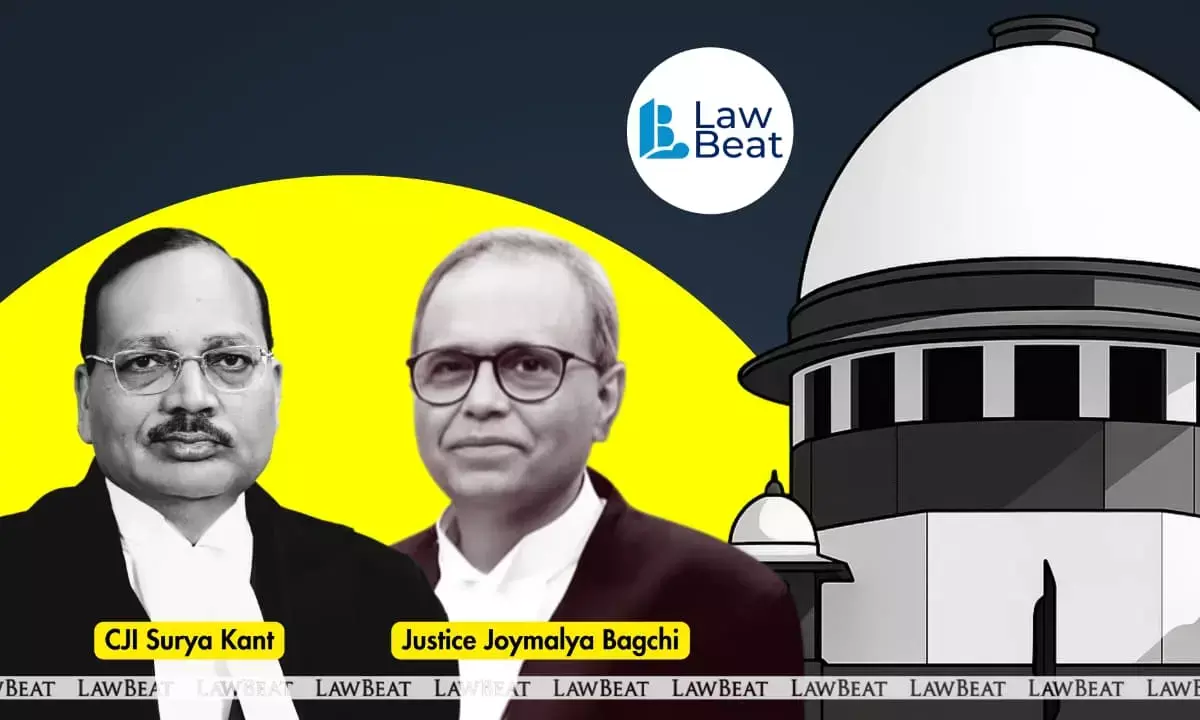
The Supreme Court today issued notice on a plea seeking exclusion of the creamy layer from the reservations for Scheduled Castes and Scheduled Tribes.
A bench of CJI Surya Kant and Justice Joymalya Bagchi has issued notice on a plea seeking direction to the Centre and States to take appropriate steps to implement Creamy Layer system in SC/ST Reservation.
Filed by Advocate Ashwini Kumar Upadhyay, the plea seeks to implement the exclusion in order to ensure that benefits reach the genuinely disadvantaged sections and to uphold the constitutional mandate of justice, equality, fraternity, administrative efficiency, and national unity.
"Reservation under the Constitution was conceived as a remedial and compensatory measure to address historical injustice, social exclusion, and structural inequality suffered by Scheduled Castes and Scheduled Tribes. The Constituent Assembly Debates clearly demonstrate that reservation was never intended to be a permanent or unconditional entitlement. Dr. B.R. Ambedkar repeatedly stated that reservation is not a privilege but a remedy for injustice created by the social system and that equality does not mean identical treatment of unequal. Late Sh. Jaipal Singh and V.I. Muniswamy Pillai emphasized that reservation was meant to uplift those who were backward in social, educational, and economic terms and not those who had already overcome such disadvantages," the plea states.
The writ petition filed through AOR Ashwani Kumar Dubey submits that the continued non-exclusion of the creamy layer has serious national consequences, as it fosters resentment between reserved and non-reserved categories and concentrates power and opportunity in the hands of a small elite section within SC/ST communities.
"This weakens public faith in constitutional governance, threatens fraternity, and undermines administrative efficiency, which the Constitution expressly seeks to protect. Socially, the absence of creamy layer exclusion has resulted in internal stratification within SC/ST communities, creating a “class within a class.” Advanced families repeatedly corner reservation benefits, while the most backward and first-generation beneficiaries remain excluded. This perpetuates inequality within the reserved categories, deepens social stigma, and defeats the very purpose of social justice. Economically, reservation without creamy layer exclusion leads to misallocation of scarce public resources," it adds.
Culturally, the plea states, that the non-exclusion of the creamy layer dilutes the unity and authentic identity of SC/ST communities. When socially advanced individuals continue to claim backward status, backwardness becomes a mere administrative label divorced from lived realities. This weakens fraternity, masks persistent deprivation, and fractures community cohesion, it states.
Court has been told that non-exclusion of the creamy layer violates Article 14 of the Constitution. "The policy fails the test of reasonable classification, as there is no intelligible differentia between socially and economically advanced SC/ST individuals and similarly placed general category individuals, and no rational nexus with the object of uplifting the weakest. The policy also results in a lack of substantive equality, as unequal within SC/ST communities are treated alike. Further, the continued application of blanket reservation without reassessment is temporally unreasonable, as a policy that may have been justified earlier has become arbitrary in changed circumstances", the petitioner argues.
The plea also relies on a recent Supreme Court judgment of State of Punjab v. Davinder Singh (2024), wherein a Constitution Bench authoritatively held that Scheduled Castes are not homogeneous and that sub-classification is constitutionally permissible to ensure equitable distribution of reservation benefits. Justice Pankaj Mithal in the said judgment observed that reservation must evolve, should ordinarily be confined to the first generation, and must be subject to periodic reassessment to exclude those who have already achieved parity.
Notably in the said judgment, former CJI BR Gavai had observed that state must evolve a policy for identifying the creamy layer even from the Scheduled Castes and Scheduled Tribes so as exclude them from the benefit of affirmative action, Justice BR Gavai has said.
"In my view, only this and this alone can achieve the real equality as enshrined under the Constitution", the Supreme Court's judge had said in his separate judgment holding sub-classification of the Scheduled Castes and Scheduled Tribes on account of reservations is constitutionally permissible. Justice Gavai had further clarified the criteria for exclusion of the creamy layer from the Scheduled Castes and Scheduled Tribes for the purpose of affirmative action could be different from the criteria as applicable to the Other Backward Classes.
As a part of the same judgment, Justice Pankaj Mithal of the Supreme Court of India had observed that in primitive India there was no existence of any caste system as people were categorised according to their profession, talent, qualities and nature. Terming the caste system to be DYSFUNCTIONAL, the supreme court judge has noted that children of Brahmins started calling themselves as Brahmins, irrespective of whether they possessed the corresponding qualities or not and this was similar with the children of other varnas also who adopted the varna of their father ignoring their own nature, talent and qualities.
Case Title: ASHWINI KUMAR UPADHYAY vs. UNION OF INDIA