
Supreme Court Refuses Ethanol Labelling Plea; Allows Petitioner To Approach High Court
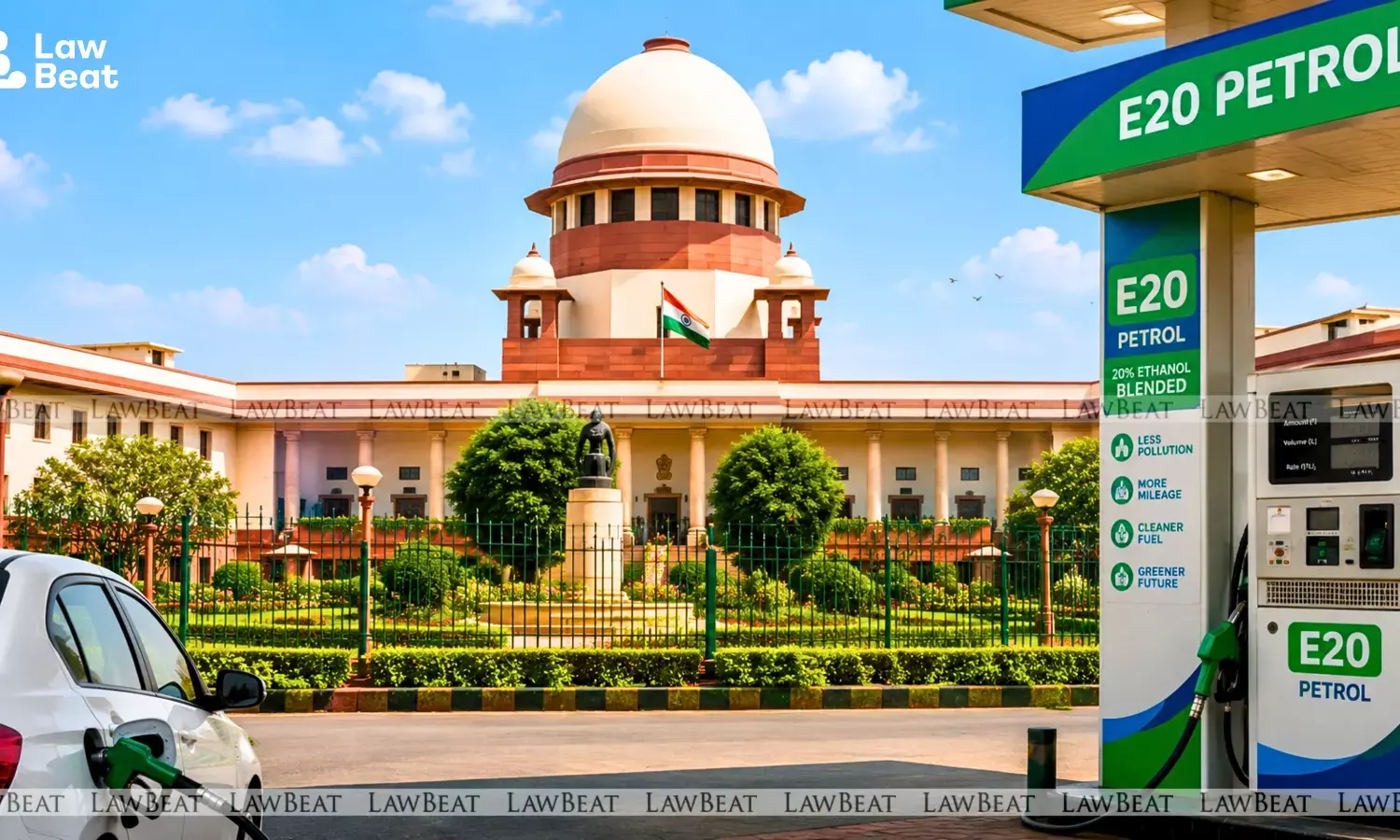
Supreme Court refuses to entertain plea seeking mandatory disclosure of ethanol content in petrol at fuel pumps and on purchase invoices
The Supreme Court on Monday refused to entertain a petition seeking mandatory disclosure of the ethanol content in petrol at fuel pumps and on purchase invoices, while granting the petitioner liberty to approach the concerned High Court.
The Bench of Justices MM Sundresh and Prasanna B Varale was hearing a plea filed by Advocate Narendra Kumar Goswami, who sought directions requiring petrol pumps to display the exact percentage of ethanol in petrol being dispensed and to mention the ethanol content on fuel bills.
During the hearing, Goswami pointed to a fuel receipt and submitted that it did not disclose the ethanol content.
“I have the right to know. We have a right to know what we are purchasing,” Goswami submitted.
He also referred to the Attorney General’s earlier submission that the ethanol blending programme was an “experiment” and sought a direction requiring the Centre to explain its position on affidavit.
The Attorney General opposed the plea, remarking: “He wants the Government of India to be answerable to him!”
Goswami responded that the issue was not about the government being answerable to him personally, but about the right of citizens to know what they are purchasing.
The petitioner had also sought a vehicle-wise database indicating compatibility with different ethanol blends, including E20 petrol, besides an expert assessment of its impact on fuel efficiency, engine life, maintenance costs, warranties, insurance and the environment.
However, the Supreme Court declined to entertain the petition and granted liberty to Goswami to approach the High Court with his grievances.
Background
The petition filed by Advocate Narender Kumar Goswami expressly clarifies that it does not question India's ethanol blending programme or the policy objective of energy self-reliance. "This petition does not invite this Hon'ble Court to assume the role of a policymaker. It does not seek to arrest the nation's march toward energy self-reliance or to question the wisdom of ethanol blending. The policy, as a policy, stands unchallenged," the plea states.
Instead, the petitioner argues that the constitutional challenge is directed against what it describes as a "silent, unconsenting compulsion" imposed on millions of vehicle owners.
"The matter... concerns the constitutional validity of a silent, unconsenting compulsion visited upon millions of citizens; the compulsion to purchase and use a radically altered fuel without knowledge of its exact composition, without access to authoritative information regarding its compatibility with their vehicles, and without the availability of any realistic alternative," the petition says.
The petitioner, appearing in person, states that he owns a 2018 Honda BR-V petrol vehicle, manufactured before E20 fuel standards were introduced. According to the plea, owners of older vehicles are currently unable to ascertain the ethanol content of the petrol they purchase because fuel pumps do not disclose the percentage of ethanol, fuel invoices carry no such information, and consumers are offered no meaningful choice of lower-ethanol fuel.
The petition argues that while the State may encourage or incentivise ethanol blending, it cannot compel citizens to expose their vehicles to possible risks without transparency.
"A great and noble object, however desirable, does not grant the State a dispensation from the Constitution... The State may encourage, persuade and incentivise; it may not, by administrative silence and structural absence of choice, compel a person to unknowingly subject his property to a risk not of his making."
Reliefs Sought
The PIL seeks several directions from the Supreme Court to make the E20 rollout more transparent and consumer-friendly.
Among the principal prayers are directions to:
-Mandate prominent disclosure of the exact ethanol percentage on every fuel dispensing nozzle at petrol pumps;
-Require every fuel invoice or receipt to mention the ethanol content of the petrol sold;
-Publish an official, searchable, vehicle-wise compatibility database indicating which vehicle models are suitable for various ethanol blends;
-Frame a transparent transition policy for legacy and non-compatible vehicles, including consideration of continued availability of lower-ethanol petrol wherever technically and logistically feasible;
-Ensure consumers are not denied warranty, insurance or service benefits where the State itself has failed to provide an alternative fuel choice; and
-Constitute an independent expert committee to examine issues relating to vehicle compatibility, engine longevity, maintenance costs, environmental impact, water consumption, food security implications and warranty concerns arising from the E20 programme.
The petitioner has also sought directions for a National Consumer Disclosure Protocol for ethanol-blended petrol and requested the Union Government to place before the Court all technical studies, policy files, compatibility reports and public consultation records underpinning the E20 rollout.
Interim Relief Sought
Pending disposal of the petition, interim directions have been sought requiring oil marketing companies to immediately display ethanol content at petrol pumps and on dispensing nozzles, print the ethanol percentage on fuel bills, publish provisional vehicle compatibility advisories and make ethanol blend information publicly searchable on their websites and mobile applications.
The plea further requests that no consumer should suffer prejudice regarding warranty, insurance or service entitlement solely because E20 fuel was used in the absence of any reasonably available alternative.
Describing the reliefs as practical rather than obstructive, the petitioner submits: "These are not the demands of obstruction; they are the safeguards of a civilised administration. They do not dismantle the ethanol policy; they clothe it with constitutional legitimacy."
The petition also notes that a representation raising these concerns was submitted on July 4, 2026, to the Ministry of Petroleum and Natural Gas and other authorities. According to the petitioner, no satisfactory response or corrective action followed, prompting the filing of the present writ petition before the Supreme Court.
Case Title: Narender Kumar Goswami v. Union of India & Ors.
Bench: Justices M.M. Sundresh and Prasanna B. Varale
Hearing Date: August 31, 2026