
Supreme Court Refuses Plea Against SCBA Resolution Supporting Sonam Wangchuk
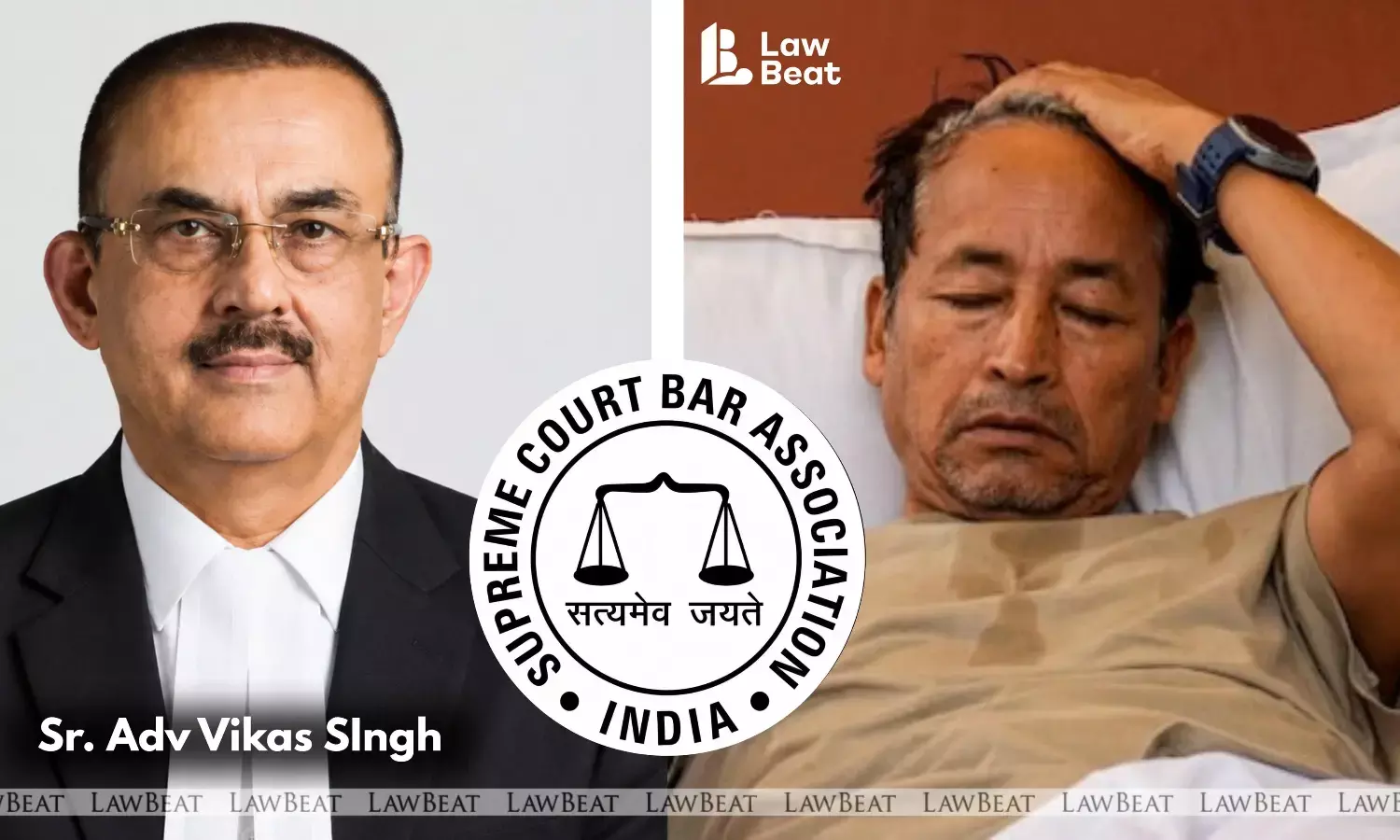
SCBA President Vikas Singh wrote a personal letter urging Sonam Wangchuk to end his hunger strike as the Supreme Court Bar Association passed a resolution supporting education reforms and offering legal assistance
The Supreme Court has declined to entertain a petition filed before it challenging the resolution passed by the Supreme Court Bar Association (SCBA) expressing solidarity with climate activist Sonam Wangchuk over his hunger strike in connection with NEET paper leak.
A bench of Chief Justice of India Surya Kant, Justice Joymalya Bagchi and Justice V. Mohana observed that disagreements over resolutions passed by a Bar Association must ordinarily be resolved through its own democratic mechanisms.
"If you believe the decision is undemocratic, gather the requisite strength under the Rules and seek a General Body Meeting. If the General Body Meeting is not convened despite a valid requisition, or if your rights are otherwise violated, that may give rise to a grievance. But it would be a very dangerous precedent if we begin interfering in the democratic process of a Bar Association, where there can always be a view, a counter-view and healthy democratic debate", the bench observed today.
Filed by one Ashish Gopal Garg, the petition challenged a resolution of the SCBA Executive Committee, contending that it reflected the personal or political views of a few office-bearers rather than the collective opinion of the Bar. Court was further told that the Executive Committee had become functus officio after the election process commenced and therefore lacked the authority to pass policy resolutions on behalf of the Association.
The Supreme Court Bar Association (SCBA) had recently passed a resolution expressing deep concern over climate activist Sonam Wangchuk's ongoing hunger strike and has urged him to discontinue the fast, while pledging support for initiatives aimed at ensuring transparency, fairness and accountability in the education system.
The resolution was adopted by the Executive Committee of the SCBA after deliberations on Wangchuk's indefinite fast, which the Committee said had drawn national attention to concerns surrounding the NEET examination system and the future of young students.
The Committee noted that Wangchuk had placed "his health and life at risk for the future of our children" and acknowledged his longstanding contribution to education, innovation and community-based learning. According to the resolution, Wangchuk's fast had served as a reminder that "moral courage is indispensable to national character" and had awakened public conscience on issues affecting millions of young citizens.
At the same time, the SCBA expressed regret that despite "a person of Mr. Wangchuk's integrity being willing to undertake such an extreme step for the betterment of the education system," institutions had failed to respond with the urgency and sensitivity the situation warranted. The Committee observed that the country was witnessing systemic failures affecting the youth and a broader erosion of accountability in public institutions.
The Executive Committee also resolved that the SCBA would extend appropriate legal and research support, within the framework of its mandate, to initiatives seeking greater transparency and accountability in processes determining educational opportunities. It further resolved to advocate reforms aimed at strengthening institutional integrity and fostering public engagement on issues of ethical governance.
Case Title: ASHISH GOPAL GARG Vs SUPREME COURT BAR ASSOCIATION
Bench: CJI Kant, Justice Bagchi and Justice Mohana
Hearing Date: August 5, 2026