
Supreme Court Refuses To Interfere With Azam Khan’s Interim Bail In ED Money Laundering Case
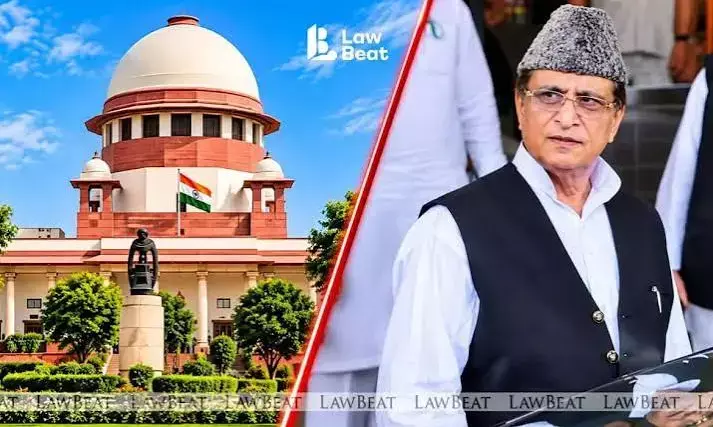
SC declines ED's challenge to Azam Khan's interim bail, says High Court's prima facie views won't decide final bail
The Supreme Court on Thursday declined to interfere with an order granting interim bail to Samajwadi Party leader Mohd Azam Khan in a money laundering case, after the Enforcement Directorate (ED) argued that the High Court had wrongly recorded the facts surrounding his arrest.
The Bench of Justices MM Sundresh and PB Varale disposed of the ED's plea, observing, "This being an interim order we are not inclined to interfere. The views of the high court being prima facie may not have a bearing while deciding the matter finally."
At the ED's request, the Bench also recorded the agency's objection to the High Court's recording of facts.
Additional Solicitor General (ASG) SV Raju, appearing for the ED, took the Bench through the circumstances of the arrest. He submitted that the grounds of arrest had been furnished to Khan and that he had refused them, adding that the agency had material to show it.
"Learned judge has granted interim bail. We have given grounds of arrest, he refuses. There's a video. There's a panchnama," Raju told the Court.
The Bench acknowledged the ASG's submission but was not persuaded that an interim order warranted its intervention. It indicated that any concern over the High Court's observations could be addressed by clarifying that they would not weigh at the stage of the final bail decision.
"We appreciate it. But it's interim bail. We can say while deciding bail this observation may not be taken into consideration," the Bench said.
Raju then flagged a practical concern: the regular bail application would be heard by the same Bench of the High Court that had passed the interim order.
"But bail will be dealt by the same bench," he submitted.
The Supreme Court declined to entertain the apprehension. "We can't attribute motive to the court," the Bench remarked, before adding, "We are not inclined."
As the order was being dictated, Raju pressed that the ED's grievance on the factual record be noted. "Facts are wrongly recorded. It may be noted," he said.
The Bench acceded and recorded in its order, "We also take note of Ld ASG that recording is incorrect."
With this, the ED's plea was disposed of. The effect of the order is that Khan's interim bail continues, while the High Court's prima facie views will not bind it when it decides the bail application finally.
Background
Allahabad High Court has granted interim bail to Khan in a money laundering case, observing that the Enforcement Directorate (ED) had prima facie failed to follow the mandatory procedure under Article 22(1) of the Constitution and Section 19 of the Prevention of Money Laundering Act (PMLA) while arresting him.
On November 18, ASG SV Raju had mentioned the plea before a CJI Surya Kant led bench. "Let status quo be maintained, interim bail has been granted as if it is a final order, we tried to serve the grounds of arrest, he refused to accept them. The learned judges say that because he was arrested when he was coming out of jail, it was mala fide."
Justice Joymalya Bagchi, also on the bench had told ASG Raju, "Heavens will not fall. Let him remain on interim bail."
"When we go through the remand application filed by Enforcement Directorate dated 1.11.2026, we do not find any such averment of video-graphing the arrest of the petitioner on 31.10.2026 having been made in the application seeking remand of the petitioner," said the high court's bench of Justice Rajiv Gupta and Justice Devendra Singh.
Article 22(1) of the Constitution provides that every person arrested must be informed of the grounds of arrest as soon as possible and has the right to consult and be defended by a lawyer of their choice. Section 19 of the PMLA empowers an authorised ED officer to arrest a person if, on the basis of material in possession, the officer has reason to believe that the person is guilty of an offence under the Act, provided the reasons are recorded in writing and the grounds of arrest are communicated to the person.
The high court passed the order in a writ petition filed by Khan, which initially sought a declaration that his October 31, 2026 arrest was illegal. He also sought that the order passed by the Special Judge, Anti-Corruption, CBI, Ghaziabad on November 1, 2025, remanding him to judicial custody, be set aside and that he be immediately released. Senior Advocate Kapil Sibal argued for Khan before the high court.
Sibal apprised the court that the petition was earlier preferred before the Supreme Court, which on November 5, directed that the matter be transferred to the Allahabad High Court. The Apex Court expressly declined to express any opinion on the merits.
Case against Azam Khan
On September 8, 2026, the UP Vigilance Establishment registered an FIR against Khan following an inquiry ordered in May 2024 concerning the sale of a plot belonging to the UP State Haj Committee at Aishbagh, Lucknow, when he was its chairman.
On October 10, the ED wrote to the UP Director General of Police under Section 66(2) PMLA, seeking registration of an FIR over alleged diversion of public funds to Jauhar University between 2013-14 and 2016-17. Consequently, an FIR was registered on October 14, at Azeem Nagar police station, Rampur, under Section 61, 316(5), 318(4) of BNS, 2023 and Sections 7, 13(1)(d), 13(2) of Prevention of Corruption Act, 1988. The ED also recorded Khan's statement under Section 50 of the PMLA inside Rampur District Jail on the same day.
On October 19, the ED issued an addendum to th ECIR/07/LKZO/2019, bringing 29 additional FIRs within its scope, including the FIR registered on October 14. Some of the cases had already resulted in relief to Khan from various courts.
On October 28, the ED issued a provisional attachment order, attaching the land and buildings of the university The next day, the Allahabad High Court suspended Khan's sentence and granted him bail in the PAN Card case. However, the high court denied suspending his conviction in the case.
After furnishing bail bonds and sureties, Khan was physically released from jail on October 31. The ED arrested him again at the jail gate at 7:10 pm. Khan alleged that the ED did not furnish the grounds of arrest in writing before producing him for remand.
On the other hand, the ED claimed that its officers attempted to serve the documents but Khan refused to receive them. Then, on November 1, the CBI judge remanded Khan to judicial custody.
Before the high court, Sibal for Khan argued that he was innocent and had been falsely implicated due to political vendetta. He also alleged that Khan's arrest violated Article 22(1) and Section 19(1) PMLA as non-compliance with mandatory arrest safeguards vitiated the arrest and subsequent remand.
Sibal further submitted that the ED initiated remand proceedings in the seven-year-old ECIR only on November 1, 2026 and the grounds of arrest did not mention the place, date or time of preparation. He further said that the grounds of arrest were not attached to the WhatsApp message sent to Khan's sister or the email dated October 31, 2026.
Although the ED claimed that the arrest was videographed, it did not produce the relevant video or photograph showing that Khan refused to receive the grounds of arrest, Sibal submitted. The proceedings amounted to persecution rather than prosecution, Sibal argued.
Opposing the plea, the ED opposed the interim relief. Itargued that its officers attempted to serve the arrest memo, grounds of arrest and reasons to believe to Khan outside Rampur District Jail, but he refused to accept the documents. Consequently, the documents could not be served at the time of arrest but were received by Khan under protest on the following day during remand proceedings.
The ED also informed the court that a running panchanama was prepared recording Khan's refusal and was annexed to the short counter affidavit. Hearing both sides, the division bench held that the matter required consideration. The bench was prima facie satisfied that the mandatory safeguards under Article 22(1) and Section 19 PMLA had not been strictly followed by the ED.
Therefore, court ordered Khan to be released on interim bail upon furnishing a personal bond and two sureties of the like amount to the satisfaction of the Chief Judicial Magistrate, Ghaziabad.
Case Title: ED v. Mohd. Azam Khan
Bench: Justices MM Sundresh and PB Varale
Hearing Date: November 19, 2026