
Supreme Court Refuses Uniform Policy On Demolition Of Long-Standing Unauthorized Properties
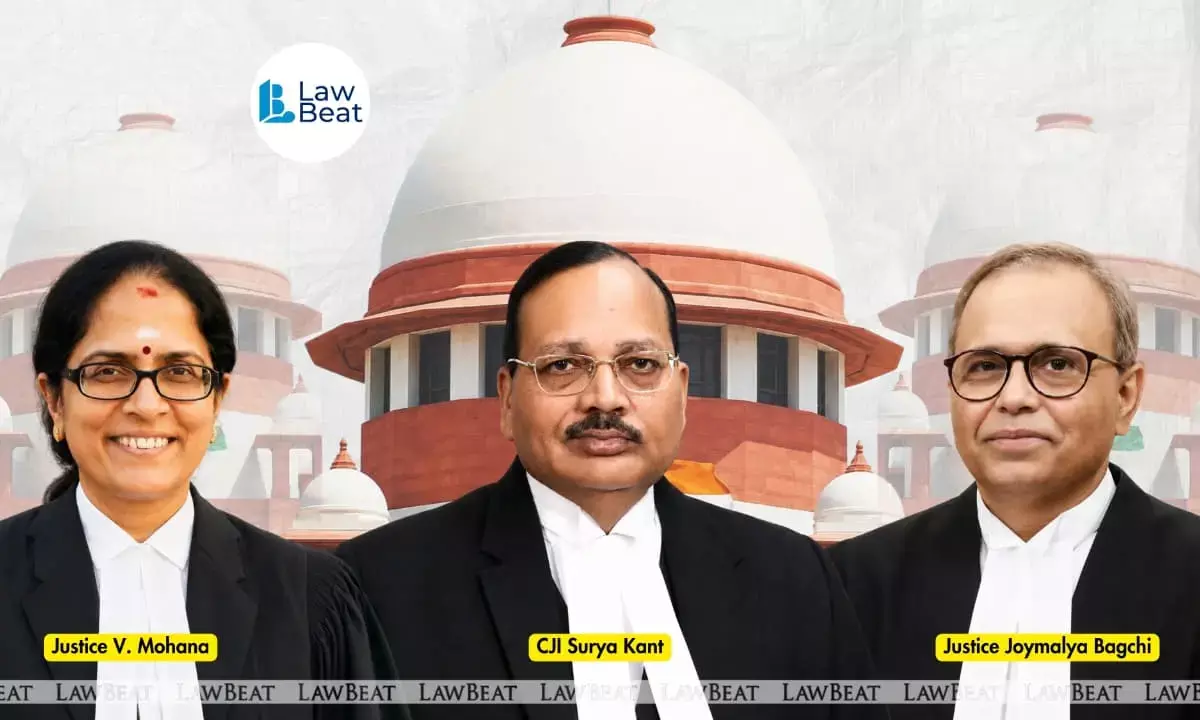
Supreme Court heard plea contending that demolition, being an extreme and irreversible measure, cannot be carried out without a policy that reconciles the enforcement of planning laws with the rights to shelter, livelihood, and dignity as guaranteed under Article 21 of the Constitution.
The Supreme Court has declined to entertain a petition seeking a uniform policy across the country for regularisation and demolition of long-standing unauthorised constructions.
A Bench of Chief Justice of India Surya Kant, Justice Joymalya Bagchi and Justice V Mohana, while acknowledging the petitioner’s concerns regarding the right to shelter and the rehabilitation of affected families under Article 21, has said such issues essentially fall within the policy domain.
"While we appreciate the concern of the petitioner organisation regarding the rehabilitation of those who are affected and whose right to shelter is adversely impacted as a result of demolition, etc., we are also of the view that such issues essentially fall within the policy domain. The factual matrix may vary from State to State, and it may, therefore warrant variations in their policy decisions as well. It would be difficult, and may not be prudent, for this Court to lay down a uniform policy framework to be applied across all States...Ordinarily, we deem it appropriate to dispose of this petition with liberty to the petitioner to forward a copy of this petition to the Union of India, all State Governments, and the Union Territories, to consider the issues raised therein for the purpose of formulating or revisiting their existing policies...We are hopeful that due consideration shall be given to all such issues by the competent authorities," CJI Kant has ordered.
The petition before court argued that State Governments across the country have, for decades, not only allowed unauthorised colonies and constructions to stand unchallenged, but have, in fact, been facilitating their regularisation by assessing municipal taxes, sanctioning electricity and water connections—thereby implying regularisation—and converting leasehold properties into freehold.
Court was further told that similar policies are in vogue in the States of Andhra Pradesh, Telangana, NCT of Delhi, but on the other hand there are other States where decade-old unauthorised structures are suddenly ordered to be demolished, with or without notice, but without any welfare scheme for the rehabilitation of the affected families.
Justice Bagchi, while responding to the submission made before the bench observed, "You cannot substitute the powers vested in a State or a municipality to enforce the rule of law by delegating them to a Court-Empowered Committee. It would be completely contrary to the Constitution....Until recently, where this Court gave certain directions that at least a 15-day notice has to be given even to a rank unauthorized occupant, these guardrails had already been put in place...The implementation of those guardrails on a case-to-case basis is something we would require to examine individually, not on a collective policy basis."
Last month, the Supreme Court had refused to entertain contempt petitions filed before it alleging that demolitions are being carried out in violation of its November 2024 judgment laying down guidelines on bulldozer action.
A CJI Surya Kant led bench said such grievances should be raised before the concerned High Courts. The bench also comprising Justice Joymalya Bagchi and Justice V Mohana, observing that there will be different factual disputes involved in each case, took the view that the Supreme Court cannot go on adjudicating each claim on facts.
ASG Aishwarya Bhati had also opposed the petitions saying, "There are 21 cases listed before this court today...there will be separate factually inquiry in each case, even if three matters are detagged..there will be 18 matters..18 cases from all across the country different instances.."
In November 2024, the Supreme Court had ordered that no demolitions should be carried out without a prior show cause notice, and every local authority was directed to assign a digital portal within 3 months which shall contain the details of these notices issued.
Court had observed that Executive cannot become a JUDGE and decide that a person is guilty and therefore punish him by demolishing their house. Former Justice BR Gavai further had said, "Such acts of the executive have to be dealt with heavy hand of the law". He further held that an authority cannot be permitted to take away the shelter of an entire family only on the ground that one person residing in the house is accused of a crime.
Case Title: CENTRE FOR LAW AND GOOD GOVERNANCE Vs UNION OF INDIA
Bench: CJI Kant, Justice Bagchi and Justice Mohana
Hearing Date: August 12, 2026