
Supreme Court registers suo motu case on definition of Aravalli Hills
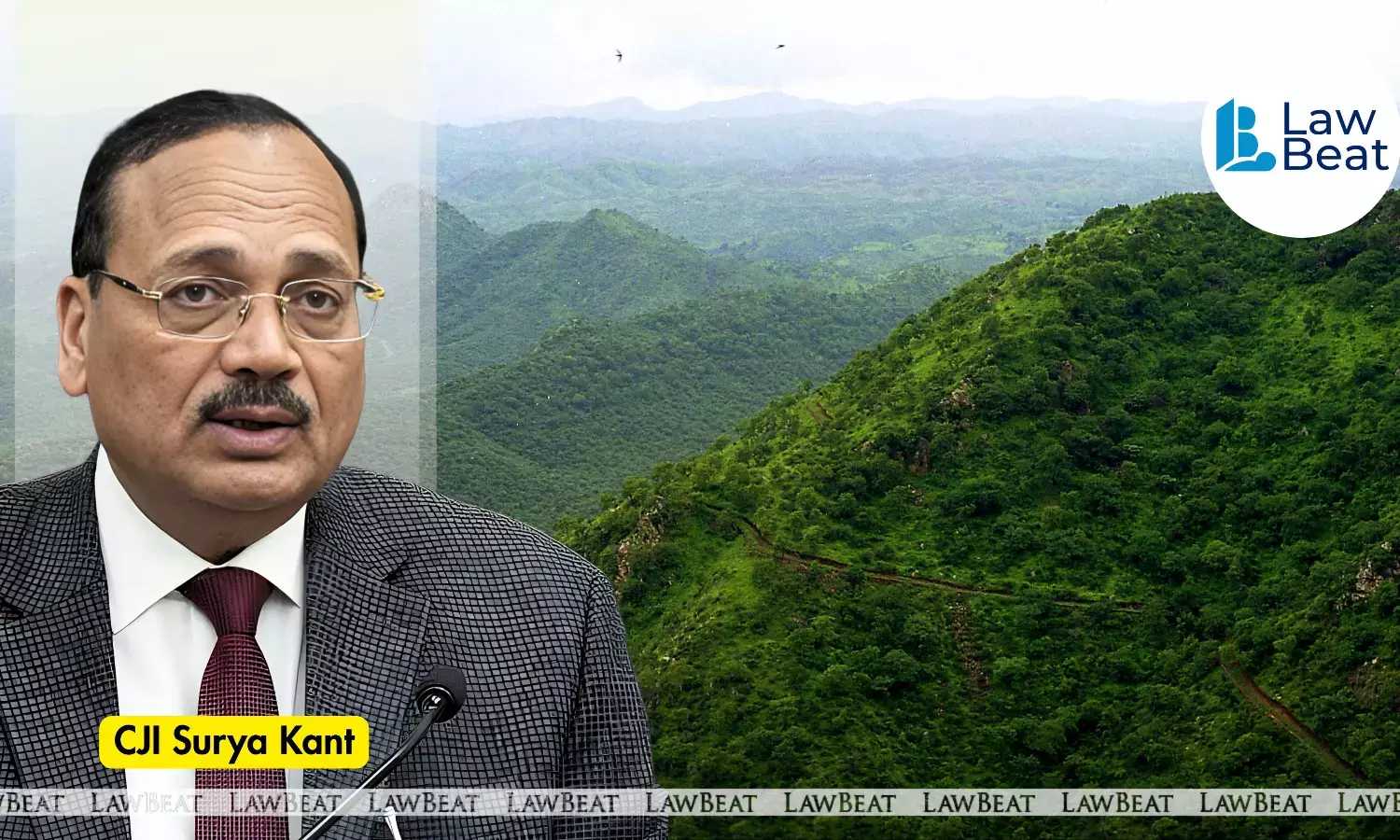
Advocate Hitendra Gandhi had recently submitted a representation to the Chief Justice of India urging reconsideration of the Supreme Court’s definition of the Aravalli Hills to prevent ecological dilution.
The Supreme Court has taken suo motu cognizance of the issues concerning the definition of the Aravalli Hills. A case titled In Re: Definition of Aravalli Hills and Ranges and Ancillary Issues will be heard by Chief Justice of India (CJI) Surya Kant led bench on December 29.
The bench also comprising of Justices JK Maheshwari and AG Masih will revisit the court's recent decision against imposing a complete ban on mining in the Aravallis.
In November, the Supreme Court had directed the Ministry of Environment, Forest and Climate Change (MoEF&CC) to prepare a Management Plan for Sustainable Mining (MPSM) through Indian Council of Forestry Research and Education (ICFRE) for the entire Aravalis, i.e., understood as the continuous geological ridge extending from Gujarat to Delhi.
A former CJI BR Gavai led bench has ordered that the MPSM must:
a. Identify permissible areas for mining, ecologically sensitive, conservation-critical and restoration priority areas within the Aravali landscape where mining shall be strictly prohibited or permitted only under exceptional and scientifically justified circumstances;
b. Incorporate a thorough analysis of cumulative environmental impacts and the ecological carrying capacity of the region; and
c. Include detailed post-mining restoration and rehabilitation measures. Court has further directed that till the MPSM is finalised by the MoEF&CC through ICFRE, no new mining leases should be granted.
The Supreme Court had noted that scientific assessments of the Aravali Range establish the fact that the Aravali ecosystem acts as a “green barrier” and forms an effective “shield” against desertification by preventing the eastward spread of the Thar Desert towards the Indo-Gangetic plains, Haryana and western Uttar Pradesh.
Taking all aspects of the matter into consideration, especially the fact that the Aravali Hills and Ranges harbour rich biodiversity, with twenty-two wildlife sanctuaries, four tiger reserves, the Keoladeo National Park, along with wetlands like Sultanpur, Sambhar, Siliserh, and Asola Bhati, and aquifers that recharge river systems including the ones at Chambal, Sabarmati, Luni, Mahi, and Banas, the court observed it to be more than appropriate that before permitting further sustainable mining activities, the same are preceded by preparation of an MPSM.
"We are of the considered view that it may not be in the interest of ecology and environment if further mining activities are permitted to be carried out without a body of experts, such as ICFRE, examining the issue of protection of the conservation areas. The MPSM will provide adequate data on the basis of geo-referenced ecological assessment and identify the areas which have wildlife and other high eco-sensitive areas, which are required to be conserved. The MPSM will also provide data as to how sustainable mining is to be conducted", the bench had further noted.
Last month, Advocate Hitendra Gandhi had written to the Chief Justice of India Surya Kant urging the Supreme Court to reconsider or clarify the definitional framework adopted for identifying the “Aravalli Hills and Ranges” in its recent order dated November 20, 2025, warning that a narrow, height-based criterion could unintentionally weaken environmental protection across North-West India.
Gandhi raised concern over the operational definition adopted in the order, under which landforms with a “local relief” of 100 metres or more above their immediate surroundings are treated as the primary criterion for identifying Aravalli hills and ranges.
The representation emphasised that the Aravallis are an ancient and highly eroded ridge system, where ecological value is not confined to prominent peaks. Gandhi argued that low-relief ridges, outcrops, slopes, corridors and recharge-bearing terrains play a vital role in groundwater recharge, dust and desertification buffering, biodiversity connectivity, microclimate moderation and the overall ecological resilience of the Delhi–NCR region.
Case Title: In Re: Definition of Aravalli Hills and Ranges and Ancillary Issues
Bench: Chief Justice of India Surya Kant, Justice JK Maheshwari and Justice AG Masih