
Supreme Court urges Centre to bring parity in law for determining market value of acquired land
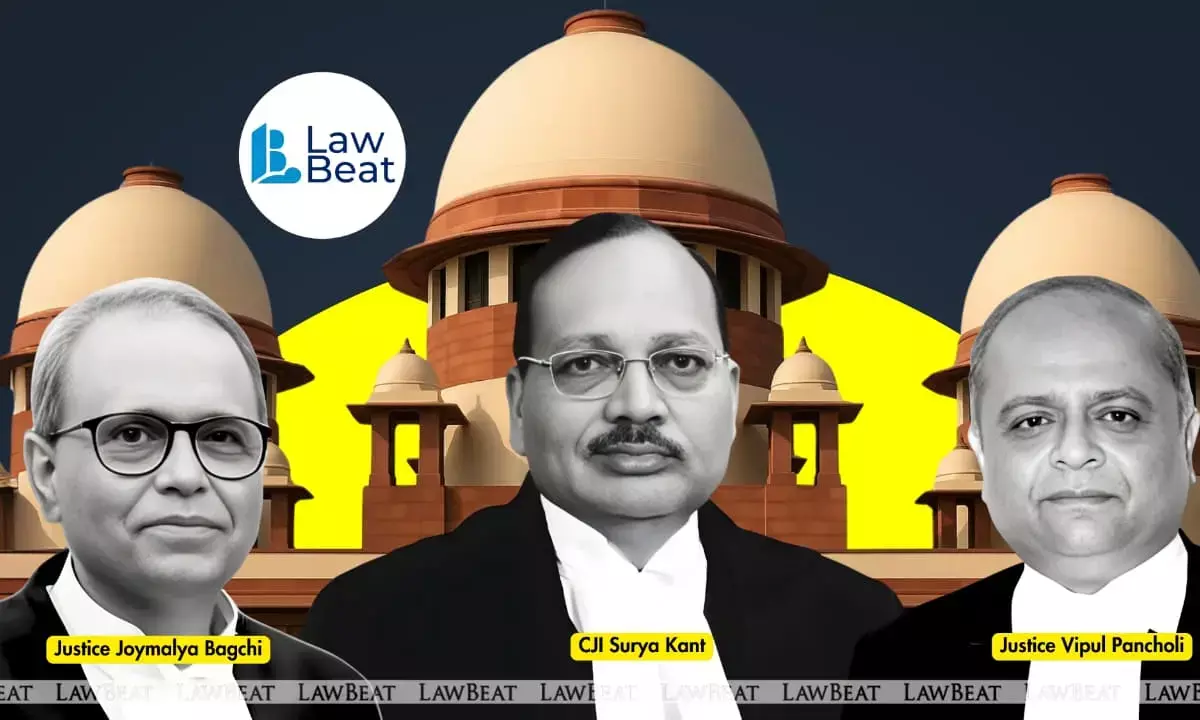
Supreme Court bench today heard a PIL challenging constitutional validity of Guidelines on Blood Donor Selection and Blood Donor Referral, 2017
Supreme Court of India has implored the Union of India to revisit the legislative scheme and consider the desirability of bringing parity in the matter of providing a mechanism for the determination of the market value of acquired land with reference to Article 300-A of the Constitution of India.
"Since the issue primarily falls within the domain of the legislature, we refrain from expressing any final opinion and leave it in the first place to the entire discretion of the authority concerned to look into this aspect and take a holistic view", a CJI Surya Kant led bench said, requesting the Attorney General for India, to look into this aspect. "The Registry is directed to send a copy of this order to the office of the learned Attorney General for India. Similarly, a copy of this order shall also be forwarded to the office of the learned Solicitor General of India. Post these matters for further consideration on 21.04.2026," it ordered further.
Before the Supreme Court applications were moved by one Anand Prakash Verma on behalf of 21 land owners, whose lands were acquired under the National Highways Act, 1956. The award was passed by the competent Authority under the 1956 Act, and being aggrieved by the determination of compensation, these land owners filed petitions under Section 34 of the Arbitration and Conciliation Act, 1996 before the Additional District Judge, Bhiwani.
While the petitions were at the final stage of arguments, the High Court of Punjab and Haryana in March 2025 rendered the Sections 3G and 3J of the 1956 Act unconstitutional. Consequently, the statutory arbitral mechanism stood invalidated. The applicants, as well as the Court at Bhiwani, instead of waiting for the outcome, acted in post-haste and the applicants were permitted to withdraw their Section 34 petitions.
Supreme Court noted that the arbitral framework envisaged under the 1956 Act again stood revived, though maybe temporarily, as the Supreme Court is yet to finally adjudicate the legality of Sections 3G and 3J of the 1956 Act. Unfortunately, if the applicants file a fresh petition, it will be barred by limitation under Section 34(3) of the 1996 Act, resultant effect being the applicants have been rendered remediless, the bench further noted.
"In such circumstances and with a view to render complete justice to the parties, we deem it appropriate to invoke our powers under Article 142 of the Constitution of India and consequently, we set aside the order dated 25.04.2025 passed by the Additional District Judge, Bhiwani, whereby the petitions filed under Section 34 of the 1996 Act were dismissed as withdrawn in light of the High Court judgment dated 20.03.2025. As a necessary corollary, all those petitions under Section 34 of the 1996 Act, filed by the applicants, stand revived and shall be processed further from the stage of their withdrawal. Ordered accordingly", it ordered.
While hearing the matter, court found that under the 1956 Act, the remedy provided to an expropriated land owner/interested party, if such person is aggrieved by the rate of compensation determined by the competent Authority, is to invoke arbitration under Section 3G(5) read with provisions of the 1996 Act.
"Such an arbitration petition is adjudicated not by a judicial authority but by an officer notified by the Central Government. Invariably, the Collectors or Commissioners of the Revenue Districts/Divisions are notified to act as arbitrators. These officers are generally pre-occupied with their multiple administrative responsibilities and they also do not have the desired experience of a judicially trained mind to adjudicate the complex issues like determination of market value of the land or other statutory benefits to which the affected parties are now entitled to in light of the decision of this Court Union of India & another vs. Tarsem Singh & others, (2019) 9 SCC 304, as well as the subsequent amendments made by the Parliament in the 1956 Act. Not only this, the further recourse left to an aggrieved expropriated land owner or any other interested party is to file an appeal under Section 34 of the 1996 Act, followed by a further appeal under Section 37 of the 1996 Act before the High Court," Court found.
Contrarily, the Court noted, the expropriated land owners/interested persons, whose lands were earlier being acquired under the Land Acquisition Act, 1894 (in short, the “Old Act”), were entitled to seek further enhancement through a reference under Section 18 of the Old Act and such references were decided only by the Judicial Courts, comprising a Presiding Officer in the rank of District Judge/Additional District Judge. It further noted there was a further remedy of first appeal before the High Court, and thus even the High Court had the power to re-appreciate and re-appraise the evidence and then form an opinion re: market value of the acquired land.
"Such a recourse for the expropriated land owners and other interested parties has been further widened by the grant of additional statutory benefits and a higher rate of compensation under the provisions of the Right to Fair Compensation and Transparency in Land Acquisition, Rehabilitation and Resettlement Act, 2013. It may, thus, be seen that the land owners, whose land is acquired under the 1956 Act, vis-à-vis the land owners whose lands are acquired now under the New Act, have been treated as separate classes, apparently without any intelligible differentia. This leads to grave heartburn among the land owners of the first category, namely, those whose lands are acquired under the 1956 Act", the bench said while calling for parity under the laws.
Case Title: M/S RIAR BUILDERS PVT LTD & ANR. vs. UNION OF INDIA & ORS.