
Tamil Nadu Defends Thirupparankundram Deepam Tradition In Supreme Court, Opposes 24-Hour Lamp On Deepathoon And ASI Takeover
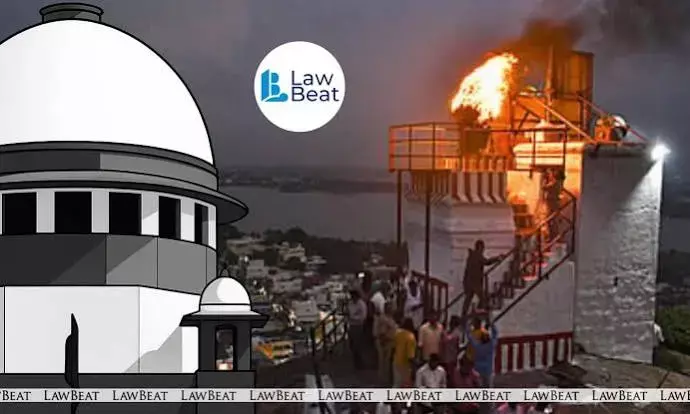
Tamil Nadu tells Supreme Court Thirupparankundram Deepam has always been lit at Deepa Mandapam, never on the summit
The Tamil Nadu government has defended before the Supreme Court the long-standing practice of lighting the Karthigai Deepam at the Deepa Mandapam near the Uchipillaiyar Temple at Thirupparankundram, and opposed a plea by the Hindu Dharma Parishad for a lamp to burn round the clock on a stone pillar called the "Deepathoon", for the entire hill to be lit during Karthigai, and for the Archaeological Survey of India (ASI) to take over the temple and the hill.
In a counter affidavit, the State's Hindu Religious and Charitable Endowments (HR&CE) Department said that "There has NEVER EXISTED any established practice, custom or even a prior claim of lighting the Karthigai Deepam upon the summit of the Hill".
The affidavit was filed by Dr T.G. Vinay, IAS, Commissioner, HR&CE, who is Respondent No. 6 in Hindu Dharma Parishad, rep. by K.K. Ramesh v. Union of India & Ors., Writ Petition (Civil) No. 1280 of 2025. It was verified at Chennai on 12 November 2026.
A Bench of Justices Aravind Kumar and Vipul M. Pancholi is reportedly scheduled to hear the matter on November 17.
The Commissioner described the petition as "wholly misconceived" and "a gross abuse of the process of this Hon'ble Court". What follows sets out the State's contentions, which the Court is yet to examine.
According to the affidavit, the Parishad seeks three reliefs under Article 32. It wants the ASI to "take over and control the entire Temple and the Hill", it wants "a lamp be kept lit upon the so called Deepathoon permanently for twenty four hours every day", and it wants "the entire Hill be lit with lamps on Karthigai Deepam", with devotees permitted to worship throughout the hill.
The State's response was blunt: "Not one of these reliefs rests upon any legal right of the Petitioner, upon any custom pleaded and proved, or upon the infringement of any fundamental right, and each of them would, if granted, unsettle and render nugatory the settled ownership and the statutory administration of the Temple".
The Commissioner described the Arulmigu Subramaniaswamy Temple as "the first of the six sacred abodes of Lord Subramania" and a public religious institution under the Tamil Nadu Hindu Religious and Charitable Endowments Act, 1959.
According to the affidavit, the Deepam "has, for over a century and five decades, been lit by the Temple only at the Deepa Mandapam at the Uchipillaiyar Temple area situated above the Temple, in accordance with the Agamas and the opinion of the Sthanikars." The State contended that decisions about the conduct of poojas and festivals, "including the manner and the place of the lighting of the Karthigai Deepam, falls within the exclusive domain of the Temple administration … and not within the domain of any devotee or of any private association such as the Petitioner."
Relying on the 1923 civil court decree, the affidavit stated that attempts by Hindus "to light a lamp near the summit of the hillock on which the Dargah stands, in the years 1862 and 1912, were resisted on the twin grounds that it was not customary to put up a light there and that a breach of the peace was apprehended."
Denying the petition's claim that hilltop lighting was an ancient Tamil tradition displaced by a wartime prohibition, the State said that "A custom set up as the foundation of a right protected under Articles 25 and 26 of the Constitution must be specifically pleaded and strictly proved by the party asserting it, and the burden of establishing such a custom lies upon that party. No such custom has ever been pleaded or proved."
On the pillar, the affidavit contended that "the description of a stone pillar upon the Hill as the Deepathoon is a recent invention that finds no mention in the decree of 1923, in the proceedings before the Privy Council, in the 1996 Directions, in the 2014 and 2017 litigation, or even in the representation dated 28.10.2025, and appears for the first time only in W.P.(MD) No. 32317 of 2025."
The State also pointed to the conflicting demands made on the temple. One petitioner wants the Deepam lit at the pillar, the Parishad wants a permanent lamp there and the whole hill lit, and others have sought lighting at spots such as the Kuthirai Sunai and the Kuthirai Sunai Thittu. These, the affidavit said, "are themselves destructive of any claim of a settled and immemorial custom, for a custom is by its nature certain and uniform, and that which varies from claimant to claimant is no custom at all." It added that "if the Temple were obliged to yield to each such demand, it could not function as a religious institution at all".
The State relied on the Madras High Court's order in W.P. No. 18884 of 1994, referred to as the "1996 Directions", which it said "remain operative to this day". Under those directions, according to the affidavit, the Devasthanam alone shall light the Deepam, ordinarily at the traditional Mandapam, and "shall NOT ALLOW ANY OTHER PERSON to light the Deepam at any other place". Lighting at any other place in future requires a decision of the Devasthanam itself, the prior permission of the HR&CE authorities, and a site at least fifteen metres away from the Dargah, the flight of steps and the Nellithope.
"The authority to decide the place of lighting thus vests, by the terms of a binding order of the High Court, in the Devasthanam acting with the prior permission of the HR&CE, and in no one else," the Commissioner stated. A permanent lamp at the Deepathoon and the illumination of the whole hill, it was argued, "are directly contrary to those subsisting directions and cannot be granted."
The affidavit added that a devotee's plea to light the Deepam on the hilltop was dismissed by the High Court on 4 December 2014 in W.P.(MD) No. 19422 of 2014, and the writ appeal was dismissed on 7 December 2017. According to the State, the Division Bench found no evidence that the existing practice violated the Agama Sastras and saw no reason to disturb a practice that had continued peacefully for decades.
The State contended that "A claim of this nature, raised as a communal right of the worshipping public and litigated in the public interest, binds the public at large, and the mere change in the identity of the individual raising it does not take it outside the bar of res judicata." It cited State of Karnataka v. All India Manufacturers Organisation, (2006) 4 SCC 683, and Forward Construction Co. v. Prabhat Mandal (Regd.), (1986).
Opposing the ASI takeover as "wholly untenable", the State said that the hill "belongs to the Temple and is governed by the Temple under the HR&CE Act", and that its ownership "stands crystallised by the decree in O.S. No. 4 of 1920 as restored by the Privy Council". The decree of 5 August 1923 declared the temple owner of the whole hill, except the Nellithope, the flight of steps leading to the mosque and the top of the rock on which the mosque stands. The Madras High Court reversed it in 1926, but the Privy Council restored it in Madura Tiruparankundram Devasthanam v. Alikhan Sahib, AIR 1931 PC 212.
The affidavit further stated that Notification No. 35 dated 1 September 1908 under the Ancient Monuments Preservation Act, 1904 protected "only the rock-cut cave and the inscriptions, measuring about fifty cents", and that by G.O. No. 95 dated 8 February 1909 the Government recorded that "it was unnecessary to declare the whole rock at Thirupparankundram to be a protected monument."
The ASI's role, the State said, "DOES NOT extend to the taking over or the administration of a living temple", and "The provision of a peaceful environment is no part of the function of the ASI", since public order lies with the State Government. The affidavit added that the temple is "a flourishing institution maintained with full religious fervour", and that no mismanagement has been alleged.
The State argued that Article 32 "may be invoked only for the enforcement of a fundamental right" and that the Parishad, a private association, had disclosed none. Its averments, the affidavit said, consist "largely of newspaper extracts, and matters drawn from the internet, none of which is evidence".
It further contended that "a petition under Article 32 does not lie to agitate disputed questions of title, of custom, of possession, and of the character of the Hill", and that the reliefs are "an invitation to this Hon'ble Court to create a right and a duty where none exists, which is impermissible."
On Article 25, the State submitted that the place and manner of lighting the Deepam "is a matter of religious observance protected under Article 25 of the Constitution, in which courts ordinarily refrain from interfering", and that essential religious practice is to be determined by "the Agamas, and the opinion of the Sthanikars, and not by a direction obtained at the instance of a devotee or a private association."
The State pointed out that the place of lighting is already before the Supreme Court in appeals arising from W.P.(MD) No. 32317 of 2025, decided by a Single Judge on 1 December 2025 and by a Division Bench on 6 January 2026, in which the Commissioner has himself filed a Special Leave Petition. "The question of the place of lighting of the Karthigai Deepam is thus squarely and presently sub judice before this Hon'ble Court in those proceedings," the affidavit said.
The Parishad's own Contempt Petition (MD) No. 1447 of 2025 is pending before the Madurai Bench. According to the affidavit, on 8 September 2026 the Supreme Court declined to interfere in SLP (C) Diary No. 53605 of 2026, which arose from that contempt case, and allowed the parties to raise their contentions before the High Court and to draw its attention to the order of 12 December 2024 in Ashwini Kumar Upadhyay v. Union of India, W.P.(C) No. 1246 of 2020.
The State contended that the reliefs fall "within the mischief" of that December 2024 order, which restrains courts from passing effective orders, including survey orders, in respect of places of worship. It described the writ petition as "a transparent attempt to obtain, by opening a fresh front in the original jurisdiction of this Hon'ble Court, that which the Petitioner could not obtain below".
The State opposed the plea to light the entire hill "as calculated to occasion a breach of the peace upon a sensitive site with a recorded history of communal tension", and the 24-hour lamp as "wholly unknown to the practice of the Temple."
Concluding, the Commissioner submitted that the petition "discloses no fundamental right and no legal right, is barred by the earlier adjudications and by the binding 1996 Directions, is an abuse of the process of this Hon'ble Court, and seeks reliefs that would unsettle the concluded title of the Temple and paralyse the statutory administration of the endowment," and prayed that it be "dismissed in limine with costs".