
Terror Funding Case: Supreme Court Examines UAPA Bail Plea of Shabir Ahmad Shah
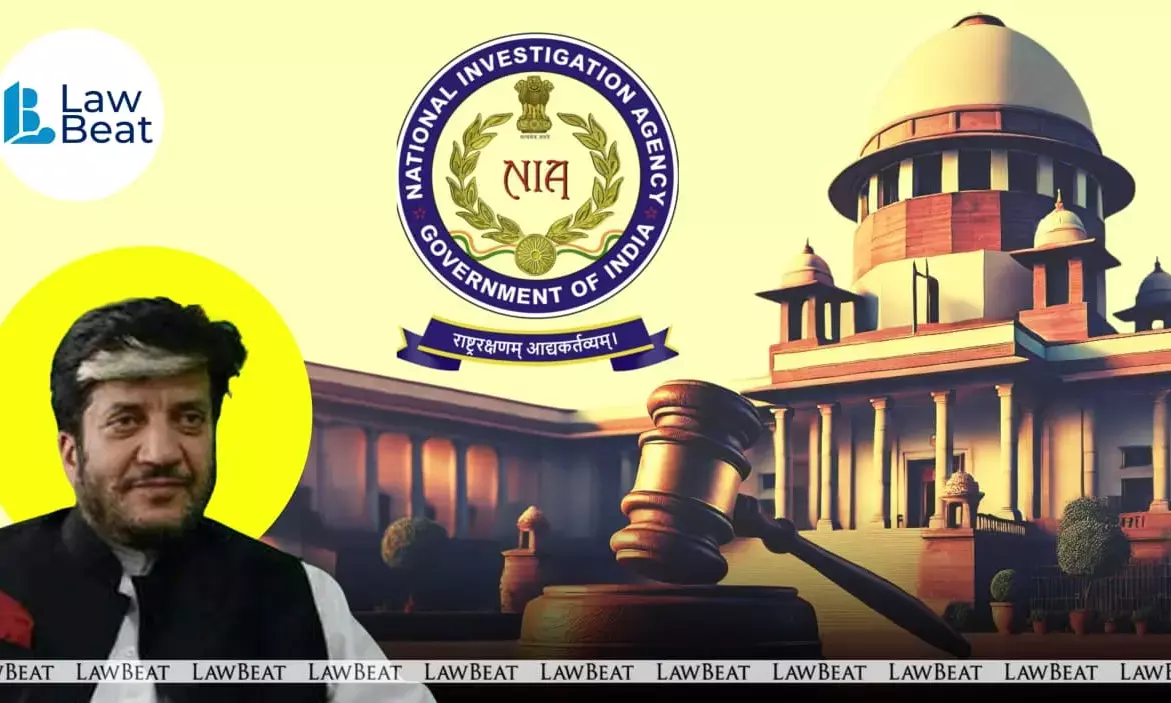
Supreme Court bench of Justices Vikram Nath and Sandeep Mehta granting bail to Kashmiri separatist leader Shabir Ahmed Shah in a terror funding case
The Supreme Court on Tuesday heard the bail plea of Shabir Ahmad Shah, who is facing prosecution under the Unlawful Activities (Prevention) Act (UAPA) for allegedly conspiring to secede Jammu and Kashmir from India.
The Bench of Justices Vikram Nath and Sandeep Mehta heard detailed arguments from Senior Advocate Colin Gonsalves, appearing for Shah, and Senior Advocate Siddharth Luthra, representing the National Investigation Agency (NIA).
Gonsalves submitted that Shah was not named in the main chargesheet or the first supplementary chargesheet and was added only in the second supplementary chargesheet. When the Court asked about the primary allegations, Gonsalves stated that Shah had been booked for allegedly making provocative speeches and for terror funding.
He argued that the last speech attributed to Shah dated back to 1993 and that the terror funding allegation was based on claims that one person was carrying ₹75 lakh allegedly meant for Shah. Gonsalves pointed out that the said individual had been acquitted in the Enforcement Directorate case and that Shah himself had already been granted bail in the ED matter.
Responding to a query on custody, Gonsalves told the Court that Shah had spent a cumulative period of nearly 40 years in custody across various cases and detentions, including over six-and-a-half years in the present FIR. He argued that Shah had repeatedly been booked on the basis of the same allegations relating to speeches, leading to prolonged incarceration.
The Bench noted that earlier FIRs also related to provocative speeches, to which Gonsalves agreed, stating that the allegations across cases were broadly similar.
Opposing the bail plea, Luthra submitted that Shah was arrested in the present case in 2019 while he was already in custody in the ED case. Luthra argued that the case involved allegations of funding street protests that disrupted the administration and claimed that protected witnesses had stated that Shah recommended candidates for medical seats in Pakistan, which were reserved for Kashmiri students.
Luthra informed the Court that 34 witnesses had been examined so far out of 248 listed witnesses, with the prosecution proposing to prune the list to around 150. He stated that charges were framed on March 16, 2022, and asserted that there had been no delay attributable to the prosecution, with four to five witnesses being examined each month.
Gonsalves countered that all allegations were already contained in the main chargesheet in which Shah was not named. He denied allegations of instigating stone pelting, stating that Shah had never thrown stones or incited violence. He also submitted that Shah had engaged with several Prime Ministers over the Kashmir issue, arguing that this demonstrated that he was not a terrorist.
Gonsalves further stated that Shah had left the All Parties Hurriyat Conference in 1996 and formed an independent group, while the allegations largely pertained to the APHC. He argued that even providing a lawyer’s contact to an accused person had been portrayed as “legal help” to terrorists.
The Bench, however, noted that findings in the order framing charges had attained finality. Gonsalves relied on judgments such as Union of India v. K.A. Najeeb and Vernon Gonsalves to argue that prolonged incarceration and delay in trial warranted bail, especially given Shah’s age and health condition.
When asked about the likely duration of the trial, the NIA maintained that there was no delay on its part and that witness pruning was underway. Gonsalves reiterated that mere words, without acts of violence or warfare, could not amount to terrorism and argued that Shah had been jailed for years for expressing uncomfortable views.
After Gonsalves concluded his submissions, Luthra sought two weeks’ time to file additional documents on behalf of the NIA. The Court scheduled the case for further hearing on February 10 at 2PM.
Notably, in November 2025, the NIA had told the Court that there are newly introduced facts in Shah’s rejoinder affidavit. Accordingly, the Bench had granted three weeks time to NIA to file response on the rejoinder counter affidavit.
Case Title: Shabir Ahmed Shah v. NIA
Bench: Justice Vikram Nath and Justice Sandeep Mehta
Hearing Date: January 13, 2026