
Trial Court Uses AI-Made Judgments; Supreme Court Says "Misconduct, Legal Consequence Shall Follow"
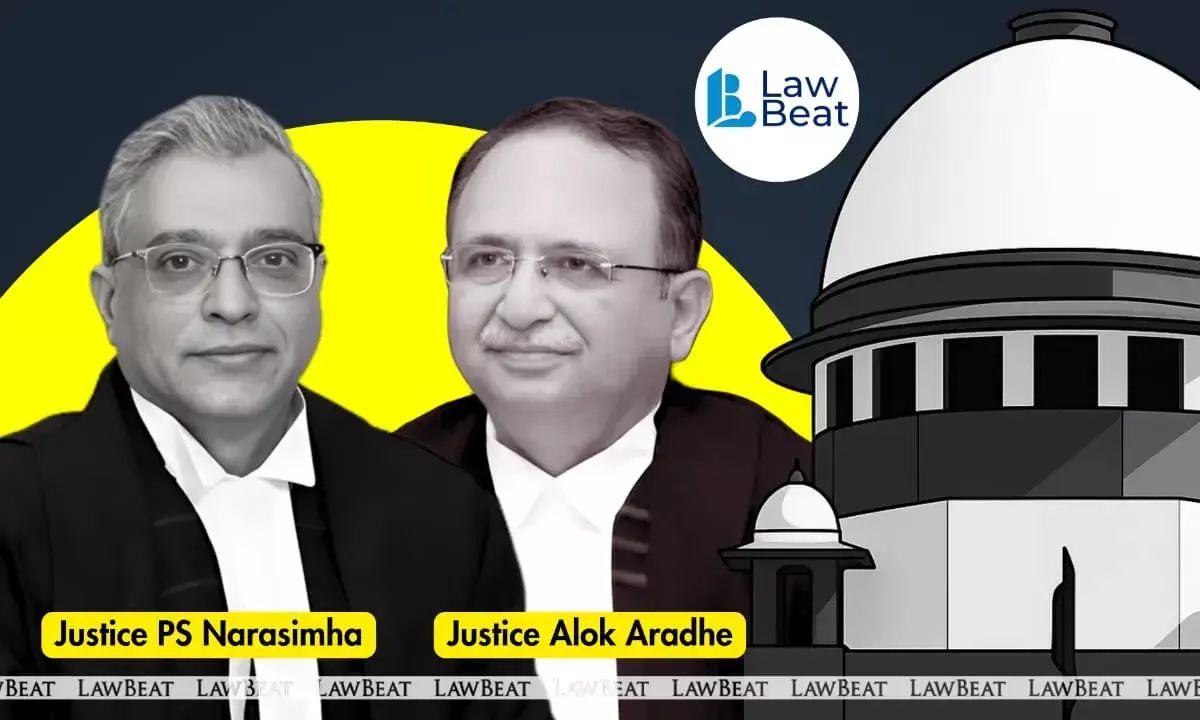
Supreme Court of India flags use of AI generated judgments by a Trial Court.
The Supreme court has flagged serious concerns over the use of AI generated judgments by a Trial Court saying that it has a direct bearing on integrity of adjudicatory process.
A bench of Justices PS Narasimha and Alok Aradhe that the trial court's decision based on non-existent and fake alleged judgments could not be said to be an error in the decision making.
"This case assumes considerable institutional concern, not because of the decision that was taken on the merits of the case, but about the process of adjudication and determination," the bench noted while issuing notice to the Attorney General, Solicitor General and the Bar Council of India.
Notably, in the case before Court, the petitioners are the defendants in a suit filed by the respondents for injunction. Pending disposal of the suit, the Trial Court had appointed an Advocate Commissioner to note the physical features of the property. The petitioners challenged the report of the Advocate Commissioner by raising certain objections. The Trial Court, dismissed the objection and in the process, relied on certain decisions being: i) Subramani v. M. Natarajan (2013) 14 SCC 95, ii) Ramasamy (1071) 2 SCC 68, iii) Chidambaram Pillai v. SAL Lakshmi Devi v. K. Prabha (2006) 5 SCC 551 and iv) Gajanan v. Ramdas (2015) 6 SCC 223.
The petitioners challenged the orders passed by the Trial Court, inter alia, contending that the judgments referred to and relied on are non-existent and fake orders. The High Court considered the objection and realized that the judgments are Artificial Intelligence (AI) generated and after recording a word of caution proceeded to decide the case on merits and dismissed the civil revision petition affirming the decision of the Trial Court. Thus, the petitioners approached the Supreme Court.
While issuing notice, returnable on 10th March, 2026 in the Special Leave Petition, Supreme Court has directed that the Trial Court shall not proceed on the basis of the Advocate Commissioner’s Report.
"We take cognizance of the Trial Court deploying AI generated non-existing, fake or synthetic alleged judgments and seek to examine its consequences and accountability as it has a direct bearing on integrity of adjudicatory process. At the outset, we must declare that a decision based on such non-existent and fake alleged judgments is not an error in the decision making. It would be a misconduct and legal consequence shall follow. It is compelling that we examine this issue in more detail. Issue notice to the Ld. Attorney General, Ld. Solicitor General and the Bar Council of India. We appoint Mr. Shyam Divan, learned senior counsel, to assist the Court. He may nominate an Advocate on Record for his assistance," the bench went on to order.
Recently too a CJI Surya Kant led bench of the Supreme Court raised concerns over growing use of artificial intelligence (AI) in drafting of petitions, relying on recent instances where lawyers cited judgments and quotations that either were found to be non-existent. “We have been alarmingly told that some lawyers have started using AI for drafting,” CJI Kant noted during a hearing.
Justice Nagarathna, also on the bench, recalled an instance where a fictitious judgment was cited and said, "There was a case of Mercy vs Mankind which does not exist". The judge further observed how actual supreme court judgment were cited but the quoted portions did not exist in the judgment.
In October last year, Justice Surya Kant of the Supreme Court, while delivering the keynote address on “Technology in the Aid of the Legal Profession – A Global Perspective” at the Bar Association of Sri Lanka’s annual law conference had said that Artificial Intelligence cannot replace the lawyer or the judge and justice will always remain a profoundly human enterprise. “Artificial intelligence may assist in researching authorities, generating drafts, or highlighting inconsistencies, but it cannot perceive the tremor in a witness’s voice, the anguish behind a petition, or the moral weight of a decision. Let us be crystal clear: we are not replacing the lawyer or the judge, we are simply augmenting their reach and refining their capacity to serve. Let technology be the guide and the human govern,” the Supreme Court judge said while cautioning against overuse of AI.
Notably last month, the Supreme Court had dismissed a Public Interest Litigation (PIL) by one Kartikeya Rawal seeking regulation of artificial intelligence in the judiciary. The petition had raised concerns over potential misuse of AI in generating fake cases and called for structured guidelines for judicial AI adoption. During the hearing, Chief Justice of India Surya Kant had observed that the judiciary already uses AI cautiously, highlighting ongoing training programmes at judicial academies and the lessons learned from Kerala High Court’s structured AI practices. He noted that the matter provided a learning opportunity for both the bar and the bench.
Case Title: GUMMADI USHA RANI & ANR. vs. SURE MALLIKARJUNA RAO & ANR.
Bench: Justices Narasimha and Aradhe
Order Date: February 27, 2026