
“Was Duty Bound To Sign”: Original Sabarimala Petitioner Says He Later Wanted To Withdraw PIL
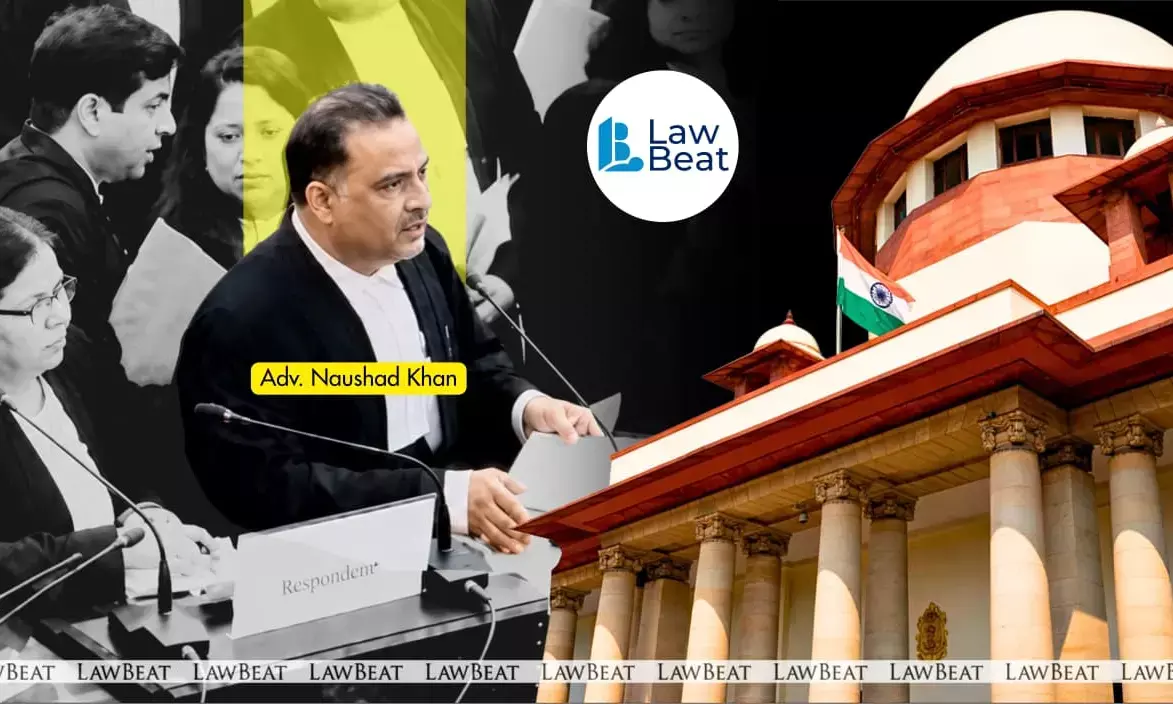
Advocate Naushad Khan appeared before Supreme Court's 9-judge bench hearing review petitions filed against its 2018 Sabarimala verdict.
Nearly two decades after the original Sabarimala petition was filed, Naushad Ahmed Khan on Tuesday told the Supreme Court that he had merely signed the plea as President of the Indian Young Lawyers Association because women members of the association were “aggrieved”, while also revealing that he had later wanted to revisit the litigation and withdraw from it.
Khan’s appearance before the 9-judge Constitution Bench assumes significance as the Supreme Court in recent hearings has repeatedly questioned the very basis on which the lawyers’ body initiated the public interest litigation challenging the traditional restriction on entry of women aged 10–50 years into Sabarimala Temple.
The appearance today happened on account of Supreme Court's recent questioning of the original petitioners, Indian young Lawyers Association over their filing of the PIL in the first place, way back in 2006 calling it a clear case of abuse of process of law.
Defending his stance, Khan told the CJI Surya Kant led bench today, "At the beginning there were many questions on me...our Association came into being in 2004, we were quite young..we have a women's cell in our association..The co-petitioners are Bhakti and Prerna, they filed this...I was duty bound to sign this petition as they were aggrieved..At that time after half an hour of the hearing we received threats.."
On his locus standi to file the said petition, Khan clarified today that he wanted to have a re-look at the issue but the then CJI had not allowed him to withdraw the plea. "Issue came so far as locus standi is concerned...we wanted to have a relook on this..but the CJI at that time said that it is a PIL and we will carry forward the petition and even if you want to withdraw it, we will not allow it..and he appointed an amicus to assist on the issue," Khan told the bench.
Reportedly, in 2016 the Supreme Court's bench of former Justices Dipak Misra and NV Ramana had said it would hear Advocate Naushad Ahmed Khan's plea who was getting threats for filing a PIL seeking entry of women in the Sabarimala temple. “Let people know this that once a public interest litigation (PIL) is filed and entertained, you cannot withdraw it,” the bench had said.
Khan had then sought urgent hearing of the matter saying he had received 500 threatening phone calls and wanted to take back the PIL. Court had ultimately granted security to Khan.
Last week, while hearing Advocate Gupta, appearing for the association, Justice BV Nagarathna had asked, "How does a juristic body have any beliefs? How can you have conscience?" Court had also said that the PIL should have been thrown into the dustbin.
When the counsel stated that the deity is said to not like young ladies and this could never be the belief of the devotees, Justice Nagarathna said, "How are you concerned with all this..you please tell us..". CJI Surya Kant also questioned the petitioners, "Are you the Chief Minister of the country?"
"Can you not work for the welfare of the bar or work for the country..other than doing this kind of work..work for the welfare of younger members of the bar who are working in rural areas, they cannot come to the cities for work, work for their welfare..rather than filing such PILs," Justice Nagarathna further pulled up the petitioner association.
Justice Aravind Kumar had added to the exchanged while questioning the locus of the association. "Mr. Counsel has the association passed a resolution authorizing the filing of this PIL..is the President a signatory to this..we are asking you on facts...whether a resolution was passed by your Association?" he had asked.
After five years of the review petitions being taken up last, the Supreme Court of India in March took up the batch of petitions challenging its September 2018 decision wherein a 5-judge Constitution Bench of the Supreme Court by a 4:1 majority had ruled that the traditional ban on women aged 10–50 years entering the Sabarimala temple was unconstitutional.Notably, more than 50 review petitions have filed by devotees, religious groups, and organisations arguing that the Court interfered with essential religious practices as Lord Ayyappa devotees form a separate religious denomination.
The issue dates back to 2006, when Indian Young Lawyers Association had filed a Writ Petition challenging the validity of Rule 3(b) of the Kerala Hindu Places of Public Worship (Authorisation of Entry) Rules, 1965 (1965 Rules) and sought a direction to permit female devotees between the ages of 10 to 50 years to enter the Sabarimala temple without any restrictions.
By a majority of 4:1, the Supreme Court allowed the Writ Petition on 28 September 2018 holding that the devotees of Lord Ayyappa did not constitute a separate religious denomination and therefore cannot claim the benefit of Article 26 of the Constitution of India. Supreme Court also concluded that exclusion of women between the ages of 10 to 50 years from entry into the temple is violative of Article 25 of the Constitution of India. Further, Rule 3 (b) of the Kerala Hindu Places of Public Worship (Authorisation of Entry) Rules, 1965 was declared as violative of Article 25 (1) to the Constitution of India and ultra vires Section 3 of Kerala Hindu Places of Public Worship (Authorisation of Entry) Act, 1965.
On 14 November 2019, a five judge Constitution Bench delivered a crucial order by a 3:2 Majority wherein it kept the Review petitions pending without overturning the 2018 judgment and referred larger constitutional questions to a 9-judge bench. The 9-judge bench led by former CJI SA Bobde held that no matter is beyond the jurisdiction of a superior Court of record unless it is expressly shown to be so, under the provisions of the Constitution and held that the review petitions were maintainable.
The Sabarimala review petitions is now one of the most important constitutional debates, balancing gender equality with religious freedom. Instead of immediately revising the 2018 verdict, the Supreme Court has chosen to examine wider questions affecting multiple faiths, making the case a landmark in constitutional and religious jurisprudence. Court has now expanded the issue beyond Sabarimala to include Muslim women’s entry into mosques, Parsi women’s religious rights and Dawoodi Bohra excommunication practices along with other similar issues.
Case Title: KANTARU RAJEEVARU Vs INDIAN YOUNG LAWYERS ASSOCIATION THR.ITS GENERAL SECRETARY MS. BHAKTI PASRIJA AND ORS.
Bench: CJI Surya Kant, Justices B V Nagarathna, MM Sundresh, Ahsanuddin Amanullah, Aravind Kumar, AG Masih, R Mahadevan, Prasanna B Varale and Joymalya Bagchi
Hearing Date: May 12, 2026