
“Whole Defence Is False, Adds To Grave Suspicion”: Inquiry Committee Holds All Three Charges Against Justice Yashwant Varma Proved
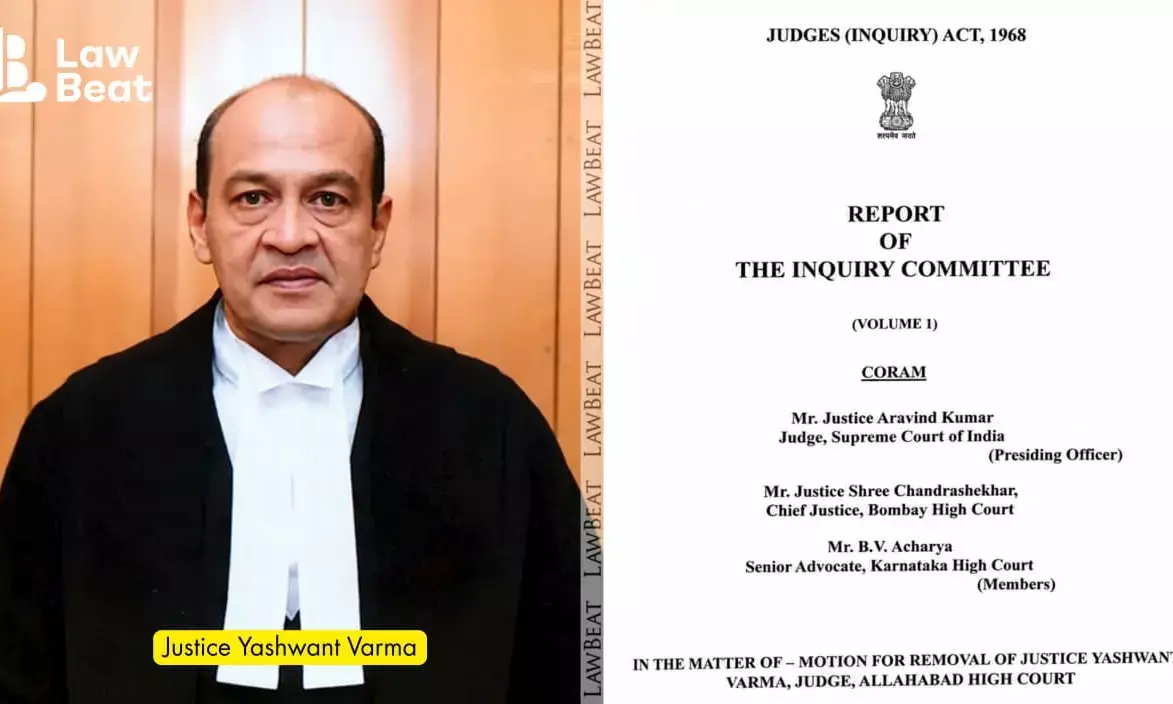
Judges Inquiry Committee report on allegations against former Delhi High Court Judge Justice Yashwant Varma is set to be tabled in the Lok Sabha.
The Inquiry Committee examining allegations against Justice Yashwant Varma has held all three Articles of Charge against him proved, recording that substantial unexplained currency notes were found within his official residential premises, material evidence was not preserved and the Judge’s explanations were evasive and unsatisfactory.
The two-volume report of the three-member Judges Inquiry Committee that investigated allegations against former Delhi High Court Judge, Justice Yashwant Varma, will be tabled in the Lok Sabha today.
The report, comprising Volumes 1 and 2 in Hindi and English, will be laid before the House along with the oral and documentary evidence recorded during the course of the inquiry. The report is being tabled by the Secretary General under Section 4(3) of the Judges (Inquiry) Act, 1968, read with Rules 9 and 10 of the Judges (Inquiry) Rules, 1969.
In one of its observations, the Committee has said that Justice Varma’s “whole defence is false and adds to grave suspicion against him”, while examining his response to the failure to secure the currency notes and preserve the scene after the fire at his official residence.
The Committee comprising Supreme Court judge Justice Aravind Kumar, the-then Bombay High Court Chief Justice Shree Chandrashekhar and Senior Advocate B.V. Acharya submitted its report after examining the evidence concerning the fire at 30, Tughlaq Crescent, New Delhi, and the subsequent discovery of currency notes in a storeroom there.
The first charge concerned the discovery and possession of unexplained Indian currency within the official premises.
The Committee found that several officials of the Delhi Fire Services and Delhi Police had spoken about burnt, half-burnt, wet or scattered ₹500 denomination notes inside the storeroom. Their evidence, it said, was mutually corroborative and was also supported in material particulars by electronic and photographic records.
While the precise amount could not be determined because the currency was neither seized nor inventoried, the Committee said this did not dilute its central finding.
“The evidence is not of a few stray notes or isolated remnants. It is of bundles, heaps and stacks of ₹500 denomination of Indian currency notes,” the report recorded.
One witness, Roop Chand, described the amount found at the site as “unimaginable” and said an estimate of ₹5 lakh was “too small”. Another witness said currency notes were spread from the door to the end of the room and that he had never seen so much money in his life.
The Committee rejected Justice Varma’s defence that the storeroom was not under his control merely because staff, security personnel and maintenance workers could access it. It noted, among other circumstances, his own statement that a locked liquor cabinet containing personal articles was maintained there, which materially weakened the contention that the room was an uncontrolled space outside his effective control.
Significantly, however, the Committee did not conclude that the currency personally belonged to Justice Varma. It expressly clarified that it was not recording a finding of “direct personal ownership” in the criminal sense. What stood established, it said, was that substantial unexplained currency was found within the official premises occupied by the Judge and that he failed to furnish a satisfactory explanation regarding its presence, source or ownership. Article I was consequently held proved.
The second charge concerned failure to preserve and interference with material evidence.
The Committee noted that the currency was not preserved, the storeroom was not immediately sealed and cleaning activity occurred after first responders had left. The material subsequently became unavailable, with no satisfactory explanation as to how currency seen by several official witnesses “disappeared or became unavailable”.
It also noted that Justice Varma was in touch with his daughter, his Private Secretary Rajinder Singh Karki and household staff member Mohd. Rahil. In a particularly significant finding, the Committee drew the inference that “they have acted at the instance of the Judge under his instructions”.
At the same time, the Committee carefully qualified its conclusion. It did not find direct proof that Justice Varma personally removed the currency. Instead, Article II was held proved on the basis of failure to secure and preserve evidence, disturbance of the evidentiary condition of the storeroom before lawful sealing and inspection, acquiescence in such disturbance through the establishment under his authority, and the resulting loss of material evidence.
The third charge concerned allegedly evasive and misleading explanations furnished by the Judge.
The Committee highlighted what it called the “changing character” of the defence. It noted that the defence moved from denial of the presence of cash to questioning the absence of seizure and verification, suggesting possible fake currency notes, possible removal by first responders, conspiracy, planting and suspicions concerning staff.
Although the Committee acknowledged that Justice Varma was not required to prove his innocence, it held that positive factual pleas such as conspiracy, planting, foul play or removal by officials required some factual foundation. No defence witnesses were ultimately produced to substantiate these theories.
The Committee concluded that the Judge’s explanation was “evasive, incomplete and misleading in effect”, observing that his initial broad denial had given way to successive alternative hypotheses which remained unsubstantiated despite an opportunity to lead defence evidence. Article III was accordingly held proved.
The development assumes significance as the committee was constituted to inquire into allegations concerning the discovery of cash at the official residence of Justice Varma, who was serving as a Judge of the Delhi High Court when the controversy surfaced. The alleged cash discovery dates back to March 14, 2025, when a fire broke out at Justice Varma's official residence in New Delhi. Justice Varma was not present at the residence at the time.
During the firefighting operation, semi-burnt wads of currency notes were reportedly discovered at the premises. The incident subsequently triggered an inquiry into allegations concerning the presence of cash at the judge's residence. Justice Varma was thereafter transferred from the Delhi High Court to the Allahabad High Court amid the controversy and took oath there on April 5, 2025. He subsequently resigned from judicial office on April 19, 2025.
On August 12, 2025, the Lok Sabha Speaker, Om Birla, had constituted a three-member inquiry committee after receiving a motion signed by 146 Members of Parliament seeking Justice Varma's removal. Presiding Officer of Judges Inquiry Committee were Hon'ble Justice Aravind Kumar, Supreme Court of India along with Hon'ble Justice Shree Chandrashekhar, the then-Chief Justice of the Bombay High Court; and Shri B.V. Acharya, Senior Advocate, Karnataka High Court. They presented the Report of Judges Inquiry Committee to Honble Speaker, Lok Sabha in Parliament House on 18 May 2026.
Separately, the Supreme Court had earlier constituted a three-member judicial inquiry panel to examine the allegations surrounding the cash discovery. The judicial panel examined more than 55 witnesses during its inquiry and reportedly found substance in the allegations concerning the presence of burnt and unburnt cash at Justice Varma's residence. The panel's findings ultimately led to a recommendation for Justice Varma's removal on grounds of misconduct.
The inquiry had also examined the circumstances surrounding the storeroom where the burnt cash was discovered. More recently, findings of the Supreme Court-appointed panel indicated that access to the storeroom was under the active control of Justice Varma and his family.
The Supreme Court recently also dismissed a plea seeking registration of an FIR and a court-monitored Special Investigation Team (SIT) probe against Justice Varma, observing that the petition appeared to be aimed at “cheap publicity.” The Bench of Justices P S Narasimha and Alok Aradhe refused to entertain the plea filed by advocate Ghanshyam Upadhayay, who sought criminal action against Varma in connection with the alleged discovery of semi-burnt and unburnt currency notes following a fire at his official residence in Lutyens’ Delhi on March 14, 2025.