
‘Won’t Allow Defamation Of Judiciary’: Supreme Court To Take Suo Motu Action Over NCERT Class 8 ‘Judicial Corruption’ Content
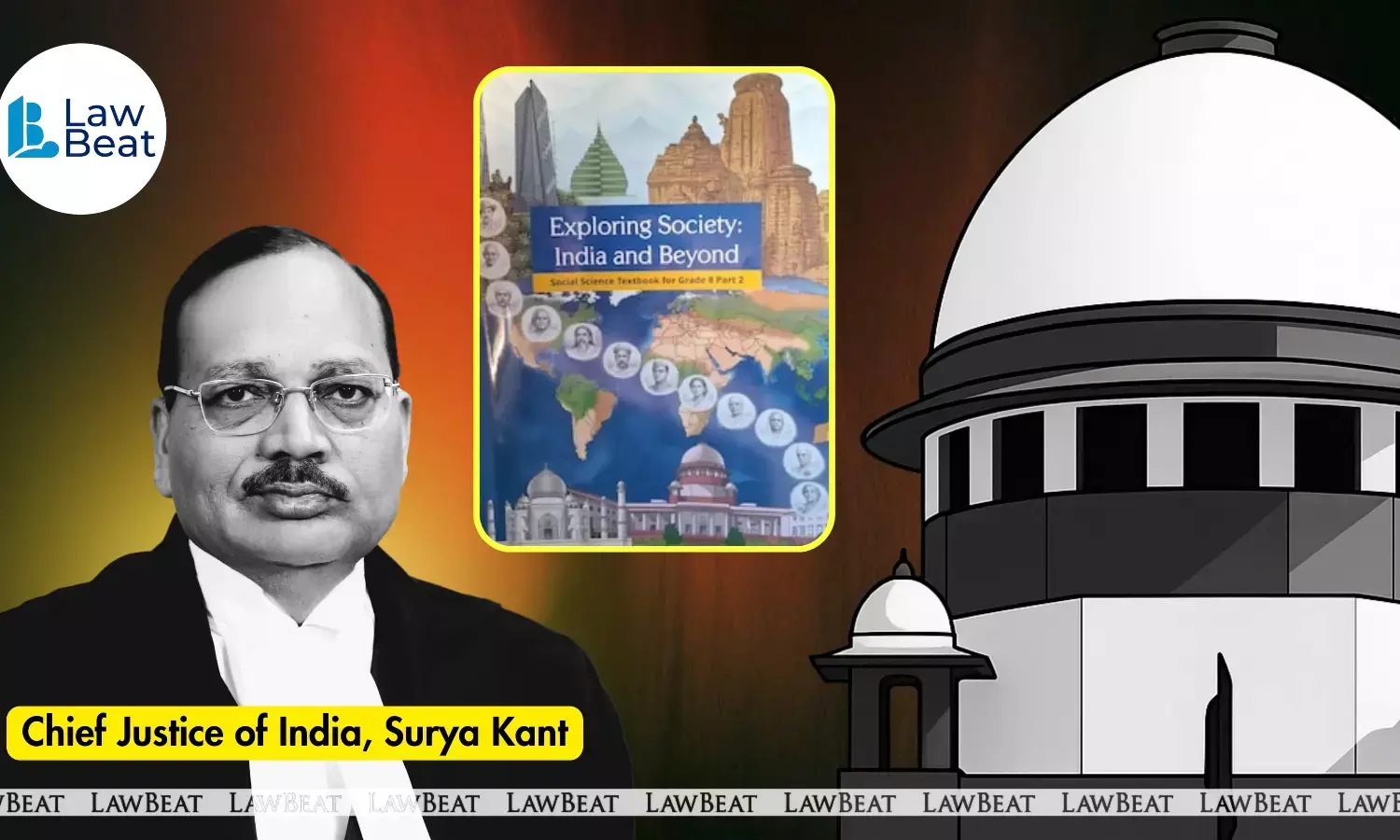
Supreme Court bench led by CJI Surya Kant had registered a suo motu case over the NCERT Class 8 textbook chapter on corruption in judiciary
The Supreme Court on Wednesday witnessed sharp exchanges after Senior Advocate Kapil Sibal raised concerns over alleged references to “corruption in the judiciary” in an NCERT textbook prescribed for Class 8 students, terming the development “absolutely scandalous.”
Mentioning the issue before a Bench led by Chief Justice of India Surya Kant, Sibal along with Senior Advocates Abhishek Manu Singhvi, Mukul Rohatgi and Gopal Sankarnarayanan submitted that the contents of the school textbook were a matter of grave concern and had caused serious disquiet within the legal fraternity.
“NCERT is teaching Class 8 students about judicial corruption. This is a matter of grave concern. We are here for the Bar,” Sibal told the Court.
He also referred to the alleged removal of portions dealing with constitutional structure from the same level of school curriculum, suggesting that the changes warranted judicial scrutiny.
Responding to the mention, the CJI indicated that the issue had not gone unnoticed. “Please wait for a few days. Bar and Bench all are perturbed. All High Court judges are perturbed,” he observed in open court.
Making it clear that the institution would respond firmly, the Chief Justice stated, “I will take up the matter suo motu. I will not allow anybody to defame the institution. Law will take its course.”
The CJI further remarked that the development appeared, at first glance, to be more than incidental. “It seems to be a calculated measure,” he said, adding, “I know how to deal with it.”
The CJI made the remarks during the mentioning of matters before the Court, and no formal petition on the issue was taken up for hearing at this stage.
The controversy centres on the portrayal of the judiciary in school-level educational material and the potential implications of introducing references to judicial corruption to students at a formative age.
Notably, the National Council of Educational Research and Training (NCERT) on Monday released a new Class 8 Social Science textbook that includes a section on “corruption in the judiciary” as part of a chapter titled “The Role of the Judiciary in Our Society.”
The chapter identifies “corruption at various levels of the judiciary” and a “massive backlog” of cases as among the challenges faced by the judicial system. It attributes pendency to multiple factors, including an inadequate number of judges, complicated legal procedures and poor infrastructure.
According to the textbook, the approximate number of pending cases stands at 81,000 in the Supreme Court of India, 62,40,000 in High Courts, and 4,70,00,000 in District and Subordinate Courts.
In contrast, the earlier edition of the textbook focused on explaining the role of the judiciary, the concept of judicial independence, the structure of courts and access to justice. While it referred to delays in adjudication and noted that “justice delayed is justice denied,” it did not include any reference to corruption within the judicial system.
The newly introduced section states that judges are bound by a code of conduct governing their behaviour both inside and outside the courtroom. It refers to internal mechanisms aimed at maintaining accountability and highlights the existence of an established procedure for receiving complaints through the Centralised Public Grievance Redress and Monitoring System (CPGRAMS).
The textbook notes that more than 1,600 complaints were received through the grievance redress mechanism between 2017 and 2021. It further explains that in cases involving serious allegations, Parliament may initiate impeachment proceedings against a judge. Such a motion, it states, is considered only after a proper inquiry, during which the concerned judge is given an opportunity to present their case.
At the same time, the book acknowledges that “people do experience corruption at various levels of the judiciary,” adding that for the poor and disadvantaged, this can exacerbate barriers to accessing justice. It states that efforts are being undertaken at both State and Union levels to enhance transparency and strengthen public confidence in the judicial system, including through the use of technology and prompt action against instances of misconduct.
The chapter also cites remarks attributed to former Chief Justice of India B. R. Gavai from July 2025. The textbook quotes him as stating that instances of corruption and misconduct within the judiciary have negatively impacted public confidence, and that rebuilding trust requires “swift, decisive and transparent action” to address such issues. It adds that any erosion of public confidence risks weakening the judiciary’s constitutional role as the ultimate arbiter of rights.
Bench: CJI Surya Kant, Justices Joymalya Bagchi and Vipul M Pancholi
Mentioning Date: February 25, 2026