
Menstrual Leave Isn't Empowerment- Why The CJI Is Right About It
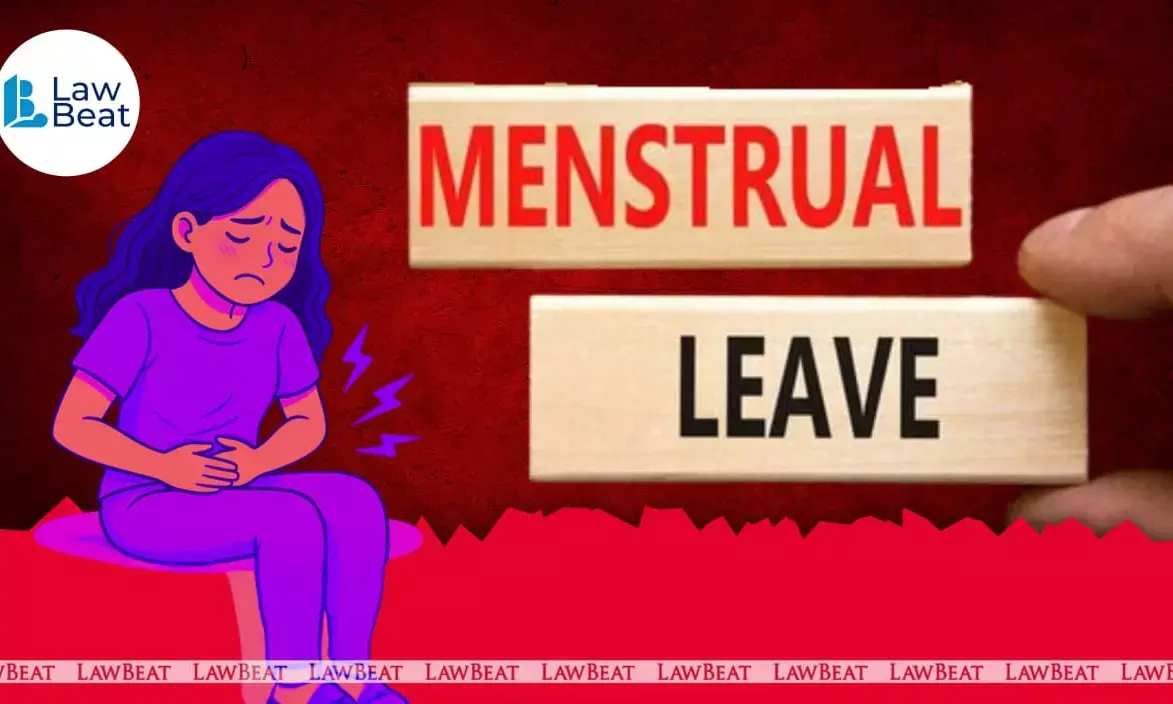
The Supreme Court of India recently highlighted concerns that mandatory menstrual leave policies could reinforce workplace bias and affect women’s participation.
For eons, matters such as marriage, procreation, and motherhood have been topics for niche discussion. Of late, what recurs constantly in society is the option for women to avail time-off during their menstrual cycle. As is well known, countries worldwide have devised schemes to accommodate such exigencies. The premise behind such accommodations has been to accord assured rights of menstrual well-being and overall emancipation.
As a consequence of the push for a countrywide menstrual leave policy, the Supreme Court of India has confined itself to rolling out directions. As was adjudicated in Shailendra Mani Tripathi v. Union of India (2023 SCC OnLine SC 228), the Supreme Court invoked the need for voluntary policies that may be implemented where the Union and the States would act as the agency to put forward the assertion for period leave. The stance, as taken earlier, has been reflected in a matter heard by the Supreme Court recently. To rub in the point, the Chief Justice of India and the brother Judge, Justice Joymalya Bagchi soared into the tangent of practicality about the bearing mandatory menstrual leaves would cast upon women in this day and age. A few points are worth noting. The Hon’ble CJI Justice Surya Kant, very candidly, has said that pleas such as this are made to instill fear in the minds of women in the menstruating age bracket. The CJI added that it is done to characterise women as weak and inferior.
The consequences are certain to follow as they are obvious to further add disparities in terms of representation and remuneration. The judges were right in pressing ahead and declaring the crudities that would hit women hard on professional lines. In doing so, the judiciary has positioned itself, in a way, to show that policy decisions are not in its realm to execute but it is for the legislature to formulate frameworks. Although the interference of courts is rare, there remains a hankering for ill-advised litigation. This is a familiar tale. Addressing this, the bench observed that it was futile to prefer rounds of litigation over the same cause of action.
Suppose, for a moment, we assume that the provision for menstrual leaves is legally ordained. What then becomes the pith of bodily autonomy of a woman? Even if we assume that this right is to meaningfully acknowledge the physiological changes that a woman may have to undergo, the conundrum of whether lawmakers can have the decision-making capacity comes to the fore. This, ipso facto, becomes quite the topic for a debate. Fluid understanding of the contemporary movements (such as the abortion rights movement and the MeToo movement) for the bodily dignity of women is surprisingly labyrinthine. It gets clearer as we notice the progression from the demands for non-interventionism from the state to lobbying for institutional recognition of women’s anatomy. Now, this sort of detour would impair the covenant of protection to women, as it amounts to confusion. One moment, the nonconformists want state backing and in the next, they object to it. In sum, actions and motives like these are needless when the employability is at stake, more so for women who come from hapless socioeconomic environments.
Coming now to the core question of safeguarding privacy. It is now settled law that ‘Right to Privacy’ is espoused with Article 21 of the Constitution of India. But, in the absence of a direct stipulation for the protection of menstrual details, it all seems a bit sketchy. More specifically, in a professional setting, the necessary concomitants of privacy cannot be ignored. In a way, it would trigger reactions as the higher-ups to fellow workers would be wary of her menstrual status. What then would be left to remedy it? It will thus, in all probability, be an inevitable lemma as the task to fortify the intimate health details of a woman is arduous.
The Supreme Court, not too long ago, mandated a three-year practice of law for judiciary aspirants. Many intellectuals and commentators, relying on the pulse of young advocates, have clamored against it. This decision, albeit tragic, was seen as manifestly adverse to the career prospects of women in particular. It is so, because it further magnifies the structural bias against women in the legal profession. However, the Chief Justice Surya Kant, while expressing a desire to reconsider the judgment hitherto decided in May 2025, said, “there is no doubt that practice is important,” “but we also have to see the impact on young talent. How do we introduce it in such a manner that it does not deprive us of meritorious candidates? Today, a fresh pass-out is not eligible.” On the whole, the substantive point of how the prolonged wait would strain females was met with and combated. This, when juxtaposed in the context of absenteeism owing to menstruation, would have the same ostensible effect. It will only add to the existing constraints to women completely ignoring the need for equitably gendered distribution of mentorship and opportunities. News analyses have indicated that policy enabling leaves during menstrual cycles could hamper chances of recruitment and promotion. Similarly, policies may inadvertently reinforce stereotypes and thereby marginalise women in workplaces.
It is essential to posit in the clearest terms that there is, of course, an imperative on the Union and State Governments to endeavour to ensure that there is physical, mental, and social well-being of women. But, to shoulder such an endeavour is not to be seen as an exercise to provide cosmetic rights (read as: rights given at a surface-level). That is, a mere impulse to balance autonomy with anatomy shouldn’t be to the detriment of working women. It goes without saying that women are making transformative strides across many fields. It requires, amongst other things, generous economic policies, commensurate roles, and above all, fair-handed participation. And when something as natural as the process of menstruation is not tagged as a “taboo,” that is when women will reach commanding heights. Perhaps that would be empowering in a true sense.
- Krithika Jamkhandi is an advocate practicing before the High Court of Karnataka.