
Bhojshala Kamal-Maula Mosque | ASI Cannot Redefine Character Of Protected Monument: Salman Khurshid
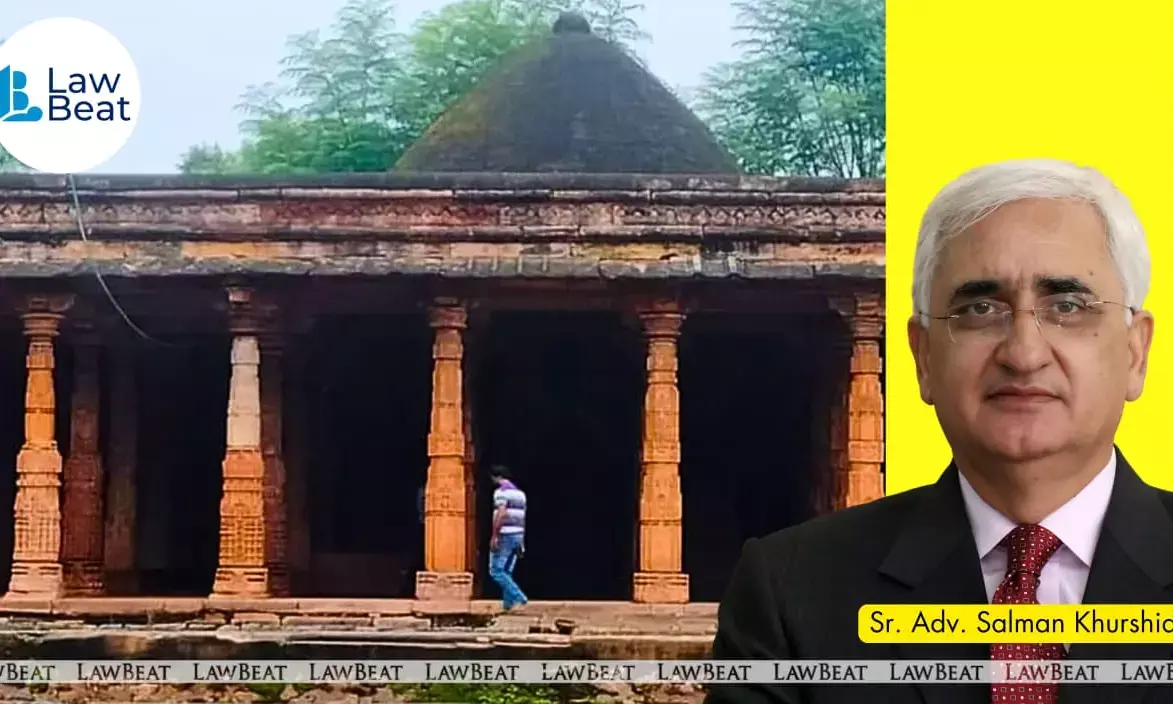
ASI Survey Built on Inferences, Not Evidence: Muslim Side Rebuts Hindu Claims in Bhojshala Matter
Senior Advocate Salman Khurshid, appearing for the Maulana Kamaluddin Welfare Society, on Monday mounted a sharp rebuttal to the claims advanced by the Hindu side in the Bhojshala-Kamal Maula Mosque dispute before the Indore Bench of the Madhya Pradesh High Court, contending that the petitions before the court sought to indirectly establish religious title without specifically pleading or proving it.
Addressing the Bench of Justice Vijay Kumar Shukla and Justice Alok Awasthi, Sr Adv. Khurshid argued that none of the pending writ petitions actually sought a declaration of title over the disputed property. According to him, the primary challenge in the petitions was directed against the Archaeological Survey of India’s 2003 order regulating access and worship rights at the site. He submitted that parties could not bypass the requirement of proving title merely by invoking Article 25 rights relating to religious freedom.
Referring to the Ayodhya judgment, Sr Adv. Khurshid argued that the Ram Janmabhoomi dispute involved a juristic deity, Ram Lalla Virajman, as a party before the court, whereas no such juristic personality had been impleaded in the present proceedings. “There is an assumption that title does not need to be established and merely on Article 25 rights can be claimed,” he submitted, cautioning the court against allowing broad religious assertions without a legal foundation.
Sr Adv. Khurshid also questioned the methodology and conclusions of the ASI survey carried out pursuant to directions of the High Court. He alleged that the videography supplied to parties consisted only of short clips, many under forty-five seconds, rather than continuous recordings of the excavation and survey process. He further claimed that objections raised by the Muslim side during the survey were not adequately reflected in the official material placed before the court.
The senior counsel maintained that there was “no direct specific evidence” in the ASI report, historical records, or compilations produced before the court to establish that a Bhojshala temple had been demolished and replaced with the Kamal Maula Mosque. At best, he argued, the material relied upon by the Hindu side merely raised inferences and retrospective interpretations.
Questioning the excavation process itself, Sr Adv. Khurshid argued that the Supreme Court and High Court orders contemplated scientific methods for investigation and not physical excavation capable of altering the structure. He also alleged that the survey was conducted simultaneously at multiple locations despite directions requiring the presence of representatives from all parties.
A substantial part of Sr Adv. Khurshid’s submissions focused on the ASI’s interpretation of recovered artefacts and inscriptions. He contended that many of the architectural fragments, sculptures, and inscriptions referred to in the survey report did not conclusively establish the existence of a temple.
Referring to a Persian inscription found at the tomb of Abdullah Shah Changal, located around one-and-a-half kilometres away from the disputed site, Sr Adv. Khurshid argued that the ASI had unfairly attempted to connect that inscription to the Bhojshala dispute despite the absence of site-specific evidence.
He further argued that references to Saraswati Sadan and learning centres in inscriptions only indicated the possibility of an educational or cultural institution and not necessarily a temple. Literary inscriptions like Parijata Manjari, he submitted, were dramatic and cultural compositions rather than documentary architectural evidence.
Also Read: Bhojshala-Kamal Maula Mosque | Hindu Front Alleges ASI Failed To Protect Hindu Character Of Site
Sr Adv. Khurshid also alleged that the ASI altered portions of the structure during the survey process, including steps, platforms, and flooring around the mosque complex. He claimed certain artefacts recovered from a sealed room appeared suspiciously clean despite allegedly being buried for centuries and pointed to the presence of plastic bottles and modern objects near the recovered material to question the credibility of the excavation.
Maintaining that the ASI was legally obligated to preserve the monument in the condition in which it had been protected since the 1904 notification, Sr Adv. Khurshid argued that Section 16 of the Ancient Monuments and Archaeological Sites and Remains Act, 1958 required preservation of the site’s existing character rather than attempts to rediscover or redefine it. Speculation cannot substitute admissible proof, he repeatedly argued.
The Bench will continue to hear the matter Tomorrow (May 13, 2026).
Case Title: Hindu Front for Justice (Regd. Trust No. 976) Through its President Ms. Ranjana Agnihotri v. Union of India Ministry of Culture and other connected matters
Date of Hearing: May 11, 2026
Bench: Justice Vijay Kumar Shukla and Justice Alok Awasthi