
Delhi High Court Orders Takedown Of Unauthorised Court Proceeding Videos In Arvind Kejriwal Case
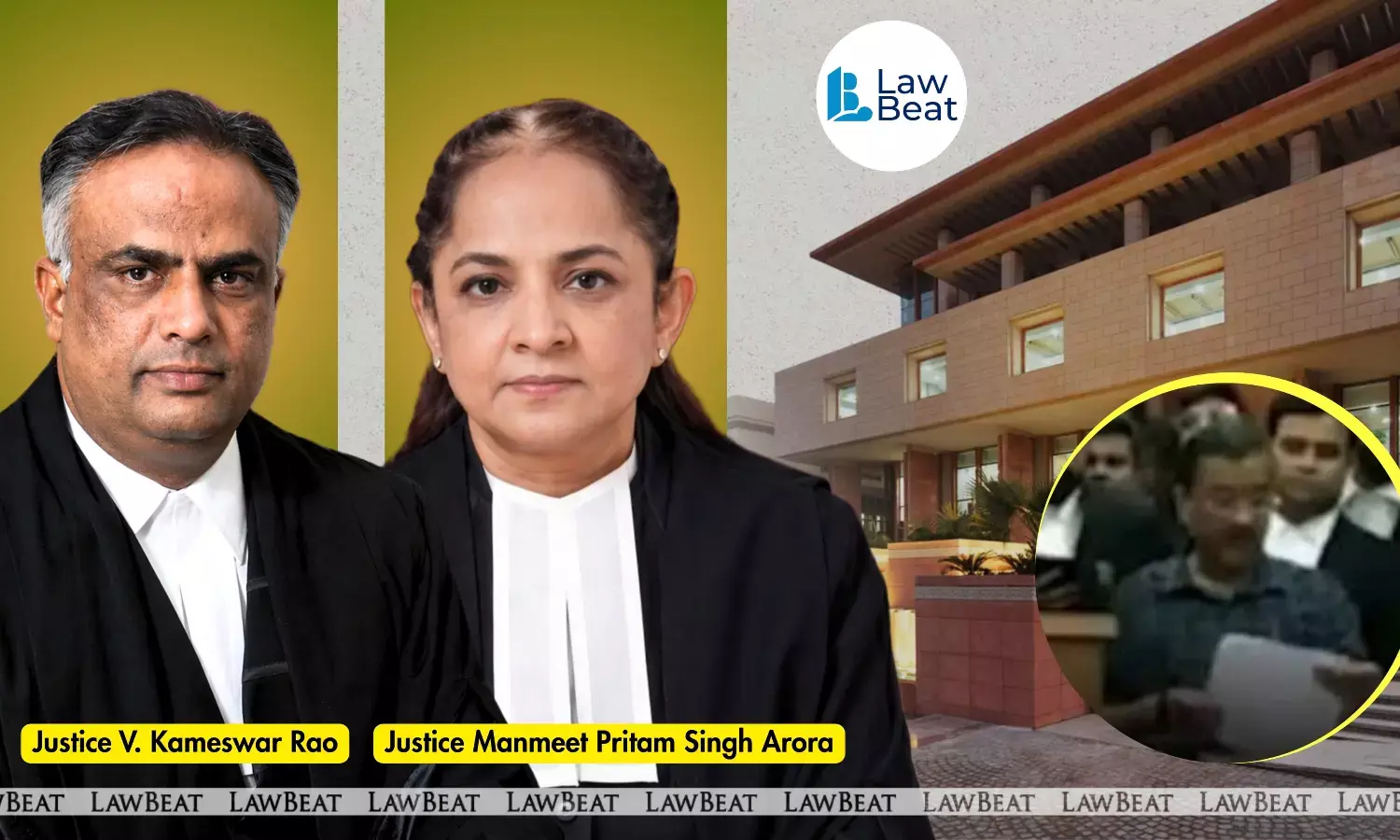
Delhi High Court hears PIL on unauthorised recording and circulation of court proceedings in Kejriwal case
The Delhi High Court on Thursday took serious note of the alleged unauthorised recording and circulation of court proceedings in connection with the excise policy case involving Arvind Kejriwal, directing social media platforms to remove identified content and assist in tracing the original uploader.
A Division Bench of Justice V. Kameswar Rao and Justice Manmeet Pritam Singh Arora was hearing a public interest litigation filed by Advocate Vaibhav Singh seeking initiation of contempt proceedings against Arvind Kejriwal, journalist Ravish Kumar and others over the alleged dissemination of video clips from a hearing conducted on April 13 before Justice Swarana Kanta Sharma.
The petitioner contended that the recording and subsequent circulation of the proceedings violated the Delhi High Court Video Conferencing Rules, which expressly prohibit recording or publication of court proceedings without prior judicial permission. It was further alleged that selectively edited clips were shared online to advance a political narrative.
During the hearing, the Bench underscored the institutional implications of such acts, observing that the issue went beyond individual violations and directly impacted the dignity of the judiciary. “We are concerned with the question at large, which affects the institution,” Justice Rao remarked.
Appearing for social media intermediaries, Senior Advocate Arvind Datar (for Meta Platforms) submitted that the company had already complied with takedown requests issued by the court registry. However, he highlighted the technological limitations in proactively identifying and filtering such content, stating that platforms rely on specific complaints or official communication to act.
Counsel for Meta and Google informed the Court that while they maintain backend data such as IP logs and subscriber information, identifying the first uploader of a video requires a targeted investigation. The Bench directed platforms to furnish details that could help trace the origin of the uploaded content.
The Court also engaged with the Additional Solicitor General (ASG) Chetan Sharma on the feasibility of systemic solutions to prevent recurrence. The ASG emphasised that unauthorised dissemination of court proceedings undermines the credibility of judicial institutions and must be addressed firmly.
Notably, the Bench acknowledged the practical difficulty of preventing re-uploads of such content, as flagged by multiple parties. It observed that while immediate takedown upon notification is achievable, automated detection of similar content remains technologically constrained.
In its order, the Court recorded that certain URLs containing the impugned recordings had already been taken down by intermediaries including Meta Platforms and Google. However, it directed Google to remove additional links identified in the petition and file an affidavit detailing its compliance and position.
The Court also issued notice to X (formerly Twitter), directing that any identified content be taken down upon intimation by the petitioner. It granted liberty to the petitioner to notify platforms of any further instances of such uploads, which must then be promptly removed.
Importantly, the Bench referred to Rule 3(1)(b) of the Information Technology Rules, 2021, noting that intermediaries are obligated to make reasonable efforts to prevent hosting or sharing of unlawful content.
The Ministry of Electronics and Information Technology (MeitY) was also impleaded, with the Court issuing notice to its Secretary to assist on the broader regulatory and technological framework.
Furthermore, the Court sought detailed responses from all parties, signalling a deeper examination of accountability, platform responsibility, and enforcement gaps.
The matter is now scheduled for further hearing on July 6.
It is to be noted that the High Court, Registrar General Arun Bhardwaj on Singh's complaint had ordered the removal of video recordings of Arvind Kejriwal’s court appearance from social media platforms, triggering a fresh controversy at the intersection of law, politics, and digital dissemination of judicial proceedings.
Case Title: Vaibhav Singh v. Delhi High Court & Ors.
Bench: Justice V. Kameswar Rao and Justice Manmeet Pritam Singh Arora
Hearing Date: April 23, 2026