
HR&CE Had No Authority to Oppose Deepathoon Ritual, Temple Alone Could Decide: Submissions Before Madras High Court
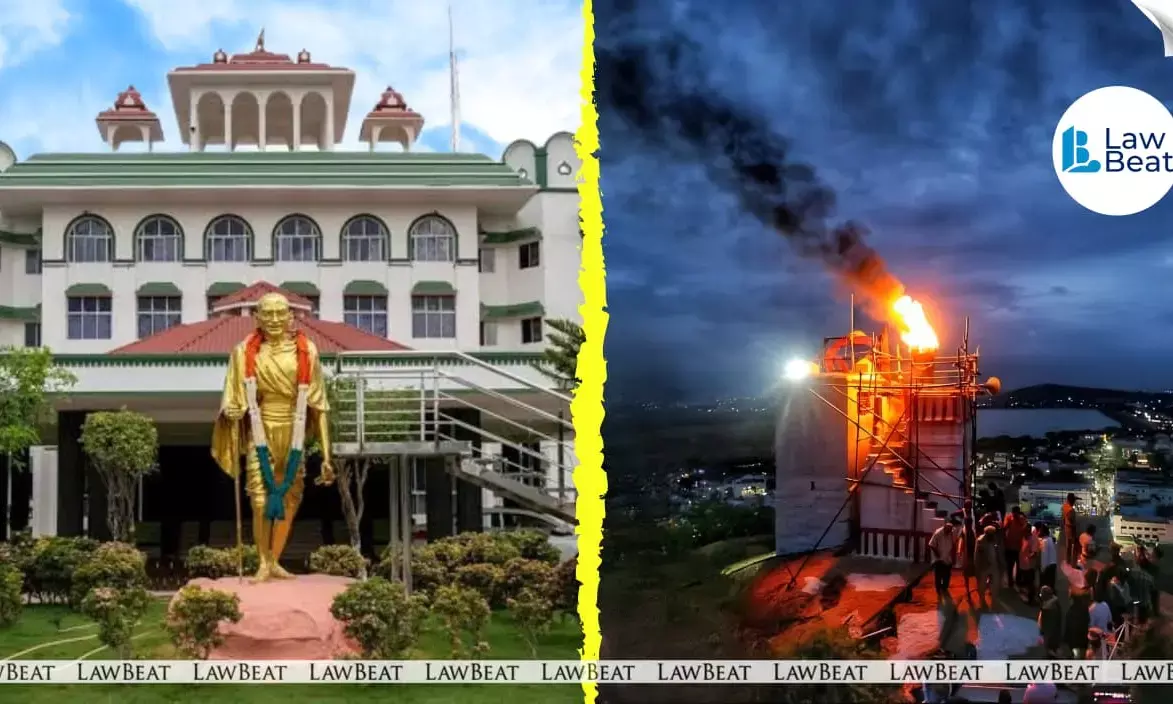
Madras High Court hears arguments on HR&CE department's authority to oppose Thiruparankundram Deepam lighting
The Madras high court on Tuesday continued hearing a batch of appeals challenging a single judge order that permitted lighting of a lamp at a stone pillar, described as “Deepathoon”, on Thiruparankundram hill during the Karthigai Deepam festival, with post-lunch submissions focusing on whether the Hindu Religious and Charitable Endowments (HR&CE) Department had the authority to oppose the ritual when the temple administration itself had taken no such stand.
After the break, one of the counsel for the original writ petitioners, Senior Advocate Guru Krishna Kumar mounted a detailed defence of the order passed by Justice G.R. Swaminathan, arguing that the State had wrongly projected the issue as one of law and order and communal harmony, while sidelining the role of the Devasthanam, which alone was competent to decide whether permission for lamp lighting should be granted.
Counsel identified four broad aspects for the court’s consideration: the existence of a custom of lighting a lamp at the disputed location, the controversy surrounding the precise site and structure referred to as Deepathoon, the nature of the right asserted before the single judge and its alleged mischaracterisation as a property claim, and the stand taken by the Executive Officer coupled with the argument that an alternate civil remedy ought to have been pursued.
Rejecting the State’s claim that there was never any such practice, counsel submitted that the long history of litigation itself belied that assertion. According to him, repeated disputes dating back to the 1920s demonstrated that lamp lighting at or near the stone pillar had been a recurring issue, making it untenable for the State to deny the existence of any such custom altogether.
A central plank of the submissions was that earlier decrees allowed devotees to approach temple authorities for permission to light the lamp at designated places. Counsel posed the question of what remedy would be available to devotees if such permission was denied, particularly when courts had already recognised a framework for seeking such approval.
Counsel then turned to what he described as the State’s excessive control over temple affairs. He submitted that under the guise of regulation, the State had gradually taken over every aspect of temple administration across Tamil Nadu. In the present case, he pointed out, the temple trustee and board were not even impleaded before the single judge, yet the entire State machinery appeared and opposed the prayer for lamp lighting.
“It was the HR&CE Department, not the temple, that told the single judge that the lamp could not be lit at the stone pillar. The Department had no authority to take that position,” counsel argued, stressing that the decision lay with the temple administration and not with the State.
The submission found resonance in the bench’s observations. Justice G. Jayachandran noted that multiple representations had earlier been made seeking permission to light the lamp at different locations and that the 1996 order had left the discretion with the Devasthanam. He observed that while the HR&CE Department disallowed lamp lighting at Deepathoon, the State also flagged law and order concerns, even though the competent authority had not taken a stand.
Counsel for the respondents responded that the Devasthanam’s silence before the single judge was precisely the problem, and that the authority competent to decide the issue was neither impleaded nor heard.
On the allegation that lamp lighting at Deepathoon would infringe Dargah's rights, counsel relied on the single judge’s recording that the pathway forks, with one route leading to the dargah and another towards the rocks to reach Deepathoon, involving use of only a few steps. He questioned the invocation of communal harmony when one community used hundreds of steps daily, while objection was raised to the other using a handful.
Counsel also argued that apprehension of breach of peace could not, by itself, defeat a fundamental right under Article 25 of the Constitution. Maintaining public order, he said, was the State’s responsibility, and mere apprehension could not be a ground to deny religious practice. He added that the 1996 order, which permitted lamp lighting at locations at least 15 metres away from the dargah, had never been challenged and that the single judge’s order was only in continuation of that settled position.
As the hearing progressed, Justice Jayachandran observed that the dispute had resurfaced every decade since 1862 and indicated that while the impugned judgment would be examined on merits, the bench was also conscious of the need to give the issue a “final quietus”, be it by mediation. The hearing is to continue tomorrow.
Case Title: The Executive Officer, Arulmigu Subramanian Swamy Temple, Thirupparankundram, Madurai vs. Rama Ravikumar and Others with connected matters
Hearing Date: December 16, 2025
Bench: Justices G Jayachandran and K K Ramakrishnan