
‘Law Is A Long-Drawn Game’: CJI Surya Kant Urges Graduates To Choose Integrity Over Instant Success
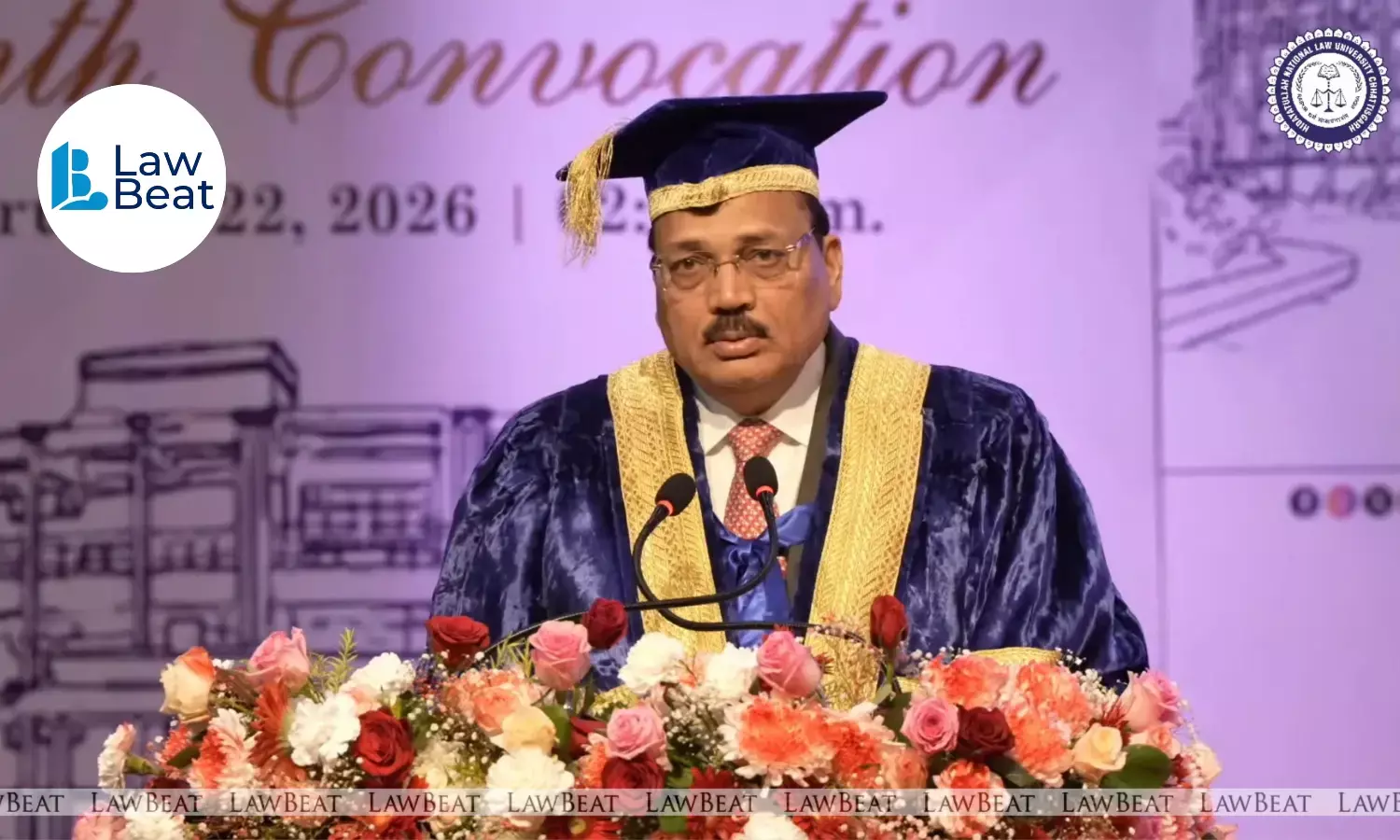
Chief Justice of India Surya Kant addressing students at the ninth convocation ceremony of Hidayatullah National Law University in Raipur
Chief Justice of India Surya Kant on Sunday called upon graduating law students to anchor their careers in collaboration, patience and professional integrity, stressing that enduring success in the legal profession flows from sustained commitment rather than short-term achievement.
Delivering the convocation address at the ninth graduation ceremony of Hidayatullah National Law University in Raipur, the CJI told students that they were stepping into a professional journey defined as much by responsibility and uncertainty as by opportunity. The true measure of progress, he said, would lie not in early recognition but in the ability to work with others while upholding ethical standards over time.
Addressing graduates, faculty members and families, the CJI observed that legal education often cultivates competition through examinations, rankings and placements. The profession itself, however, rests on cooperation.
“While legal education often emphasises competition through examinations, rankings and placements, the legal profession itself is sustained by cooperation,” he said.
Drawing an analogy between the justice system and a river fed by many tributaries, the CJI explained that the administration of justice is a collective enterprise. It depends on the contributions of juniors and seniors at the Bar, colleagues in chambers, court staff and even opposing counsel. No lawyer, he suggested, builds a credible career in isolation.
He urged graduates to treat their peers with respect, fairness and empathy, noting that today’s classmates would tomorrow become colleagues, adversaries in court and, in some instances, members of the judiciary. Professional relationships formed early in one’s career often shape long-term trajectories.
Sharing an anecdote from his own early years at the Bar, the CJI recalled assisting a fellow lawyer without any expectation of personal gain. That gesture, he said, resulted in enduring professional trust and collaboration. Such acts of goodwill, he emphasised, strengthen not only individual careers but also the institutional credibility of the legal profession.
Describing law as a “long-drawn game,” the CJI cautioned graduates against measuring success through immediate milestones. Authority, reputation and trust, he noted, are built gradually over decades of consistent effort.
He acknowledged that the initial years of legal practice can feel slow and uncertain, particularly when compared with other professions where advancement appears more rapid. Yet, he said, that formative phase is indispensable. It is during this period that young lawyers gain an understanding of court functioning, develop legal reasoning skills and learn the nuances of client engagement.
“The early years in practice may feel slow and uncertain,” he observed, “but the foundational learning during this period is critical for long-term success.”
Encouraging graduates not to judge their progress through short timelines, the CJI underscored that consistency, diligence and integrity ultimately earn enduring respect within the legal community. Comparing career growth to the construction of a building, he remarked that unseen foundations determine future strength. What may not be immediately visible in the early stages often becomes the bedrock of later achievements.
He advised the graduating class to support one another, remain connected to the professional community and approach their responsibilities with seriousness, while also maintaining balance in life.
Notably, in December 2025, while delivering the convocation address at the first graduation ceremony of Dr. B.R. Ambedkar National Law University, Sonipat, CJI Kant said that the legal profession today stands at a point where its relevance is unquestioned, yet the expectations from it are increasingly demanding.
“You enter the profession at a time when its relevance is unquestioned, but its expectations are demanding, shaped by technological disruption, economic complexity, expanding rights discourse, and heightened public scrutiny,” the CJI had said.
Emphasizing perseverance over impatience, the CJI reminded young advocates that early recognition is not the measure of a successful career in law. “Many of the finest lawyers and judges did not begin with certainty or advantage. Their growth was gradual, shaped by patient preparation and composed perseverance. What distinguished them was not early acclaim but consistency,” he had observed.
Also, addressing the 7th Convocation Ceremony of the Rajiv Gandhi National University of Law (RGNUL), Patiala, the CJI had cautioned against reducing law to a narrow, transactional pursuit focused only on procedure and outcomes. “This certainly produces competent practitioners, but it does not necessarily produce nation builders,” he said, drawing a sharp distinction between lawyers who merely build cases and those who shape society.
Speaking to a graduating cohort of law students, Justice Kant said that while ambitions of arguing landmark cases, drafting complex contracts, or appearing before constitutional benches were legitimate, young advocates must ask a more enduring question. “What is the role of the lawyer in a nation like India, at this moment in its history?” he had asked. The CJI had urged the young lawyers to look beyond winning cases and billing hours, reminding them that the legal profession carries a far deeper responsibility towards the nation and its constitutional future.
Convocation Date: February 22, 2026