
Thiruparankundram Deepam Row | 'People Want To Have Darshan'; Police Bandobast Shouldn't Come In Way Of Religious Rights: Madras HC
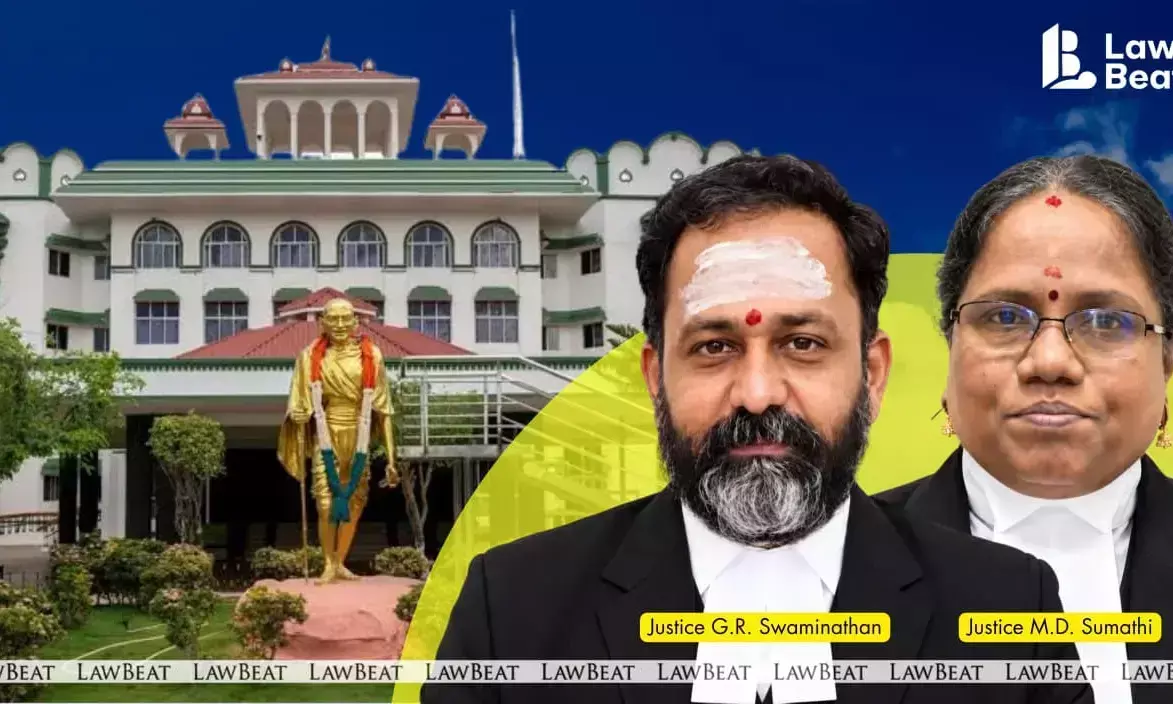
Supreme Court had recently allowed Deepam at Thirupparankundram Deepathoon only for November 24, recognising no customary right.
In an urgent hearing, the Madras High Court on Tuesday orally remarked that the police restrictions imposed by the Madurai district administration on devotees seeking to visit Thiruparankundram during the Karthigai Deepam celebrations, observing that the security/Bandobast arrangements should not obstruct the exercise of religious rights under Article 25 of the Constitution.
"Everybody would like to go for Girivalam, be present, and have darshan when the lamp is lit. By passing this Section 163 order, everything is sought to be collapsed. Let the police bandobast be there in full force, but let them not come in the way of exercising one's religious rights", a Bench of Justice G.R. Swaminathan and Justice M.D. Sumathi remarked.
The Court was hearing a batch of petitions challenging the prohibitory order issued by the Madurai District Collector under Section 163 of the Bharatiya Nagarik Suraksha Sanhita (BNSS), which petitioners alleged had effectively prevented people from entering Thiruparankundram and undertaking religious activities.
During the hearing, Justice Swaminathan emphasised that the Supreme Court's November 20 interim order permitting the lighting of the lamp at the disputed Deepathoon on a one-time basis dealt with the ceremony at the hilltop site. The restrictions imposed by the Supreme Court in that regard, he indicated, should not be extended to curtail other religious activities in the wider area.
"There are two aspects: one is lighting the lamp at the hilltop. The Supreme Court has dealt only with that. In fact, all the restrictions were placed regarding what happens at the site—that line we have to underline," the judge observed.
He added: "Now, the petitioners here are concerned with their fundamental right - everybody would like to go for Girivalam, be present, and have darshan when the lamp is lit. By passing this Section 163 order, everything is sought to be, to use a colloquial expression, collapsed. Let the police bandobast be there in full force, but let them not come in the way of exercising one's religious rights. Only for that."
The Court had directed Madurai District Collector Nishant Krishna to appear physically before it before taking up the petitions. Senior Advocate Gopal Sankaranarayanan appeared for the Collector.
Petitioners allege blanket restrictions on entry, arrests of devotees
The petitioners challenged the Section 163 BNSS order, contending that it imposed sweeping restrictions on entry into Thiruparankundram, including on devotees seeking to undertake Girivalam and have darshan.
One of the counsel submitted that local residents traditionally undertake Girivalam on every Pournami and that the prohibitory order had prevented them from continuing the practice. The petitioners also pointed out that the reports relied upon by the District Collector to issue the order were dated November 16 and 19, both preceding the Supreme Court's November 20 order.
They alleged that the Collector had relied on those earlier reports to impose a blanket prohibition on processions and other activities, and that people arriving from different places had been arrested.
The Bench sought to clarify the central grievance. Justice Swaminathan asked one of the petitioners' counsel whether the apprehension was that, under the guise of enforcing the Section 163 order, the authorities would prevent devotees from entering Thiruparankundram and exercising their fundamental right under Article 25.
When counsel agreed, the judge said that the same concern had been raised by the other petitioners and cautioned against repeatedly making the same submission.
Another counsel referred to the Madurai City Police's bandobast scheme, which stated that between 6 pm and 6.30 pm, when the lamp was to be lit, only authorised persons, including temple representatives and government officials, would be permitted at the site.
The petitioners contended that the restrictions were being applied beyond the area where the Supreme Court had confined public access during the ceremonial lighting.
'We cannot overreach Supreme Court's orders'
The Bench repeatedly clarified that it would neither interpret nor overreach the Supreme Court's November 20 directions.
When a counsel sought directions for the deployment of the CRPF, Justice Swaminathan pointed out that the Supreme Court's order provided for such assistance if the State Government sought it. Since the State had not made such a request, the High Court could not intervene on that aspect.
"If the State Government has not sought it, we obviously cannot step in here. We will not overreach the Supreme Court's orders. We will not. If the State Government hasn't sought it, why should we even talk about CRPF? " the judge said.
The Bench also acknowledged that the State was entitled to seek a review of the Supreme Court's order. When a petitioner questioned the State's decision to move a review petition while allegedly relying on the same order to impose restrictions, Justice Swaminathan said: "They are entitled to file a review. We can't stop them".
Bench questions alleged differential treatment of protesters and devotees
The petitioners further argued that persons openly calling for non-compliance with the Supreme Court's order were being allowed to speak, whereas devotees seeking to visit the temple were allegedly being detained.
Justice Swaminathan described this as a "point well taken" and put the grievance to the Collector's counsel: persons calling for the Supreme Court's order to be defied were being allowed to exercise their freedom of speech, while those seeking to exercise their Article 25 rights had allegedly been arrested.
Senior Advocate Gopal Sankaranarayanan initially said he did not have details of the alleged arrests and would obtain instructions if the names were provided.
The judge, however, referred to one specific instance, stating that Advocate Kutrananathan of Tirunelveli had been arrested that morning. Petitioners' counsel said they could provide several other names.
Sankaranarayanan submitted that any grievance concerning the implementation of the Supreme Court's order, including police action and preventive detention, should ideally be raised before the Supreme Court, which was already seized of the dispute. He argued that the Section 163 order had also been issued in pursuance of the Supreme Court's directions and that questions about the steps taken by the authorities were implementation-related issues.
He also submitted that if either group, those protesting against the Supreme Court's order or those supporting it, interfered with its implementation, they should be treated on an equal footing.
Referring to the Supreme Court's November 20 order, Sankaranarayanan read out the provision stating that no member of the general public could accompany the authorised team for the lamp-lighting ceremony and that no procession, public congregation, demonstration, slogan-raising or activity extraneous to the ceremony would be permitted at the site.
He also referred to the Supreme Court's description of the arrangement as a " limited, one-time measure, subject to stringent safeguards ", and clarified that the permission did not recognise any asserted right or establish a customary religious practice.
Article 144: 'We are entitled to command officials to obey Supreme Court'
Justice Swaminathan said the petitioners' apprehension arose from the possibility that the Supreme Court's directions concerning the Deepathoon ceremony could be used to prevent the exercise of religious rights elsewhere in Thiruparankundram.
The judge referred to Article 144 of the Constitution, which requires all civil and judicial authorities in the territory of India to act in aid of the Supreme Court. He said the High Court could direct the District Collector, Commissioner of Police and Temple Board to ensure compliance with the Supreme Court's directions without interpreting or travelling beyond them.
"We can't overreach the Supreme Court's orders, we can't interpret Supreme Court orders. But we are entitled to command the District Collector, the Commissioner of Police, and the Temple Board that you will obey what the Supreme Court directed. That we are entitled to say " he observed.
The judge also referred to the apprehension of a repeat of last year's events, when the implementation of the High Court's directions had led to further proceedings. He said the petitioners did not want the Supreme Court's one-time arrangement to be rendered infructuous.
The Bench indicated that it intended to refer to a Supreme Court judgment recognising that a writ petition could be maintained to enforce a judicial order.
For his part, Sankaranarayanan informed the Court that the district administration had held meetings with revenue authorities from November 20 onwards, conducted coordination and review meetings, and consulted officials of the Archaeological Survey of India. He also said that the materials required for the lamp-lighting ceremony had been procured by November 23.
The Supreme Court's November 20 order had permitted the ceremonial lamp to be lit at the Deepathoon on November 24 as a one-time arrangement, while restricting access to the site to an authorised team and necessary officials. It had also directed the District Collector to submit a compliance report within three days after the festival. The arrangement was expressly not to be treated as recognition of an established custom or an enforceable right for subsequent years.
The High Court thereafter asked the parties to consider the concerns raised during the hearing and posted the matter for further hearing at 4 pm. The officials were exempted from appearing in person again.