
‘40% Women In Trial Courts, But Hardly Any In Supreme Court’: Former CJI NV Ramana Raises Gender Imbalance In Judiciary
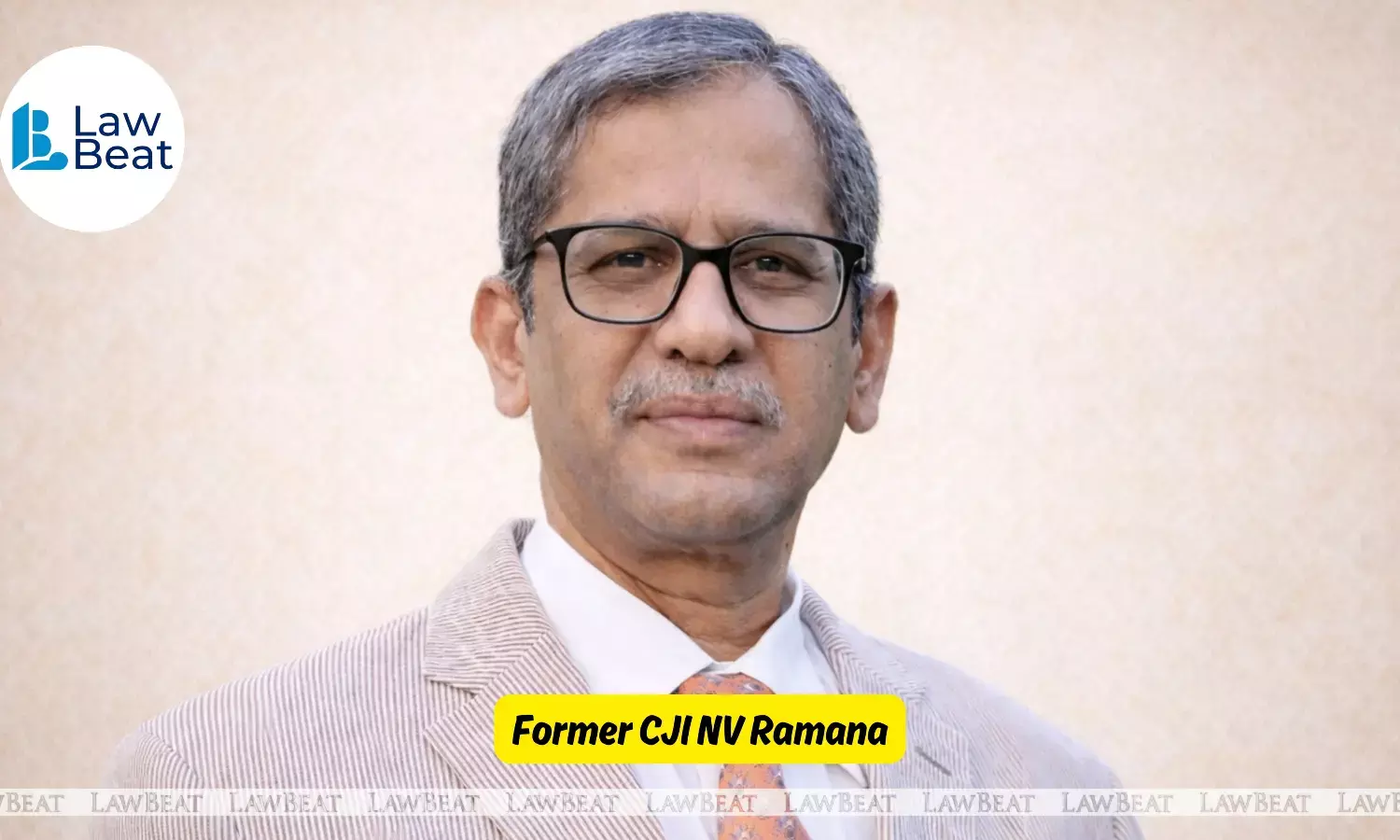
Former Chief Justice of India NV Ramana spoke about the lack of gender parity in the higher judiciary during the Indian Women in Law conference at the Supreme Court on International Women’s Day
Former Chief Justice of India N. V. Ramana on Sunday said that the government lacked sufficient intent and determination to ensure gender parity in constitutional courts, even as women account for nearly 40 percent of the judiciary at the trial court level.
Justice Ramana made the remarks during an interactive session at the first national conference of Indian Women in Law (iWiL) held at the Supreme Court of India, coinciding with International Women's Day.
Highlighting the disparity in representation, the former CJI observed that while women have made significant inroads at the lower levels of the judiciary, their presence remains disproportionately low in the higher judiciary, particularly in the High Courts and the Supreme Court.
“The government always showed a casual attitude in appointments of women as judges of the Supreme Court and High Courts,” Justice Ramana said during the question-answer session.
During Justice Ramana’s tenure as Chief Justice from April 2021 to August 2022, three women judges were appointed to the Supreme Court, a development widely regarded as historic.
On August 31, 2021, Justices Hima Kohli, Bela M. Trivedi and B. V. Nagarathna took oath as judges of the apex court.
However, no other woman judge has been appointed to the Supreme Court since then, despite the change of leadership through five successive Chief Justices: U. U. Lalit, D. Y. Chandrachud, Sanjiv Khanna, B. R. Gavai and the current CJI Surya Kant.
Interestingly, Justice B. V. Nagarathna is slated to become the first woman Chief Justice of India on September 24, 2027.
Speaking in Justice Nagarathna’s presence, Justice Ramana remarked that two future Chief Justices were present at the event, Justice Nagarathna and Justice P. S. Narasimha, who is expected to succeed her.
He expressed hope that during their respective tenures, at least seven to eight women judges would be appointed to the Supreme Court.
Responding to the remark, Justice Nagarathna assured him that she would make sincere efforts to increase the representation of women in the apex court.
Justice Nagarathna is scheduled to retire on October 29, 2027.
Explaining his observation regarding the government’s lack of intent, Justice Ramana said successive Union law ministers had often written to Chief Justices of High Courts requesting them to recommend women advocates and judicial officers for appointment as High Court judges.
However, he added that the government had not strongly insisted on ensuring effective representation of women in those recommendations.
Justice Ramana also pointed to the stark numerical imbalance in the higher judiciary. While women constitute about 40 percent of judicial officers in the subordinate judiciary, their numbers are significantly lower in constitutional courts.
Across High Courts, there are only 116 women judges against a sanctioned strength of 1,122. In the Supreme Court, which has a sanctioned strength of 34 judges, there is currently only one woman judge.
The former CJI said it would be unfair to place the entire responsibility for the skewed representation solely on the government. “The judiciary must respond with sincerity towards inclusivity as there is no dearth of talented women lawyers who can be High Court judges,” he said.
Justice Ramana added that most major metropolitan centres have a large pool of highly competent women lawyers capable of serving on the High Court bench.
“Except for a few High Courts, in most major metropolitan centres there exists a large pool of highly competent women lawyers. It is very worrisome why these numbers are not reflected in judicial appointments,” he said.
In a related news, Chief Justice of India Surya Kant had also called on High Court collegiums across the country to take proactive steps to increase women’s representation on the Bench, urging them to actively consider more women advocates for judicial appointments.
Speaking on the occasion of International Women's Day, the CJI had also cautioned collegiums against mechanically rejecting potential candidates solely because they do not strictly meet the prescribed age criteria.
Delivering the keynote address at the iWiL Conference organised by Senior Advocates Pavani Mahalakshmi and Shobha Gupta on the theme “Half the Nation, Half the Bench,” the Chief Justice stressed that the judiciary must take concrete measures to improve women’s representation. “High Court collegiums must recognize that the moment for measured action is not in the future, it is now,” he said. When suitable women members are available at the Bar, their consideration “should not be an exception but a norm,” he had added.