
Ex-CJI Chandrachud on Umar Khalid: 'If expeditious trial not possible, grant bail'
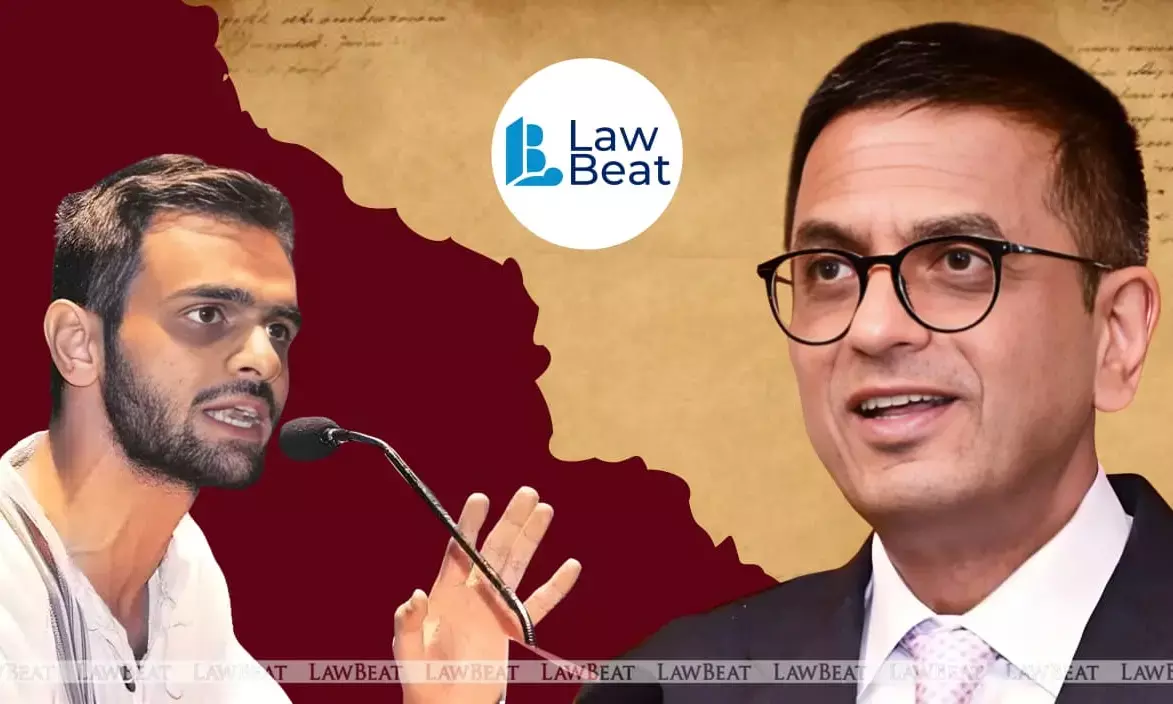
Supreme Court recently denied bail to Umar Khalid and Sharjeel Imam in the Delhi Riots case while holding that they stood on a “separate footing” from other accused in the case.
Former Chief Justice of India DY Chandrachud has said that if an expeditious trial is not possible in a case, then bail should be the rule and not the exception. Justice Chandrachud made this statement in response to a question posed before him by Vir Sanghvi at the Jaipur Literature Festival on January 20 2026, on Umar Khalid being denied bail by the Supreme Court recently.
On January 5, 2026 the Supreme Court had denied bail to Umar Khalid and Sharjeel Imam in the Delhi riots larger conspiracy case, holding that a prima facie case under the Unlawful Activities (Prevention) Act (UAPA) was made out against them. The Bench of Justices Aravind Kumar and N.V. Anjaria held that the statutory bar on grant of bail under Section 43D(5) of the UAPA was attracted in the case of Khalid and Imam, and therefore their continued incarceration could not be interfered with at this stage.
At the Literature Festival Sanghvi questioned Justice Chandrachud on why Umar Khalid should still be in jail even after five years with no kind of trial taking place. "Can you explain what the Supreme Court's position now is, or what the legal position should be?", Sanghvi asked.
At the outset, the former Supreme Court judge claimed that he was speaking as a citizen and not as a judge. He then stated that bail before conviction should be a matter of right because our law is founded on one presumption and that's the presumption of innocence, that every accused is presumed to be innocent until they are proved guilty at a trial.
"Pre-trial bail cannot be a form of punishment because if someone is in jail for say 5 years or 7 years as an under trial and then is finally acquitted, how do you compensate for the lost time? Yeah. When do you when do you deny bail to an accused? I'll give you a very simple example and then answer your question. Go ahead. Suppose you have a serial rapist and a murderer who has been arrested on the allegation that that person has committed say six or seven rapes and murders. There's a danger that if you let that person out into society, that person might repeat the offense. So this is a classic case where you would deny bail where there is a danger that a person after being released on bail would commit the same offense. Second, a second exception where a person on being released on bail wouldn't be available to face trial, that is leave the Indian jurisdiction and escape out. That's a valid reason to deny bail. The third, a person who would tamper with evidence at the trial. If these three exceptions are not made out, bail has to be the rule," Justice Chandrachud went on to explain.
Referring to the problem faced by courts today, former CJI Chandrachud said, a lot of our laws, particularly those relating to national security, have turned the law on its head by substituting the presumption of innocence with almost a presumption of guilt. He added that the court is duty bound to carefully scrutinize as to whether national security is involved and whether the detention of the accused is proportional to the plea for national security.
Further answering the question posed to him, Justice Chandrachud said that laws enacted by parliament are tributaries which follow from that source and therefore ordinary laws must yield to the constitution. I'm very clear in my mind that unless the well settled exceptions are made out in a particular case the accused is entitled to bail, he added.
When Sanghvi asked Justice Chandrachud if he would have given Khalid bail if the case had come up now, the former judge said, "Well, you know, it's wrong of me to presume what I would have done...You know, it's easy to sit outside the court. Having said this, you know, judges, let me also be fair in the court judges have to look at the record of a particular case and then see what the kind of evidence there is, what kind of material there is before the court. So therefore I think, as a judge who has sat in the hot seat for 25 years be slow to criticize merely because I have a difference of opinion on this one...".
Notably, last year in September, Justice Chandrachud had questioned the narrative set by a particular segment of the society over the bail plea filed by Umar Khalid, accused in the Delhi riots larger conspiracy case. Throwing light on the adjournments sought by Khalid's counsel, Justice Chandrachud has said, "I do not want to comment on the merits of the case but I must tell you one thing which is lost sight by a lot of people when it comes to Umar Khalid‘s case, can you imagine that the case was adjourned, they were at least seven if not more adjournments which were sought by the council appearing for Umar Khalid and eventually the application for bail was withdrawn.".
In an interview, the former Chief Justice of India had asked what is to be said about such actions of a lawyer appearing for the accused who repeatedly ask for adjournment of cases before a judge and then withdraw a case. "Can then a segment of the bar or civil society say, or the must be at least told that look at the record. Here was a case where someone appearing for the accused has repeatedly short time before the court. Why this reluctance to argue a case? Either you argue it on the first day, or you say that I don’t want to press my application for bill, I will reserve my application for bail before the High Court or before the district court as the case may be. But in Umar Khalid‘s case itself the record it seems to show that repeated applications for adjournment was made before the court", ex-CJI Chandrachud had added.