
Sabarimala Reference| Visiting Temples Not Mandatory To Remain Hindu: Supreme Court
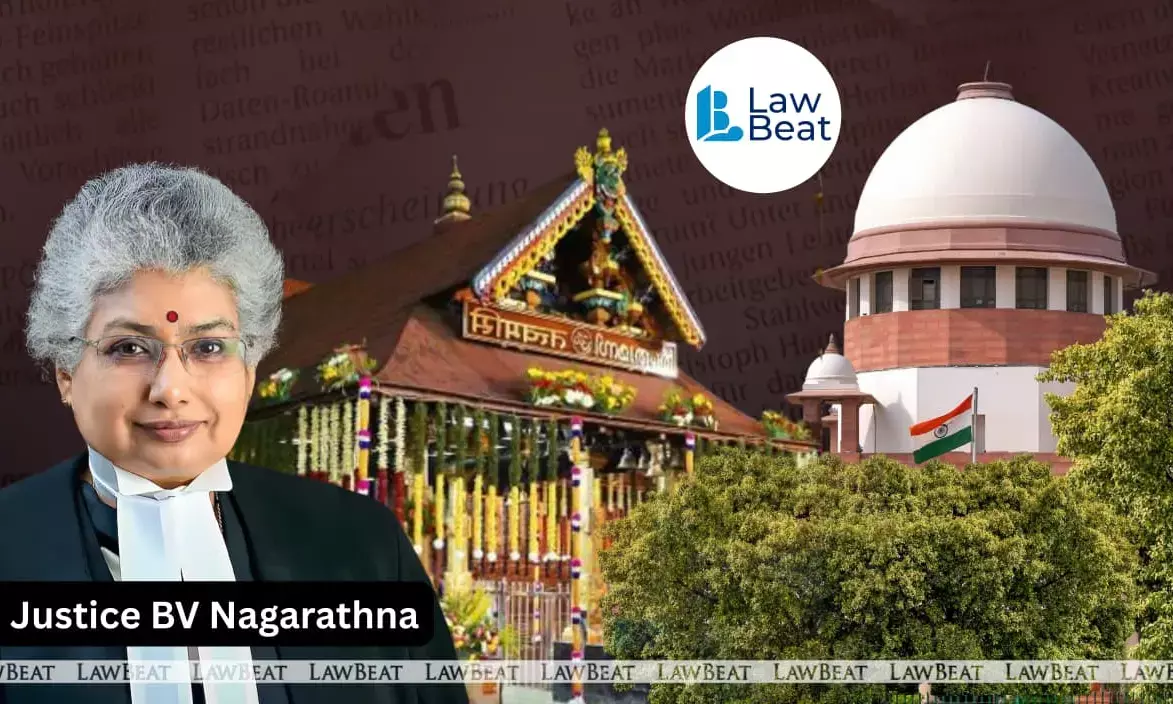
Supreme Court hears Sabarimala reference on Hindu faith and temple rituals.
The Supreme Court on Wednesday observed that Hinduism is “a way of life” and said that visiting temples or performing rituals is not mandatory for a person to remain Hindu, as a nine-judge Constitution Bench continued hearing the reference case arising out of the Sabarimala temple entry issue and questions concerning religious freedom.
Justice BV Nagarathna, during the hearing, remarked that a Hindu need not necessarily visit a temple or perform rituals to profess the faith.
“Nobody can come in the way of people having their faith,” she observed, while stressing that Hinduism has often been understood as a way of life.
The remarks came in response to submissions made by advocate Dr G Mohan Gopal, appearing for one of the intervenors, who questioned earlier judicial definitions of Hindu identity. He argued that courts had wrongly assumed in 1966 that all Hindus accept the Vedas as the highest authority in religion and philosophy. While expressing respect for the Vedas, he argued that not every Hindu today necessarily holds that belief.
Chief Justice of India Surya Kant, who is heading the nine-judge Bench, also orally observed that even lighting a lamp at home could be enough to express one’s religious belief.
The Bench, also comprising Justices MM Sundresh, Ahsanuddin Amanullah, Aravind Kumar, Augustine George Masih, Prasanna B Varale, R Mahadevan and Joymalya Bagchi, is hearing issues relating to exclusionary religious practices, including the Sabarimala controversy and matters concerning the Dawoodi Bohra community.
The observations came on the 15th day of hearings before the Constitution Bench examining larger constitutional questions referred after the Supreme Court’s 2018 verdict permitting entry of women of all age groups into the Sabarimala temple in Kerala.
In the 2018 judgment, a five-judge Constitution Bench had, by a 4:1 majority, struck down the centuries-old practice barring women between the ages of 10 and 50 from entering the shrine, holding the restriction unconstitutional. Subsequently, several review petitions were filed, leading the top court in 2019 to refer broader questions relating to essential religious practices, denominational rights and the interplay between equality and religious freedom to a larger bench.
During the ongoing hearings, the Bench has repeatedly engaged with questions on the scope of Articles 25 and 26 of the Constitution, the autonomy of religious denominations and the extent to which courts can examine religious customs.
Earlier, the Bench has also discussed whether every religious practice could be subjected to constitutional scrutiny. Court also observed that every religious institution must function within a framework of norms and regulations, and that the right to manage religious affairs cannot translate into “anarchy”.
The hearing in the matter is continuing.
Case Title: Kantaru Rajeevaru Vs Indian Young Lawyers Association Thr. Its General Secretary Ms. Bhakti Pasrija And Ors
Bench: CJI Surya Kant, Justices B V Nagarathna, MM Sundresh, Ahsanuddin Amanullah, Aravind Kumar, AG Masih, R Mahadevan, Prasanna B Varale and Joymalya Bagchi
Hearing Date: May 13, 2026