
Social Media Ban For Children Under 13: Supreme Court Issues Notice On Indore School's Plea
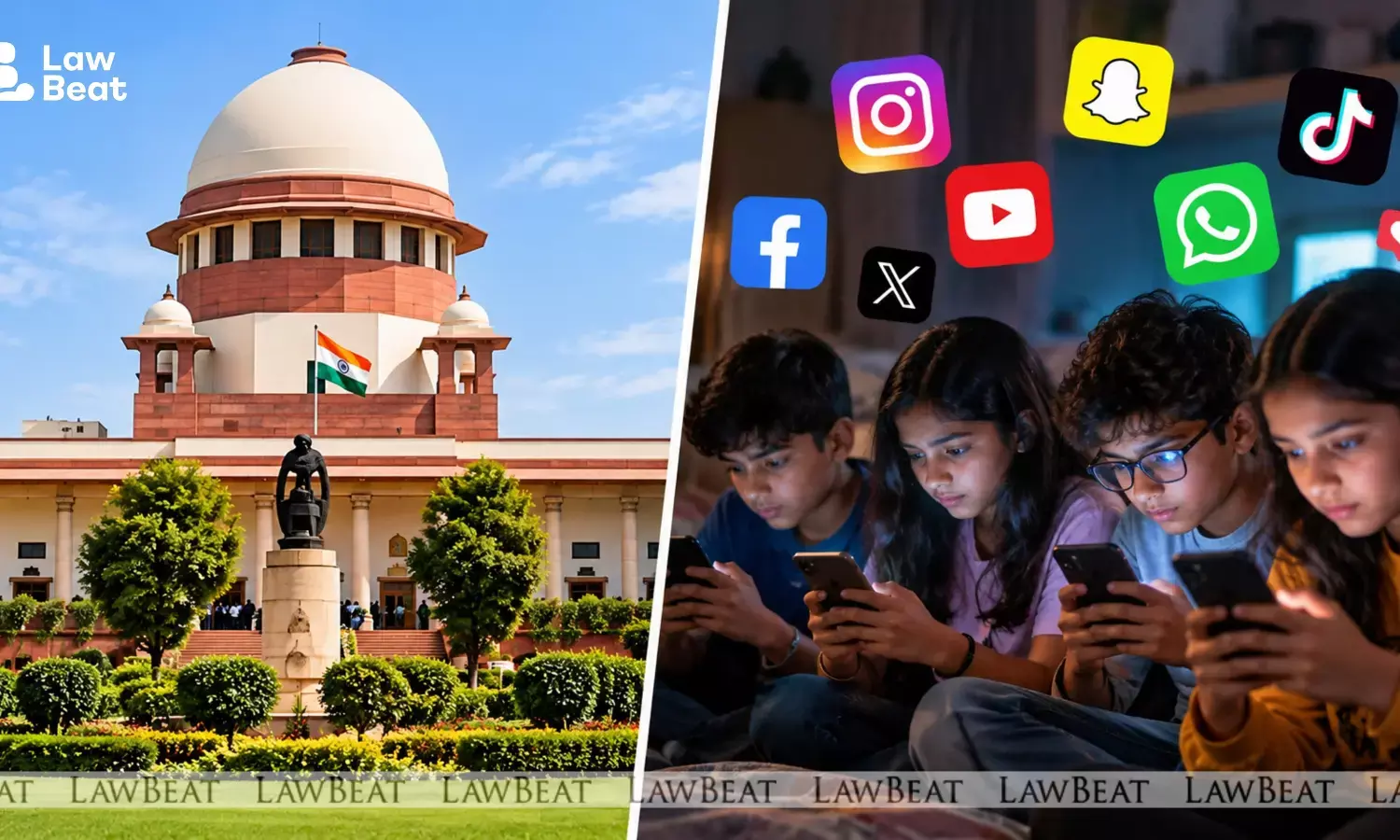
Emerald Heights International School, Indore, and its director of academics, Siddharth Singh Girnar, have filed a public interest petition under Article 32 in the Supreme Court seeking a regulatory framework for children's access to social media platforms
The Supreme Court bench comprising CJI Surya Kant and Justice Bagchi today issued notice in a PIL by an Indore School seeking directions to the Centre to put in place a binding child-safety framework for social media..
"Children in India are signing up for social media platforms that verify nothing beyond a self-declared date of birth, while the same children cannot buy liquor, tobacco or acid and cannot watch adult content on an OTT platform without an age check," the plea states.
The petition has been filed under Article 32 by Emerald Heights International School, a co-educational day-cum-boarding school in Indore affiliated to the CBSE, and its director of academics, Siddharth Singh Girnar. The school states it has about 4,115 students and stands "in the position of a guardian (in loco parentis)" to them.
The petition has been drawn by Advocates Khusbhu Jain, Mayank Singh Rawat and Zaid Ahmed, and filed through Advocate-on-Record (AoR) Vaibhav Choudhary.
The petitioners point out that the minimum age adopted by platforms is "at best, a self-imposed threshold of 13 years, generally based on self-declared age." They contend that this threshold "bears no correspondence to the protection accorded to children under Indian law", since the Digital Personal Data Protection Act, 2023 treats every person below 18 as a child.
According to the petition, children "including those well below 18 years are routinely exposed to social-media platforms that are not designed or operated as child-safe environments." The platforms, it says, "are structured to maximize attention, prolong engagement and monetize user behavior".
The school says its concern comes from what it has seen in its own classrooms and hostels: children below the stated age "holding and operating social-media accounts", children "being contacted by strangers", and children "coming to school sleep-deprived, distracted and unable to concentrate". It adds, "there is hardly a parent-teacher meeting in which parents do not express their anxiety over the hold which social media has come to have over their children."
The petitioners also argue that the absence of a central law has produced unequal protection, as Karnataka, Andhra Pradesh and Goa have announced their own measures with different age limits. A child in Karnataka, the petition says, "may be subject to one rule, a child in Andhra Pradesh to another with a different age limit, and a child in Madhya Pradesh to none at all, although all of them use the same platforms." It relies on Entry 31 of List I and Article 253 to argue that the subject belongs to the Union.
The petition places primary fault on the intermediaries. Relying on a 2021 study by the National Commission for Protection of Child Rights (NCPCR), it states that "37.8% of 10-year-old children surveyed had Facebook accounts", and alleges that the intermediaries "are aware of this and have chosen not to act, because more users mean more revenue for them."
It contends that features such as endless scrolling, autoplay, "streaks", "likes" and constant notifications act "with particular force on children", and that the resulting harm "is therefore not an accident but a consequence of how the product is designed." Where an algorithm pushes harmful content to a child who never searched for it, the petition argues, the intermediary "is not a mere passive carrier of third-party content but an active participant in the harm."
On safe harbour, the petitioners submit that an intermediary "that knowingly allows underage users, makes children's profiles visible to strangers and allows unknown adults to contact them cannot be said to have observed due diligence" under Section 79 of the IT Act and Rule 3(1)(b) of the IT Rules. They further argue that, since an agreement with a minor is void under Section 11 of the Indian Contract Act, the platforms are collecting children's data "without any valid legal basis."
The petition lists several gaps in the IT Rules, 2021. It points out that neither the IT Act nor the Rules prescribe a minimum age for opening a social media account or require parental consent. The expression "harmful to child" in Rule 3(1)(b) "is nowhere defined", and the duty under Rule 4(4) to use technology to detect child sexual abuse material "is only an 'endeavour' and is not mandatory."
It also proposes a graded model as a reasonable and proportionate measure: children below 13 would not hold accounts, children between 13 and 16 would have access only with "the verifiable consent and supervision of the parent or guardian and with child-safe settings", and those between 16 and 18 would have access subject to data protection and safeguards against harmful content. This, it says, is "far less intrusive than a complete prohibition" and satisfies the proportionality test in Modern Dental College and Puttaswamy.
Relying on foreign developments, the petition includes Australia's minimum age of 16, in force from December 10, 2025, under which access to about 4.7 million accounts of children below 16 was "reported to have been restricted" within about five weeks. They also refer to measures adopted or announced in France, Denmark, Spain, the United Kingdom, Brazil and the European Union.
The petitioners also cite the Union's own Economic Survey 2025–26 and a statement of the Union Minister dated February 17, 2026 that "age-based regulation has to be there", and argue that "inaction after acknowledging the danger is arbitrary". They say their representation of March 9, 2026 to the authorities has gone unanswered. The petition notes that the Supreme Court has already issued notice on a similar issue in Just Rights for Children Alliance v. Union of India.
Case Title: The Emerald Heights International School and Anothers v. Union of India and Others.
Bench: CJI Kant, Justice Bagchi
Hearing Date: October 16, 2026