
Supreme Court Directs Centre To Ensure Encroachment-Free Walking Space Along Every Road
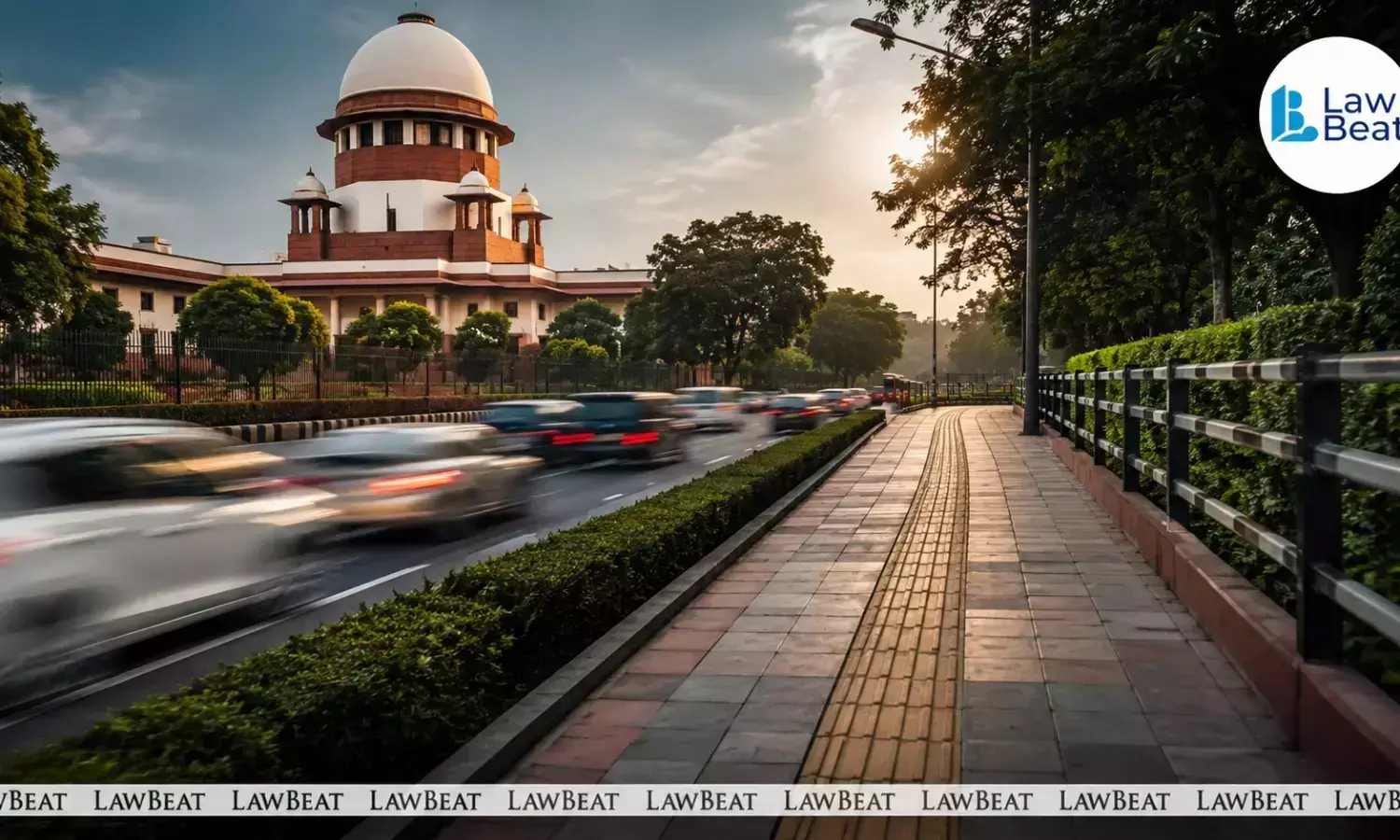
Supreme Court directed the Centre to ensure encroachment-free, properly demarcated walking spaces wherever roads exist
The Supreme Court on Monday directed the Union Government to ensure that every road in the country has a properly demarcated, encroachment-free space for pedestrians, reiterating that the right to walk safely cannot remain merely a constitutional promise.
The Bench of Justices P.S. Narasimha and Alok Aradhe asked the Centre to issue instructions to the concerned authorities to ensure that pedestrian spaces are clearly marked, protected from encroachments, and separated from lanes meant for motor vehicles.
Appearing for the Centre, Additional Solicitor General K.M. Nataraj was directed to communicate the Court's concerns to the appropriate authorities within two weeks.
Emphasising that the exercise did not require major infrastructure projects or significant expenditure, the Bench observed: "Without any big investment and construction, just ensure that proper demarcation is done of walkers' space. Wherever there is a road, there should be a walkers' space. Do it with a rope or anything and ensure it is not encroached."
The Court underscored that pedestrians must be able to walk with confidence, knowing that the designated space belongs to them and is free from the threat of moving vehicles.
The matter has been listed for further hearing after two weeks.
The directions come in continuation of the Supreme Court's landmark judgment delivered on June 19, in which it declared that the right to walk on a properly demarcated footpath is a fundamental right.
Why Did the Supreme Court Recognise the Right to Walk?
Court said walking is not merely a mode of travel but an essential part of life and personal liberty. It held that the right to walk flows from the constitutional guarantee of free movement under Article 19(1)(d), as well as the rights to life, expression, assembly and association under Articles 21, 19(1)(a), 19(1)(b) and 19(1)(c).
According to the Court, the Constitution protects not just the freedom to move, but also the ability to do so safely. Therefore, the right to walk necessarily includes access to dedicated footpaths.
Who Is Responsible for Providing Footpaths?
The Court said that recognising a fundamental right also creates a corresponding duty on public authorities. "If the road exists, there is a duty to ensure that there are demarcated and well-maintained footpaths for walkers," the Bench had said.
The responsibility lies with urban development authorities, municipal corporations, municipalities and panchayats, which must ensure that footpaths and other pedestrian infrastructure are properly constructed, maintained and protected. Court further held that citizens can seek constitutional and legal remedies, including compensation, if their right to walk on safe footpaths is violated. Such remedies would be independent of those available under the Motor Vehicles Act, 1988.
Tragedy That Led to the Case
The observations came while deciding an appeal arising from the death of a five-year-old boy who was fatally hit by a tanker while walking to school with his father. Recalling the incident, Court noted that the father had left home to drop his son at a nearby school, unaware that it would be their last walk together. The tanker struck the child from behind, crushing his lower body. He later succumbed to his injuries.
Court said such tragedies continue to occur because India has failed to adequately recognise and protect pedestrians' rights.
"Accidents like this continue to occur, perhaps they are inevitable till we restructure our rights regime as regards access to roads and recognise their correlative duties," it had observed.
Case Title: In Re: Fundamental Right to Walk and Footpath Vs Ministry of Housing and Urban Affairs
Bench: Justices P.S. Narasimha and Alok Aradhe
Hearing Date: August 3, 2026