
Supreme Court Directs Union of India, State Governments To Completely Ban Retail Sale Of Acid
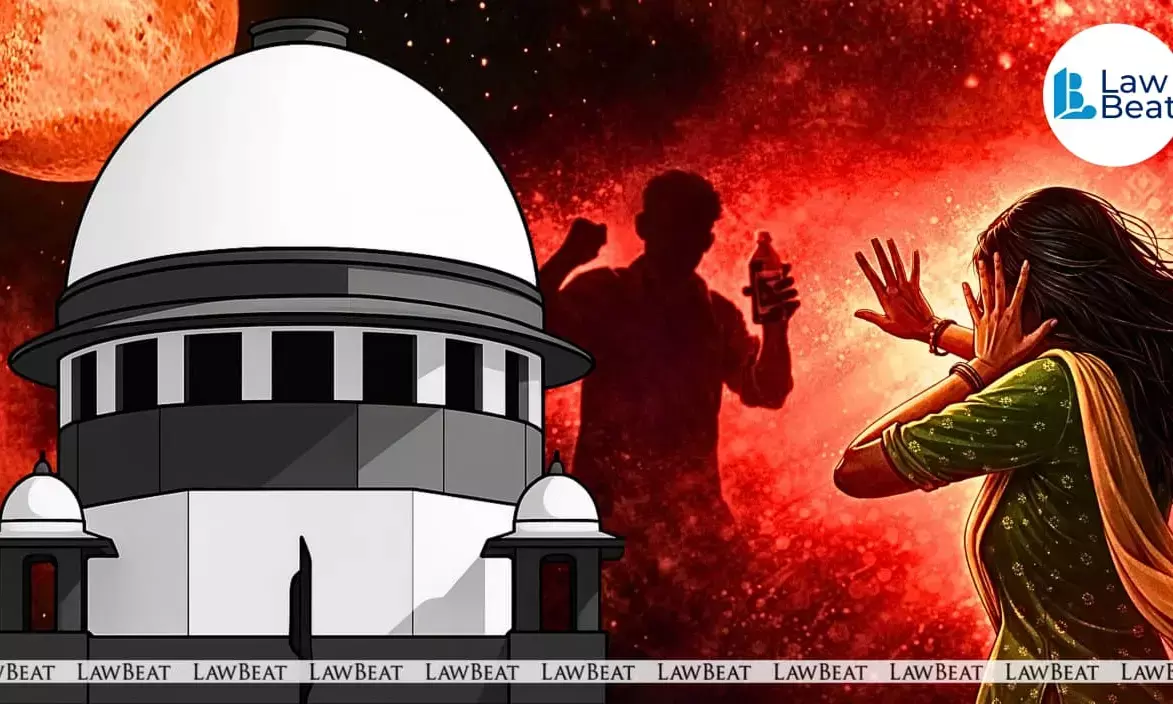
Supreme Court heard a PIL by Acid-attack survivor Shaheen Malik.
The Supreme Court has impressed upon the Union of India and the State Government to consider, through appropriate legislative or rule-making interventions, putting in place a comprehensive framework for regulating the sale of acid and preventing its misuse. A CJI Surya Kant led bench has called for complete ban on retail sale of acid by private persons, including through online or door-delivery platforms.
The bench has further said retail sale of acid for medical purposes may be permitted only through medical stores or pharmacies attached to Government hospitals, and only upon obtaining the prior written approval of the Chief Medical Officer or the Civil Surgeon, as the case maybe.
"Every such sale may be made against a prescribed Form recording the particulars of the buyer, including Aadhaar or any other Government-issued photo identity, the quantity and purpose of purchase, their address and contact details for easy identification. The Form shall carry a declaration that the acid shall be used solely for the stated purpose, with the buyer being made liable, in accordance with law, for its diversion or misuse. The abovementioned diversion shall include misuse by any other person, whether with or without the knowledge of the buyer, making the buyer vicariously liable for such misuse. The Form may further require particulars of the immovable property of the buyer, which may be attached, in accordance with law, in the event of misuse of the acid so purchased, for treatment and/or compensation of the victim(s)," the order issued on November 23rd adds.
Furthermore, court has directed the Union of India, through the Ministry of Education and the Ministry of Health and Family Welfare, to consider the desirability of constituting an Expert Committee, in consultation with the NCERT, the UGC, the National Medical Commission, National Legal Services Authority, the National Commission for Women, the State authorities, burn-care experts and survivor-led organisations, to develop a model module of educational material on acid attack prevention, emergency response and the rights of survivors, in school and college curricula.
In August, the Supreme Court had sought a response from the Centre on whether a complete ban on the retail sale of acid should be imposed or not.
The Supreme Court's order was prompted by submissions made before it by an acid attack survivor who told court, "Government aati hai, bolti hai hum kaam karenge but kuch hota nhi hai..aur kitni ladkiyon ki zindagi kharaab hogi? Humare NGO mei ek ladki hai..uski dono aankhen chali gyi..uska kya career ho sakta tha..padhai likhai sab choot gyi..koi hume seriously nhi leta kyunki hum kisiko matter nhi karte..jab bhi ladki ghar se nikalti hai. ek darr rehta hai ki koi paani ki tarah kuch fekenga aur poora chehra damage ho jaega..kitni aur ladkiyaan?"
In January, the court had mulled over selling assets of acid attack accused to provide compensation to victims, highlighting the need for more effective financial rehabilitation of the survivors. CJI Kant had further said the court will make sure the petitioner Malik she gets the best lawyer to fight her case in the high court. This assurance came as the survivor told the court that "all accused had been acquitted by a lower court".
Court had earlier taken a stern view of rising acid crimes, especially cases involving the forceful ingestion of acid, and directed the Jammu and Kashmir High Court to expedite all five pending trials. During a hearing, the petitioner Shaheen Malik had highlighted an especially brutal case involving a 28-year-old woman who was allegedly forced to drink acid. She now weighs barely 20 kilograms, with a haemoglobin level of 3 court was told. Solicitor General Tushar Mehta had described such acts as “animal instinct,” adding that people who commit these crimes “have no right to roam in society.” The CJI agreed, calling them a threat not just to civilians but to the rule of law itself. The Bench also noted that NALSA schemes were functioning effectively and that coordination with state governments had improved. SG Mehta reminded the Court that the Criminal Procedure Code allows courts to direct the accused to pay compensation to victims.
Previously the Court had come down heavily on the prolonged pendency of acid attack trials in the country, calling the 15-year delay in the prosecution of survivor Shaheen Malik’s case “a mockery of the legal system.” The Court had issued notice on Mallik’s Public Interest Litigation seeking systemic reforms, stronger safeguards, and faster trials for acid attack cases.
The Bench has been hearing the matter, with Mallik; who survived a brutal acid attack in 2009, appearing in person. She told the Court that despite the attack taking place 15 years ago, the case had not progressed meaningfully for a decade. “In 2009, the attack took place and till 2019 nothing happened. I had lost all hope in law and justice,” Malik had said. She added that she regained the courage to continue her legal fight only after a Judicial Officer, Parvinder Kaur (currently a District Judge), who helped revive her case. Mallik informed the Court that the matter is currently at the stage of final arguments before a Rohini District Court and no conviction has been secured so far.
Case Title: Shaheen Malik v. Union of India
Bench: CJI Surya Kant, Justice Joymalya Bagchi and Justice Mohana
Order Date: November 23, 2026