
Supreme Court Stays Madras HC Order Striking Down TN Policy On Compassionate Appointments To Karur Stampede Victims’ Families
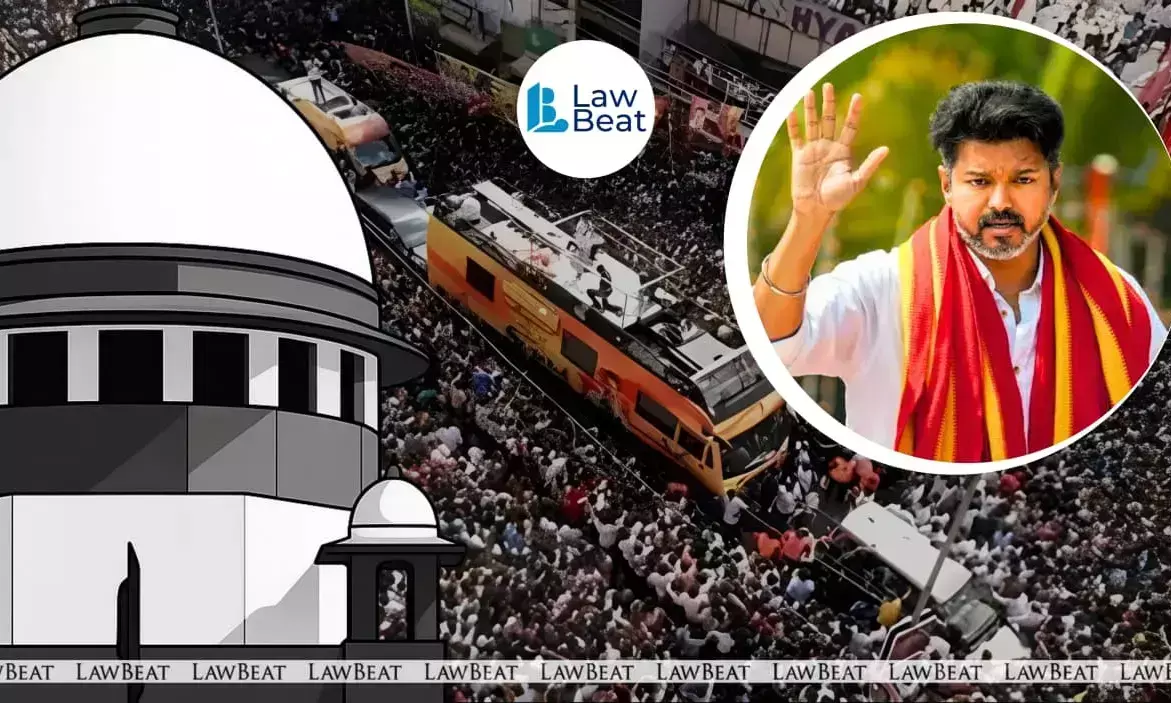
Supreme Court Bench of Justice JB Pardiwala and Justice K Vinod Chandran hearing Tamil Nadus plea against Madras High Court order on compassionate appointments for Karur stampede victims families.
X

Supreme Court stays Madras High Court order striking down Tamil Nadu's policy on compassionate appointments to families of Karur stampede victims

Supreme Court stayed the Madras High Court's order that struck down Tamil Nadu's policy providing compassionate appointments to eligible family members of Karur stampede victims

The Supreme Court on Friday stayed the Madras High Court's order that had struck down a Tamil Nadu Government Order (GO) providing for compassionate appointments to eligible family members of those who died in the Karur stampede tragedy.

The Bench of Justice JB Pardiwala and Justice K Vinod Chandran issued notice on the State's challenge to the High Court judgment and stayed its operation in the interim.


Senior Advocates Abhishek Manu Singhvi and Mukul Rohatgi appeared for the State of Tamil Nadu. Singhvi argued that the State's decision to provide compassionate appointments was a policy decision taken under Article 162 of the Constitution and questioned the High Court's interference with the policy.

“If the State wants to give out [compassionate appointment] out of killings as a policy decision under Article 162, how can the High Court interfere? There is no quashing sought of my circular, no challenge in the petition to my circular. In employment, can you file a PIL [by a lawyer]?”

During the hearing, an advocate appearing for a political party opposed the State's policy, submitting that compassionate appointment could not be left to the discretion of the government. He also alleged a conflict of interest on the ground that the political party allegedly responsible for the stampede was in power in the State.

When the Bench asked the advocate whom he represented, he said he appeared for a political party.

Justice Pardiwala questioned the relevance of the political party's intervention, while Justice K Vinod Chandran remarked, “Don't bring politics here.”

The Bench also questioned why the State should be prevented from extending employment to families who had lost their earning members in the tragedy.

Justice Pardiwala observed: “A stampede took place, something very unfortunate happened, some hundreds of people died. Now if the government decided that the family members should be provided with some succour, and suppose they would have decided to compensate them with money, would you have objected? Who are you to question the policy of the government, saying no employment should be given. Suppose if the sole earning member has died in the stampede and there is nobody else in the family who is earning, shouldn't the government give some employment to son or daughter or wife as per their educational [qualifications].”

Madras HC had struck down Tamil Nadu GO

The proceedings arise from the July 27 judgment of the Madurai Bench of the Madras High Court, which had struck down the Tamil Nadu Government Order providing for compassionate appointments to eligible family members of those who died in the Karur stampede.

Holding that public employment cannot be thrown away as ‘largesse’ and that the appointments violated the constitutional guarantees of equality under Articles 14 and 16, the High Court had set aside two Government Orders through which the jobs had been granted, the Court held that executive power cannot be exercised in a manner that bypasses the settled constitutional framework governing public employment.

A Division Bench of Justice C.V. Karthikeyan and Justice R. Sakthivel had allowed three public interest petitions challenging Government Order dated July 6, 2026, through which the State had appointed 32 next of kin of the 41 persons who lost their lives in the tragedy.

The Bench also quashed Government Order dated July 9, 2026, which amended certain appointments made under the earlier Government Order.

What was the case of the petitioners?

Before the High Court, the petitioners contended that the Government had created an impermissible class of beneficiaries by granting government jobs solely because the beneficiaries had lost family members in the stampede.

They further argued that the tragedy was already under investigation by the Central Bureau of Investigation, under the supervision of a former Supreme Court Judge, pursuant to proceedings before the Supreme Court, and therefore extending public employment during the pendency of the investigation was wholly unwarranted.

Case Title: Prabakaran Selvakumar and Anr. v. Theeran Thirumurugan @ Thirumurugan

Bench: Justices JB Pardiwala and K Vinod Chandran

Hearing Date: August 14, 2026

Tags

Next Story