
Delhi Courts Weekly Round Up [May 4 - May 10, 2026]
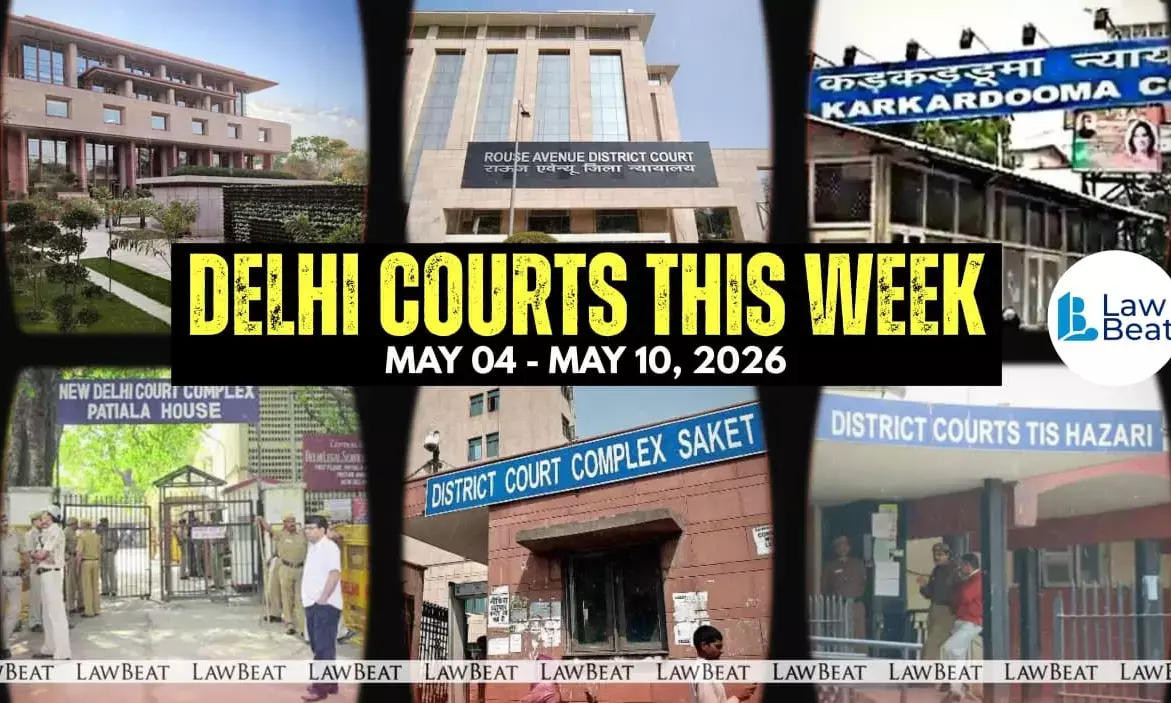
A weekly wrap of key developments from Delhi courts between May 4- May 10, 2026
1. [Al-Falah University Chairman] A Delhi court has refused regular bail to Jawad Ahmad Siddiqui, chairman of Al-Falah University, in a money laundering case linked to alleged large-scale fraud involving false claims of accreditation and recognition. Additional Sessions Judge (ASJ) Sheetal Chaudhary Pradhan of the Saket Court held that the allegations against Siddiqui were “grave and serious” and that no case for bail was made out at this stage. “It is prima facie made out that the accused had generated proceeds of crime and laundered the same,” the Court observed, noting that the funds were allegedly routed through multiple entities controlled by Siddiqui’s family members and associates. According to the prosecution, the case stems from two FIRs registered by the Delhi Police Crime Branch, alleging that the university falsely projected that it had accreditation from the National Assessment and Accreditation Council and recognition from the University Grants Commission to mislead students into enrolling.
Case Title: ED v. Jawad Ahmad Siddiqui
Bench: ASJ Sheetal Chaudhary Pradhan
Click here to read more
2. [Abhijit Iyer Mitra] A Delhi court has stayed the order directing registration of an FIR against Abhijit Iyer Mitra in a complaint filed by Manisha Pande, who had alleged abusive and sexually coloured remarks against her and other women employees on social media. Additional Sessions Judge (ASJ) Purushottam Pathak of Saket Court stayed the April 22 order passed by the Judicial Magistrate First Class, granting interim relief to Mitra on his challenge to the FIR direction. The magistrate’s order, now stayed, had allowed registration of an FIR on Pande’s complaint, holding that Mitra’s posts on social media platform X amounted to “sexually coloured remarks” intended to insult the modesty of the complainant. The court had observed that the allegations disclosed cognizable offences under Sections 75(3) and 79 of the Bharatiya Nyaya Sanhita. “On perusal of the material placed on record, this Court is of the view that the content posted by the accused qualifies as sexually coloured remarks and appears intended to insult the modesty of the complainant. Therefore, on perusal of the application and the material placed on record by the complainant, this Court is of the view that the content of the tweets posted by the accused on “X” platform discloses commission of cognizable offences under section 75(3) and 79 of BNS,” the court noted, adding that Pande had been specifically named in at least one of the tweets. The magistrate had also noted that the alleged offences were committed in cyberspace and required police investigation.
Case Title: Abhijit Iyer Mitra v. State (NCT of Delhi) and Ors.
Bench: Additional Sessions Judge (ASJ) Purushottam Pathak
Click here to read more
3. [IRS Officer’s Daughter Murder Case] A Delhi court has extended the judicial custody of Rahul Meena, the accused in the murder case of an Indian Revenue Service (IRS) officer’s daughter, by four more days. Judicial Magistrate First Class (JMFC) Deepika Thakran passed the order after considering an application moved by Delhi Police seeking further judicial custody of the accused in view of the ongoing investigation. Rahul Meena was produced before the Saket court after the expiry of his earlier custody period. He had been arrested on April 22 from a hotel in Dwarka following registration of an FIR at Amar Colony police station in connection with the alleged murder. During the hearing, the prosecution informed the court that the investigation is still underway and certain crucial aspects remain pending. Police submitted that two mobile phones belonging to the victim’s parents are yet to be recovered. It further stated that forensic examination, including analysis of the accused’s walking pattern, is also pending. The Court thereafter allowed the plea and extended Meena’s judicial custody by four days.
Bench: Judicial Magistrate First Class (JMFC) Deepika Thakran
Click here to read more
4. [CBI's Appeal; Arvind Kejriwal] The Delhi High Court has deferred hearing in the CBI’s plea challenging the discharge of all accused in the alleged excise policy case, while indicating that it would appoint Senior Advocates as amicus curiae to represent AAP leaders Arvind Kejriwal, Manish Sisodia and Durgesh Pathak, who continue to remain unrepresented in the proceedings. The matter came up before Justice Swarana Kanta Sharma. At the outset, the Court noted that objections had been raised regarding the maintainability of the CBI’s petition challenging the discharge order. Vijay Nair and Arvind Kumar Singh say that the plea is not maintainable. Solicitor General Tushar Mehta, appearing for the CBI through video conferencing, sought to commence arguments on maintainability first. He also informed the bench that the reply has already been filed in the maintainability plea. “I would like to start. It is my petition. I would like to argue on how it is maintainable. Later, they can argue how it is not maintainable,” Mehta submitted before the Court.
Case Title: CBI v. Kuldeep Singh & Ors.
Bench: Justice Swarana Kanta Sharma
Click here and here to read more
5. [Air India Labour Cases] The Delhi High Court has held that writ petitions challenging labour court awards against Air India remain maintainable despite the airline’s privatisation. The Court clarified that while Air India may no longer qualify as “State” under Article 12 of the Constitution, awards passed by labour tribunals are still subject to scrutiny under Articles 226 and 227. Justice Shail Jain observed that judicial review in such cases is directed not merely against the private employer, but against the adjudicatory process and the industrial tribunal’s award itself. The Court held that denying such scrutiny would effectively make labour tribunal awards immune from challenge. The Court categorically stated: “Once a Labour Court or Industrial Tribunal renders an award, such award is subject to judicial review by the High Court under Articles 226/227.” The Judgment came while deciding a batch of petitions filed by casual workers and unions challenging awards of the Central Government Industrial Tribunal (CGIT), which had held their termination illegal but granted limited compensation instead of reinstatement.
Case Title: Sauraj Singh v. M/s Indian Airlines Ltd and Anr. and connected matters
Bench: Justice Shail Jain
Click here to read more
6. [POCSO Act] The Delhi High Court has refused to grant bail to a man accused of sexually assaulting a minor girl while pretending to treat her through spiritual healing. The Court held that the material on record prima facie showed that he took advantage of the girl’s vulnerable condition and of the family’s belief that he could cure her through spiritual treatment. The bench of Justice Swarana Kanta Sharma observed that the girl had been unwell for several years and that her family, believing she was under the influence of a jinn or evil spirit, had turned to faith healing after medical treatment did not improve her condition. “….the trial is already at an advanced stage and the prosecution evidence is nearing completion. The Hon’ble Supreme Court in X v. State of Rajasthan: 2024 SCC OnLine SC 3539 has observed that ordinarily, in offences like rape, murder, dacoity, etc., once the trial commences and the prosecution starts examining the witnesses, the Courts should be loath in entertaining bail applications of the accused”, the Court observed.
Case Title: Mohd Mubarak v. State (NCT of Delhi)
Bench: Justice Swarana Kanta Sharma
Click here to read more
7. [Procedural Irregularities] The Delhi High Court recently expressed concern over a procedural irregularity in the course of a police investigation after noticing that an Investigating Officer (IO) had issued a notice to an accused person without mentioning the date on which appearance was required. Observing that investigative procedures must remain clear and transparent, the Court directed the concerned police authorities to examine the issue and submit a report. The observations were made by Justice Girish Kathpalia while hearing a petition filed by two individuals seeking protection from alleged harassment in connection with an FIR. The petitioners submitted that the offences invoked against them were bailable and argued that despite their willingness to cooperate, the police had not accepted their bail bonds. During the hearing, the Court examined a notice issued by the IO directing petitioner no. 1 to join the investigation. While the notice specified the time for appearance, the date column had been left blank.
Case Title: Sonia Bansal & Anr. v. State of NCT of Delhi & Anr.
Bench: Justice Girish Kathpalia
Click here to read more
8. [Ashok Swain Backlisting Challenge] The Delhi High Court has granted the Union government an additional two weeks to file its response to a petition filed by academician Ashok Swain, who has challenged an alleged blacklisting order barring his entry into India. The matter was heard by Justice Purushaindra Kumar Kaurav, who acceded to the request made by counsel appearing for the Centre seeking more time to file a reply. The Court accordingly extended the timeline and listed the case for further hearing on July 23. Swain, a professor and head of the Department of Peace and Conflict Research at Uppsala University, has approached the High Court challenging what he describes as an undisclosed blacklisting order purportedly issued under the Foreigners Act. He claims that the order effectively prevents him from entering India despite holding an Overseas Citizen of India status. The petition traces the dispute back to the cancellation of his OCI card by the Embassy of India to Sweden and Latvia on February 8, 2024, under the Citizenship Act. Swain contends that the cancellation, along with the alleged blacklisting, was carried out without proper disclosure of reasons or adherence to procedural safeguards mandated by law. According to the plea, Swain became aware of the blacklisting only through a counter affidavit filed by the Centre in earlier litigation. He argues that the authorities have failed to provide him with the contents or legal basis of the order, thereby violating principles of natural justice and constitutional protections guaranteed under Articles 14 and 21.
Case Title: Ashok Swain v. Union of India & Ors.
Bench: Justice Purushaindra Kumar Kaurav
Click here to read more
9. [Income Tax returns] In a significant ruling reinforcing the right to privacy, the Delhi High Court has held that income tax returns (ITRs) of an individual constitute “personal information” and are exempt from disclosure under the Right to Information Act, 2005, unless a demonstrable larger public interest justifies such disclosure. The judgment was delivered by Justice Purushaindra Kumar Kaurav, who set aside an order of the Central Information Commission directing the Income Tax Department to furnish the husband’s financial details to his estranged wife. The case arose from a matrimonial dispute wherein the wife had sought access to her husband’s income tax records from the financial year 2007-08 onwards. The request was made under the RTI framework to support her maintenance claim in pending matrimonial proceedings. Acting on this request, the Central Information Commission had directed disclosure of the husband’s net taxable income details. Challenging this direction, the husband approached the High Court, contending that such information is protected under Section 8(1)(j) of the RTI Act, which exempts disclosure of personal information that would result in an unwarranted invasion of privacy. Accepting this argument, the Court unequivocally held that income tax returns fall within the ambit of personal and sensitive information. The Court observed that there was no ambiguity in categorising ITRs as personal data, noting that disclosure in such circumstances would violate the individual’s right to privacy. It emphasized that the RTI Act, while designed to promote transparency and accountability in public authorities, does not extend to exposing private details of individuals without sufficient justification rooted in public interest.
Case Title: Kapil Agarwal v. CPIO, Income Tax Officer, Moradabad
Bench: Justice Purushaindra Kumar Kaurav
Click here to read more