
Delhi Riots Case: Court Cancels Sharjeel Imam’s Interim Bail For Breaching Condition Against Contact With Media persons
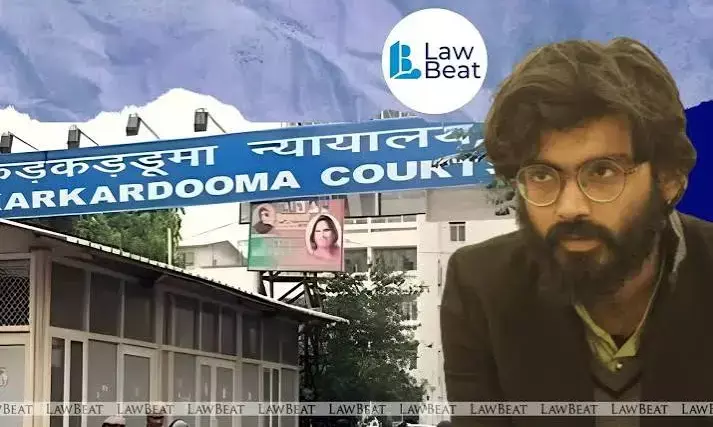
Sharjeel Imam, whose interim bail in the 2020 northeast Delhi riots case was cancelled by a Delhi court
X

A Delhi court cancelled activist Sharjeel Imam’s interim bail in the 2020 northeast Delhi riots case after finding that he had breached a condition barring contact with media persons

A Delhi Sessions Court found that the activist was seated in the room while a journalist interviewed his brother, and directed him to surrender in jail by Saturday evening

A Delhi Court on Saturday cancelled the seven-day interim bail granted to Sharjeel Imam to attend his cousin’s wedding, after holding that he had violated a condition prohibiting him from coming in contact with media persons.

Additional Sessions Judge (ASJ) Sameer Bajpai passed the order on an application filed by the prosecution seeking cancellation of the interim bail.

By an order dated September 22, the court had released Imam on interim bail for seven days, from October 4 to 10, to enable him to attend his cousin’s wedding. The relief was subject to conditions, including a prohibition on the use of social media and on interacting with media persons.

Prosecution Alleged Breach Through Imam’s Presence During Brother’s Interview

The prosecution alleged that Imam had violated the bail conditions by being present while a media person interviewed his brother.

The defence contended that Imam had neither given an interview nor interacted with any media person. It submitted that the interview had been given by Imam’s brother, who was not subject to the bail conditions.

The defence further argued that the video relied upon was a compilation of separate clips and that Imam was not present during the interview.

Footage Shot in the Same Room at Approximately the Same Time; ‘Compilation’ Plea Rejected

The court examined videos uploaded on YouTube and on the social media platform X. It observed that the footage showed Imam sitting in the same room in which his brother was being interviewed by a journalist.

Rejecting the defence’s contention, the court said the footage indicated that the clips had been shot in the same room at approximately the same time.

The court observed that the journalist was present in the room where Imam was also sitting, and held that he had violated the condition imposed in the September 22 order granting him interim bail.

Surrender Directed by Saturday Evening

The court directed Imam to surrender in jail by Saturday evening. His counsel submitted that he had already boarded a flight and would reach Delhi to surrender.

The case pertains to an FIR registered in connection with the 2020 northeast Delhi riots and includes charges under the Unlawful Activities (Prevention) Act and various provisions of the Indian Penal Code.

In its application seeking cancellation of the relief, the police referred to a video allegedly circulating in the media in which Imam could be seen interacting with media persons. “Therefore, the accused grossly violated the aforesaid condition that he shall not come in contact of any media person,” the plea stated.

The police described the alleged violation as “wilful and deliberate” and argued that Imam had misused the liberty granted to him by the court. It accordingly sought cancellation of his interim bail.

Imam was arrested on January 28, 2020, and booked under the Unlawful Activities (Prevention) Act (UAPA). The prosecution has alleged that he was a key intellectual architect of the conspiracy behind the February 2020 communal riots in northeast Delhi, which left 53 people dead and hundreds injured.

In a related news, Additional Sessions Judge Bajpai had, on July 5, rejected fresh bail applications filed by Imam and co-accused Umar Khalid. The court referred to the Supreme Court’s January 5 order denying them bail and laying down conditions for reconsidering their applications.

Imam and Khalid had relied on a May 18 Supreme Court judgment granting bail to Syed Iftikhar Andrabi in a narco-terror case investigated by the National Investigation Agency. In that judgment, a Bench of Justices BV Nagarathna and Ujjal Bhuyan had expressed “serious reservations” about the reasoning adopted in the January 5 order. The police’s latest application seeks cancellation of Imam’s interim bail on the ground of the alleged breach of the conditions imposed for his temporary release.

Background

Earlier, in March this year, he was granted 10-day interim bail to Sharjeel Imam to attend his brother’s wedding.
Imam is among the accused in the larger conspiracy case related to the February 2020 communal violence in northeast Delhi, which left 53 people dead and more than 700 injured.
Notably, the Supreme Court rejected Imam’s regular bail plea in January this year. At the time, the apex court also refused bail to Umar Khalid in the same conspiracy case.
In its January 5 order, a Bench of Justices Aravind Kumar and N. V. Anjaria held that delay in trial and prolonged incarceration cannot become a “trump card” for securing bail in cases registered under the stringent Unlawful Activities (Prevention) Act, 1967 (UAPA). The court had observed that while personal liberty is an important constitutional value, it cannot be the sole factor when allegations involve serious offences affecting public order and national security.
While rejecting the bail pleas of Khalid and Imam, the Supreme Court granted bail to five other co-accused in the case, including Gulfisha Fatima, Meeran Haider, Shifa-ur-Rehman, Mohd Saleem Khan and Shadab Ahmad.
The court had noted that Khalid and Imam stood on a different footing compared to the other accused due to what it described as the “hierarchy of culpability”.
Both have spent more than five years in jail in connection with the case.
The case stems from the violence that erupted in Northeast Delhi in 2020 during protests against the Citizenship Amendment Act (CAA). The clashes between supporters and opponents of the Act led to large-scale incidents of stone-pelting, arson, and violence, leaving 53 people dead and injuring thousands.
The Supreme Court had clarified that Imam and Khalid may renew their bail pleas after one year or once all protected witnesses in the trial are examined, whichever occurs earlier. It had further emphasised that the mere passage of time cannot automatically justify bail in cases involving offences under special statutes like the UAPA and that courts must balance constitutional protections under Article 21 with Parliament’s intent behind stricter bail conditions in national security-related laws.
The Delhi Police before the apex court had filed a detailed affidavit against Imam, accusing him of being a “key conspirator” in the 2020 Delhi riots, allegedly acting under the directions of Umar Khalid and other senior planners.
The affidavit claimed Imam was instrumental in engineering the first phase of violence between December 13 and 20, 2019, which later escalated into the February 2020 riots that left 53 people dead and hundreds injured.
The police alleged that Imam “conspired and executed” the initial unrest that began near Jamia Millia Islamia, during which 10 FIRs were registered, 101 police personnel and 41 civilians injured, and police booths, vehicles and buses burned.
According to the affidavit, electronic evidence including WhatsApp chats from the “MSJ Core Group” and multiple public speeches by Imam showed that he played a pivotal role in strategising the protests and calling for a disruptive “Chakka Jam” in the national capital.
One such chat, dated December 7, 2019, cited by the police, read: “अगले हफ्ते हमें कुछ करना होगा” (We must act next week). The police said that Imam, during a December 13 speech at Jamia, described the initial violence as merely a “spark” and urged the crowd to intensify the movement. In his speech, he reportedly said, “यह तो आज हुआ है, यह चिंगारी थी... अगर organised way में हो, और लोग आएंगे तो... हमारी ख्वाहिश है कि दिल्ली में चक्का जाम हो। (This happened today, it was a spark... If it's done in an organized way, and more people come, then... Our desire is for Delhi to be brought to a standstill)"
The affidavit had further cited Imam’s subsequent speeches at Aligarh Muslim University (January 16, 2020), Asansol (January 22, 2020), and Chakand in Bihar (January 23, 2020), which, according to police, revealed his intent to mobilise people, block highways and “cut off” regions of India. The police had reproduced excerpts from these speeches where Imam allegedly stated: “अगर हमें असम की मदद करनी है, तो हमें असम का रास्ता बंद करना होगा… फ़ौज के लिए और जितने भी सप्लाई जा रहे हैं, बंद करो। (If we want to help Assam, then we will have to close the way to Assam... For the army and whatever supplies are going, stop them)"
The affidavit had claimed that Imam’s statement; “चार हफ्ते हैं, सोच लीजिए क्या कर सकते हैं” (We have four weeks; decide what you can do), made on January 23, 2020, proved his awareness of the impending February 2020 riots, which erupted exactly four weeks later.
The Delhi Police had also linked Imam’s actions to other accused members of the Jamia Coordination Committee (JCC), including Shifa-ur-Rehman, Safoora Zargar, Meeran Haider, Asif Iqbal Tanha, and Saiful Islam, alleging that they executed the “final stage” of the conspiracy by sending Jamia students to various protest sites in northeast Delhi to trigger violence during the visit of then-US President Donald Trump.

Bench: ASJ Sameer Bajpai

Tags

Next Story