
Delhi Riots Conspiracy Case: Court Rejects Fresh Bail Pleas Of Umar Khalid, Sharjeel Imam As 'Not Maintainable'
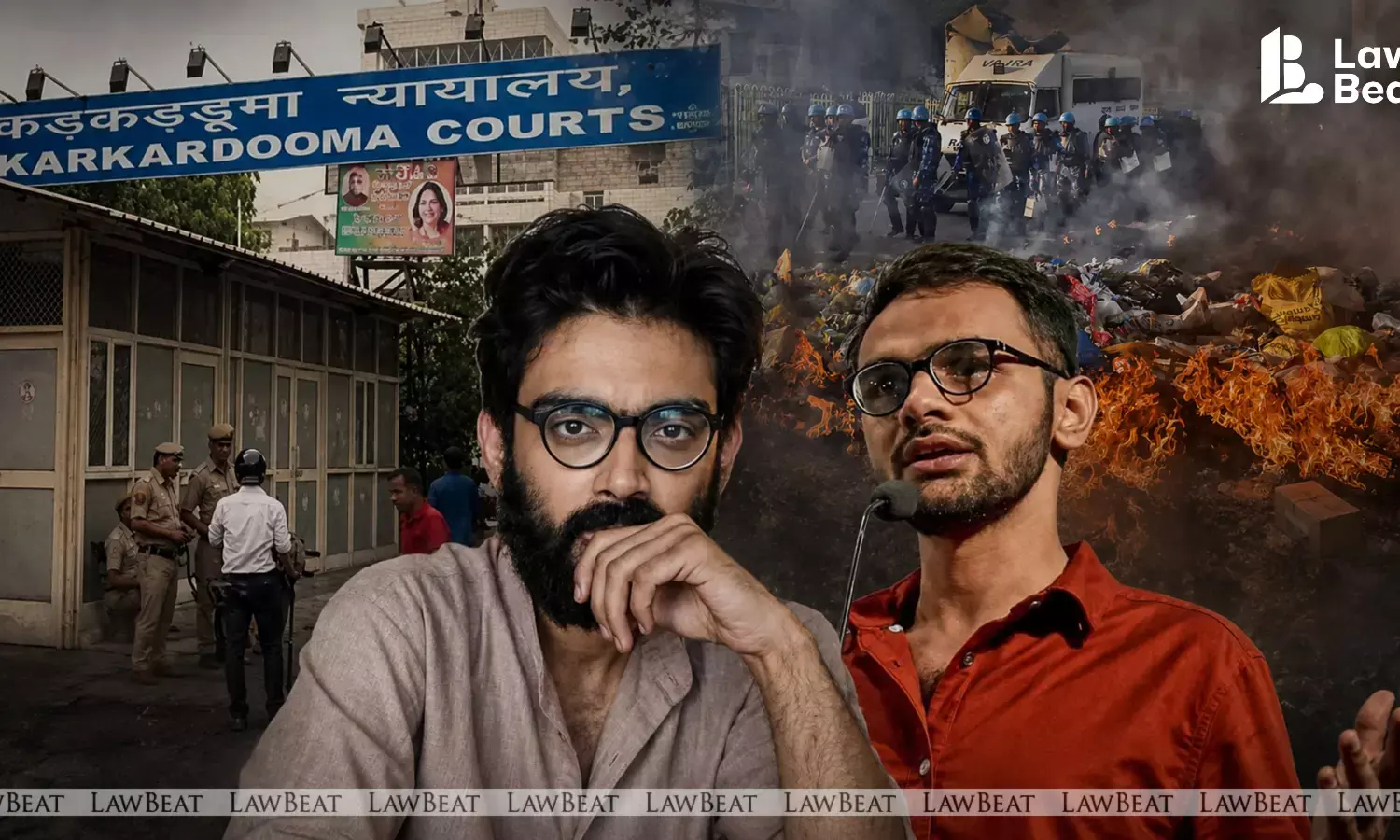
The Karkardooma Court rejected fresh bail applications filed by Umar Khalid and Sharjeel Imam in the Delhi riots conspiracy case, citing the Supreme Court's binding directions
A Delhi court on Saturday dismissed the fresh bail applications filed by Umar Khalid and Sharjeel Imam in the larger Delhi riots conspiracy case, holding that the pleas were not maintainable in view of the Supreme Court's January 5, 2026 order governing their liberty to seek bail afresh.
Additional Sessions Judge Sameer Bajpai of the Karkardooma Court held that the trial court was bound by the Supreme Court's earlier decision rejecting the duo's bail pleas and could not entertain fresh applications until the conditions stipulated by the apex court were fulfilled.
"Importantly, this Court has no option but to follow the judgment dated 05.01.2026, as passed by the Hon'ble Supreme Court, whereby the petitions of both the applicants were dismissed," the Court observed.
The trial court noted that while rejecting their bail pleas earlier this year, the Supreme Court had expressly permitted Khalid and Imam to renew their bail applications only after the examination of the prosecution's protected witnesses or upon the expiry of one year from the date of the order, whichever occurred earlier.
Quoting the apex court's directions, the Sessions Court said: "In the said judgment, the Hon'ble Supreme Court, while dismissing the pleas of the applicants opined that only on the completion of the examination of the protected witnesses as relied upon by the prosecution, or upon the expiry of a period of one year from the date of said order, whichever is earlier, the applicants would be at liberty to renew their prayer for grant of bail before the jurisdictional Court. Thus, following the said order of the Hon'ble Supreme Court, this Court cannot entertain the applications and grant bail to the applicants."
Accordingly, the Court concluded: "Infact the applications are not maintainable and they are hereby dismissed."
The fresh bail pleas had been filed after a coordinate Bench of the Supreme Court recently raised questions regarding the interpretation adopted while denying bail to the two accused in the case.
Arguments before the Court
Before the Sessions Court, the applicants argued that more than six months had elapsed since the Supreme Court rejected their bail pleas, yet there had been no meaningful progress in the trial. They pointed out that arguments on charge were still incomplete and highlighted that both accused had remained in custody for nearly six years.
Appearing for Umar Khalid, Senior Advocate Trideep Pais contended that the Supreme Court's subsequent decision in the Andrabi case, which questioned the rationale adopted in denying bail to Khalid and Imam, entitled his client to seek fresh consideration of his bail plea. He further argued that the embargo imposed by the Supreme Court on filing fresh bail applications did not survive in view of subsequent developments.
Sharjeel Imam's counsel, Advocate Talib Mustafa, submitted that the validity of the Supreme Court's direction restraining the accused from seeking fresh bail for one year was itself under consideration before a larger Bench of the apex court. He also argued that similarly placed co-accused had already been granted the benefit of the reference.
Opposing the applications, Special Public Prosecutors Madhukar Pandey appearing for Delhi Police argued that unless the Supreme Court clarified or modified its earlier order, the January 5, 2026 judgment continued to bind the trial court.
The prosecution submitted that if the applicants were aggrieved by the embargo imposed by the Supreme Court, the appropriate course was to seek clarification from the apex court itself rather than approach the Sessions Court.
Accepting the prosecution's contention, the trial court held that it had no jurisdiction to depart from the Supreme Court's binding directions and consequently dismissed both bail applications as not maintainable.
Background of the Case
The case arises out of FIR No. 59/2020, registered by the Delhi Police Special Cell in connection with the alleged larger conspiracy behind the communal violence that erupted in North East Delhi in February 2020. The FIR invokes multiple provisions of the Indian Penal Code, 1860, along with offences under the UAPA.
In his bail application, Sharjeel Imam has highlighted that despite more than six months having elapsed since the Supreme Court's judgment refusing bail, there has been no meaningful progress in the trial. He has pointed out that arguments on charge are yet to conclude and that he has remained incarcerated for nearly six years.
Imam has contended that the prolonged delay in the proceedings has resulted in continued detention without commencement of trial, strengthening his claim for grant of regular bail. Umar Khalid has also sought regular bail on similar grounds before the trial court.
The two accused are among several individuals facing prosecution in the conspiracy case. Others named in the FIR include former AAP councillor Tahir Hussain, Khalid Saifi, Ishrat Jahan, Meeran Haider, Gulfisha Fatima, Shifa-ur-Rehman, Asif Iqbal Tanha, Shadab Ahmed, Tasleem Ahmed, Saleem Malik, Mohammad Saleem Khan, Athar Khan, Safoora Zargar, Faizan Khan and Natasha Narwal. The prosecution alleges that the accused were part of a larger conspiracy that culminated in the North East Delhi riots of February 2020. The accused have consistently denied the allegations.
Recently, the High Court had granted Khalid a three-day interim bail in the larger conspiracy case connected to the 2020 northeast Delhi riots, allowing him to meet his mother, who is scheduled to undergo surgery, and attend the Chehlum ceremony of his deceased uncle.
The Court had held that the circumstances warranted a humanitarian approach and temporarily released Khalid despite the pendency of serious charges against him under the Unlawful Activities (Prevention) Act, 1967 (UAPA). By granting only three days of interim bail instead of the fifteen days sought, the High Court sought to balance Khalid’s personal circumstances with the concerns raised by the prosecution regarding the nature of the allegations against him. Earlier, Additional Sessions Judge Sameer Bajpai at Karkardooma court rejected the bail plea of Umar Khalid.
Case Title: State v. Tahir Hussain
Bench: ASJ Sameer Bajpai
Order Date: July 4, 2026