
Delhi-NCR Air Pollution: Supreme Court Pushes Long-Term Fixes, Tells Agencies to Stop Objecting & Start Implementing
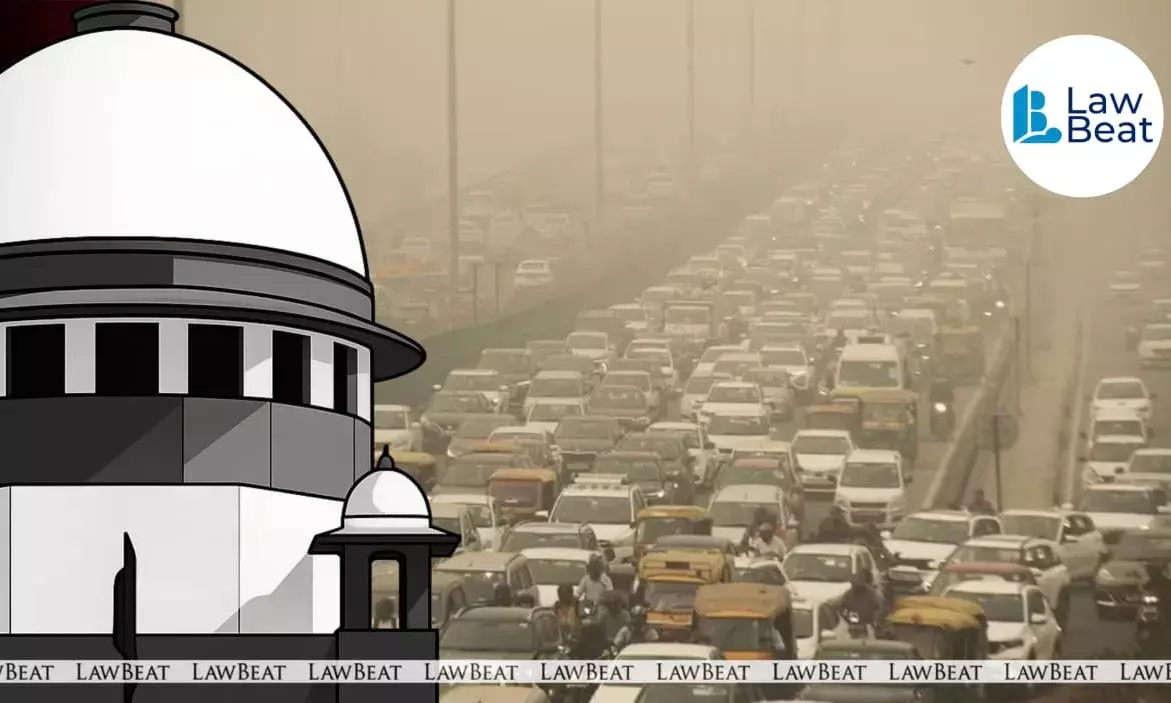
Supreme Court has directed registration of suo motu proceedings on the issues concerning Delhi-NCR air pollution.
The Supreme Court on Wednesday took up the worsening air pollution crisis in Delhi-NCR, signalling a decisive shift from debate to execution by directing authorities to focus on implementing long-term measures without delay.
The Bench of Chief Justice of India Surya Kant, Justices Joymalya Bagchi and Vipul Pancholi heard submissions on a comprehensive report filed by the Commission for Air Quality Management (CAQM), which outlines structural and sector-specific interventions to address persistent air pollution in the National Capital Region.
Appearing for the Centre, Additional Solicitor General (ASG) Aishwarya Bhati informed the Court that the CAQM’s expert committee has identified the vehicular sector as the primary contributor to air pollution in Delhi-NCR. She submitted that the Commission supports a sector-wise approach, as earlier suggested by the court-appointed amicus curiae, and has proposed a series of long-term corrective measures.
These include phased removal of highly polluting vehicles from Delhi-NCR through scrapping or relocation outside the region, implementation of the upgraded Pollution Under Control regime (PUC 2.0), expansion of metro and railway networks, development of additional Regional Rapid Transit System (RRTS) corridors, revision of the electric vehicle policy, and higher incentives for scrapping old vehicles.
Pollution Under Control (PUC 2.0) refers to an upgraded, digitised, and more stringent version of India's vehicular emission testing regime, developed by the NIC e-Transport Division to enhance transparency and prevent fraudulent certificate issuance. This system (often termed Next Gen PUCC 2.0 or just PUCC 2.0) has been adopted in various states, including Uttar Pradesh and West Bengal, to ensure mandatory, real-time tracking of vehicle emissions.
The amicus curiae, Senior Advocate Aparajita Singh, urged the Court to require authorities to commit to clear timelines for implementing these steps. In response, the ASG submitted that a “meta-study” compiling findings from multiple expert studies has already been placed in the public domain for comments, allowing wider stakeholder participation.
The Chief Justice observed that the Court could wait briefly to receive further suggestions, but made it clear that deliberation cannot become an excuse for inaction. He noted that CAQM has not only recommended long-term measures but has also identified the specific agencies responsible for executing them. “There can be no doubt that these long-term measures need to be given effect without delay,” the CJI remarked, calling upon all stakeholders named in the CAQM report to submit their respective action-taken plans. The Court granted four weeks for compliance, categorically stating that it would not entertain objections to the measures and would focus solely on implementation.
The Bench also took note of CAQM’s recommendations aimed at decongesting vehicular entry into Delhi, including suggestions relating to toll plazas and traffic management beyond Gurugram. The Chief Justice directed concerned agencies, particularly the Municipal Corporation of Delhi (MCD) and authorities in neighbouring states, to act immediately on these recommendations. “We don’t need objections. All we need is implementation,” the CJI said, stressing coordinated action by Delhi authorities and neighbouring states to address the region-wide nature of the pollution crisis.
The Court further requested the amicus curiae to suggest any additional long-term measures, clarifying that CAQM would examine and incorporate them if found necessary.
On the last hearing, earlier, this month, the Court had came down heavily on authorities over the persistent air pollution crisis in the Delhi-NCR, expressing serious dissatisfaction with delays, lack of clarity on causes, and the absence of concrete long-term solutions. The Bench had made it clear that the Court would hear the matter on a continuous, issue-wise basis and refused to grant long adjournments sought by the Union government.
Previously, on December 17, 2025, the Court, calling air pollution an “annual feature” had said it was time to move beyond firefighting and evolve a phased, long-term plan. It had requested the Commission for Air Quality Management (CAQM) to revisit long-term measures covering urban mobility, industry and energy, stubble burning and farmer incentives, regulation of construction with alternative employment, household pollution, green cover, public awareness, strengthening public transport, and any other relevant areas. The Bench had also underscored the need for coordinated action by Delhi, Uttar Pradesh, Haryana and Rajasthan through a unified NCR-wide body.
On December 15, the CJI had said that orders would be passed in the air pollution case that can be complied with by all the stakeholders. Recently, it had questioned whether stubble burning is the sole reason for the Delhi air pollution crisis. The bench noted that it is easy to blame farmers who engage in stubble burning when they are not represented before the Court.
Case Title: MC Mehta v. Union of India
Bench: CJI Surya Kant, Justices Joymalya Bagchi and Vipul Pancholi
Hearing Date: January 21, 2026