
Registered Sale Deed Cannot Be Rejected on Minor Discrepancies Alone: Supreme Court
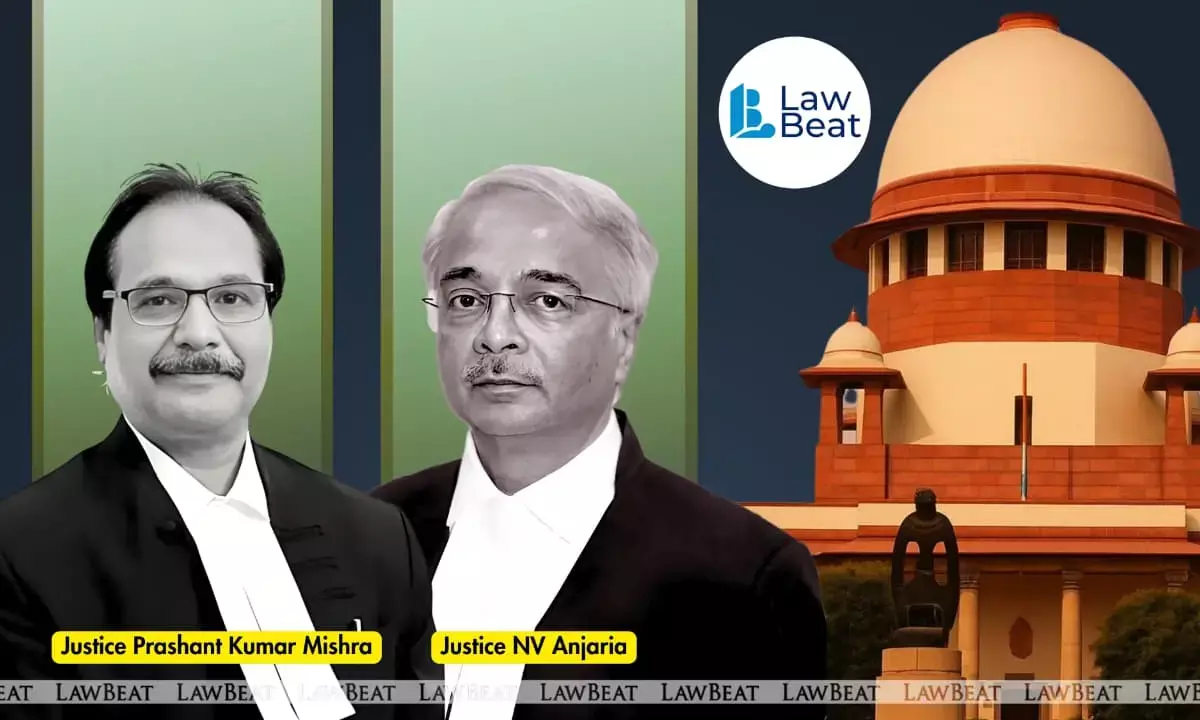
Supreme Court reinforces presumption of validity for registered sale deeds.
The Supreme Court has held that a registered sale deed cannot be discarded merely on the basis of conjectures or insignificant discrepancies. It said the burden of disproving the validity of a registered conveyance lies heavily on the person challenging it.
A Bench of Justices Prashant Kumar Mishra and N V Anjaria said this burden can be discharged only through clear, cogent and convincing evidence showing fraud, fabrication, lack of execution or any other circumstance that goes to the root of the transaction.
Court also clarified that attestation is not a statutory requirement for the validity of a sale deed.
"Unlike instruments such as Wills or gifts, a sale deed does not derive its validity from attestation. Consequently, minor discrepancies relating to the particulars of an attesting witness cannot, by themselves, render the execution of a registered sale deed doubtful, particularly where the document otherwise carries the statutory presumption attached to registered instruments," the Bench observed.
The observation came while allowing an appeal filed by Sharafat Ali (deceased) through his legal representatives and others.
Also Read| 'Boundaries in Sale Deed Crucial': SC Sets Aside HC Order on Injunction Suit
Background of the case
The dispute arose from rights claimed by the appellants under a registered sale deed executed on June 4, 1957.
The Supreme Court held that the high court and the consolidation authorities committed a manifest error by treating the sale deed as void and ignoring it on the basis of immaterial discrepancies concerning the attesting witness.
The Bench noted that the dispute, which initially began as mutation proceedings, later travelled through proceedings under the UP Zamindari Abolition and Land Reforms Act, 1950 and the consolidation framework. However, the authorities at every stage held that the appellants had failed to prove the execution of the sale deed, forcing them to approach the Supreme Court.
According to the facts, the predecessors of the appellants had purchased 15 bigha, 11 biswa and 0 biswansi of land in village Narsipur Kalan, Jwalapur Pargana, Roorki Tehsil, Haridwar district through the registered sale deed of 1957.
Since the purchasers were minors at the time, the property was purchased through their predecessors. The appellants claimed that possession of the land was handed over immediately after the purchase and that they had remained in possession ever since.
In 1984, the Naib Tehsildar ordered mutation of the land in favour of the appellants.
Also Read| Urgent Need For Digitisation Of Registered Documents, Land Records: Supreme Court
During consolidation proceedings initiated in 1991, their names were not recorded in the revenue records. On their application, however, the Consolidation Officer directed that they be recorded as bhumidhars on the basis of the 1957 sale deed.
The sellers, Rashideen, widow of Inayutulla, and Hasantulla, son of Fateh Mohd, later sought recall of that order. The Consolidation Officer allowed the recall application and ordered a fresh hearing.
In 1993, the matter appeared to be settled through a compromise, following which the Consolidation Officer directed that the appellants' names be entered in the khata and those of the original khatedars be deleted. However, it was later claimed that not all co-tenure holders were parties to the compromise, resulting in the proceedings continuing on merits.
In 1999, the Consolidation Officer rejected the appellants' claim, holding that the execution of the sale deed had not been proved because of inconsistencies regarding the identity of the attesting witness and the absence of sufficient documentary evidence.
The appellate authority, revisional authority and the high court all upheld that view. They also held that the sale deed violated Section 154 of the UP Zamindari Abolition and Land Reforms Act and was therefore void.
Could the sale deed be treated as void under Section 154?
The Supreme Court answered this in the negative.
It held that merely executing a sale deed does not automatically attract Section 154 unless it is established that the purchaser's total landholding exceeded the prescribed ceiling limit.
The Bench explained that the statutory scheme does not automatically render such a transfer void. Instead, it merely exposes the transferee to the possibility of ejectment if the Gaon Sabha files an appropriate suit.
In the present case, no such suit was ever filed within the limitation period or thereafter.
Also Read| Unregistered Agreements To Sell, Even If Coupled With Possession Don't Convey Title: SC
Court therefore held that the high court and the consolidation authorities were wrong in treating the 1957 sale deed as void.
It further clarified that consolidation authorities cannot disregard a voidable sale deed unless it has first been cancelled by a competent civil court.
Presumption of validity attached to registered sale deed
The Bench reiterated that a registered document carries a legal presumption of valid execution and genuineness unless that presumption is rebutted by convincing evidence.
In the present case, only a certified copy of the original sale deed was available. Court held that this made no difference because Section 79 of the Indian Evidence Act, 1872 requires courts to presume that certified copies issued in accordance with law are genuine.
"Thus, the certified copy of the registered sale deed produced in the present case carried a presumption as regards its genuineness and due certification, particularly when the genuineness of the sale deed itself has never been questioned," the Bench said.
Court noted that the authorities below had doubted the execution of the sale deed solely because of a discrepancy in the description of the attesting witness.
It held that this discrepancy was "wholly inconsequential" and incapable of displacing the presumption attached to a registered conveyance executed nearly four decades earlier.
The Bench pointed out that the sale deed had been executed in 1957, whereas the attesting witness deposed only in 1995, almost 38 years later.
"In such circumstances, minor variations in the description of residence or village particulars could hardly be treated as material contradictions striking at the root of the transaction itself, particularly when both villages are admittedly proximate to each other," Court observed.
Also Read| How To Determine If An Agreement Creates A License Or Lease? Supreme Court Answers
Court also noted that the respondents had never alleged that the sale deed was forged, obtained through coercion, impersonation or fraudulent misrepresentation.
"The challenge was not founded upon any allegation that the executants were deceived as to the character of the document, nor that the transaction suffered from fraud of such nature as would render the instrument void ab initio. At the highest, the objections raised pertained only to peripheral discrepancies in proof. Such circumstances, by no stretch, could justify disregarding a registered conveyance carrying a presumption of validity in law," the Bench said.
It further observed that the appellants had consistently claimed possession of the land under the sale deed and that this claim had not been effectively disputed by the respondents.
Holding that the findings of the consolidation authorities and the high court were legally unsustainable, the Supreme Court set aside the impugned judgment and directed that the appellants' names be entered in the revenue records.
Case Title: Sharafat Ali (Deceased) Through LRs And Others Vs Deputy Director of Consolidation And Others
Bench: Justices Prashant Kumar Mishra and N V Anjaria
Date of Judgment: June 23, 2026